
Population growth in Alabama and across the country has slowed, particularly when it comes to immigrants coming from abroad, according to the latest estimates from the U.S. Census Bureau. The estimates cover the period between July 2024 and July 2025.
Domestic migration into Alabama also decreased but remains higher compared to rates seen in the first two decades of the century. Due to an aging population and lower birth rates, deaths continue to outnumber births in the state. Thus, without in-migration, Alabama’s population would be declining modestly.
The Census Bureau estimates that by July 2025, Alabama was home to 5.2 million people, an increase of about 30,000 people or 1% compared to 2024. Alabama ranked No. 15 among U.S. states in population growth and No. 20 in percentage population increase over the period.
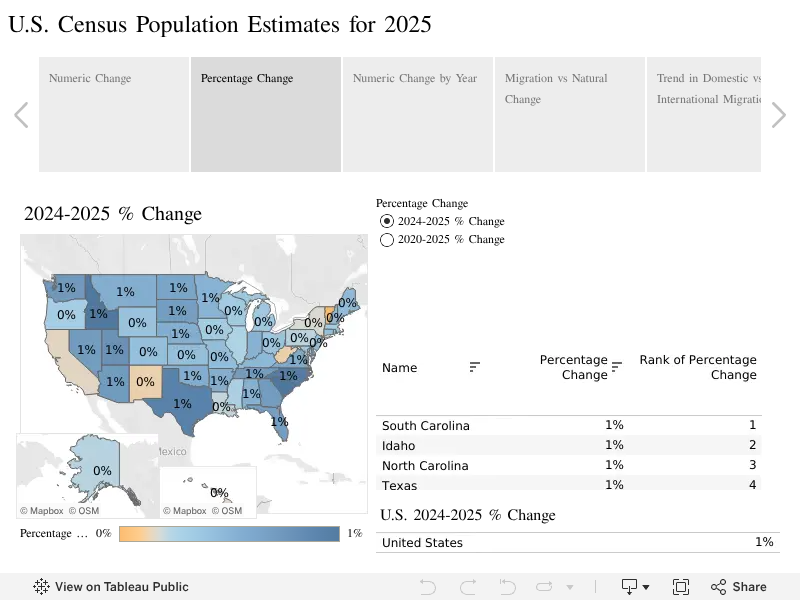
Even as growth slows, Southern states continued to outpace states in most other regions. South Carolina was No. 1 in rate of growth, and Texas was No. 1 in numeric population gain, adding almost 400,000 over the period. North Carolina, Georgia, Florida, and Tennessee also ranked in the top 10 for numeric growth. Western states like Idaho, Utah, Washington, and Arizona were also leaders in population growth.
Five states saw population declines, according to the estimates: California, Hawaii, Vermont, New Mexico, and West Virginia.

In 2024, Alabama’s population growth had accelerated to its highest level in decades, adding almost 50,000, but in 2025, growth slowed, according to the estimates.

In 2025, Alabama attracted about 15,000 fewer people through migration. Deaths outpaced births by a slightly wider margin than in 2024.

International migration to Alabama dropped by 13,156, compared to 2024, while domestic migration was down by 1,595.
Despite the slower growth, Alabama’s rate of domestic migration ranked No. 11 in 2025. The domestic migration rate estimates the number of residents from other states moving into a state and adjusts for the receiving state’s population.

Meanwhile, Alabama’s rate of international immigration ranked No. 42 in the US. Historically, Alabama has attracted new residents from abroad at a lower rate than most other states. The most recent estimates capture the last seven months of the Biden administration and the first five months of the Trump administration.

After a surge of immigration in the early years of the Biden Administration, new policies drove down unauthorized crossings sharply in 2024. That trend has continued and accelerated under the Trump Administration, along with a decline in authorized immigration. Thus, the current decline in international immigration is likely to continue.
Alabama’s unemployment rate has been consistently below the U.S. rate since 2019, which appears to be attracting new residents from other states. Census estimates from last year show that population gains are concentrated in metro counties, particularly in North Alabama near Huntsville. Increasing numbers of retirees seeking a warm coastal climate continue to drive growth in Baldwin County on the Alabama Gulf Coast.
Meanwhile, Alabama’s rate of natural population change is weighed down by a higher death rate than most states. Alabama’s death rate is the fifth-highest in the U.S. Only West Virginia, Mississippi, Maine, and Arkansas have rates that are higher. These states tend to share characteristics like elevated poverty, poor health outcomes, and lower rates of access to health care providers.
