
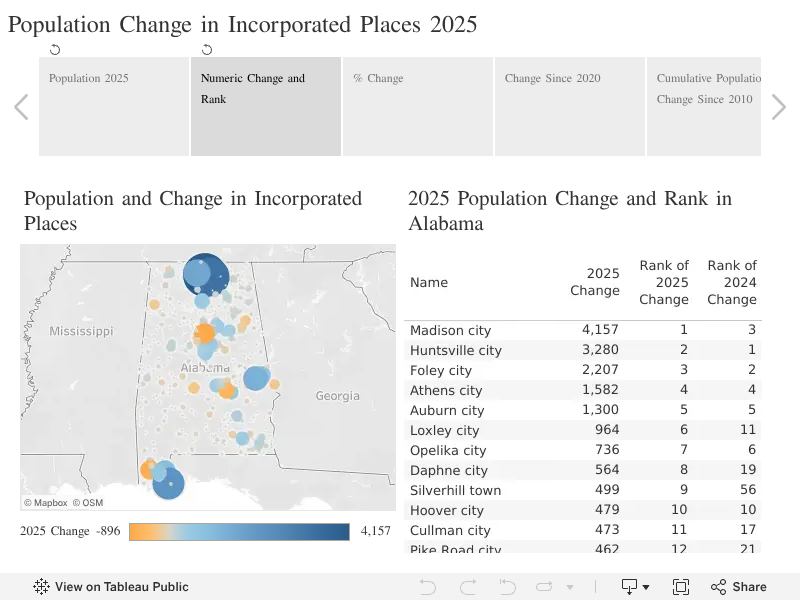
Use the tabs to move between different views of the data and use the menus to focus in on the systems, schools, or subjects that you are most interested in.
Growth moderated across most of Alabama cities in 2025 according to new population estimates for Alabama cities.
Earlier this year, state-level estimates showed that population growth had tapered in Alabama and across the U.S., primarily due to a drop in international migration. In Alabama, migration into the state by residents of other states slowed as well. Estimates for counties and metropolitan areas showed that the drop in international immigration disproportionately affected the central counties of Alabama metro areas, where, in years prior, more international immigrants had arrived.
The latest estimates for incorporated places do not include components of population change, like international and domestic migration. However, the new estimates suggest that central cities, like Birmingham, Montgomery, and Mobile, are feeling the effects of that drop in international migration. Mature central cities tend to attract international immigrants and young people. At the same time, as families form and grow or move to the area, they tend to seek new homes, which tend to be built in outlying suburbs. For more context on growth patterns within cities, see a series of analysis pieces published in February by AL.com. That analysis is based on the Census Bureau’s American Community Survey.
Metro Birmingham
Birmingham is a particular example of that dynamic. Birmingham’s population total declined by almost 900 in 2025 and by 4,333 since 2020, according to the estimates.
Since the 1960s, Birmingham has been hemmed in by suburbs, where most of the new housing and population growth has occurred. A few areas of the city are adding population, according to an AL.com analysis of American Community Survey Data. That includes the Oxmoor Valley, one area of the city that was previously undeveloped. Now, some built-out and close-in suburbs are seeing population declines. That includes Vestavia Hills, down 900 since 2020, and Mountain Brook, down about 850 over the same period, according to the estimates. Contributing to population declines in established communities is the aging and increased mortality of the Baby Boom generation. Succeeding generations are smaller and have fewer children (see Change Since 2020 tab above).
North Alabama
Meanwhile, the state’s growth champion, Huntsville, has been able to expand its boundaries and avoid the pitfalls of suburbanization that challenge Birmingham.
Huntsville and its neighboring city, Madison, led all Alabama cities in growth over the past year. Madison added over 4,157 residents while Huntsville saw a net gain of 3,280 in 2025. Together, the two cities have added almost 30,000 residents since 2020.
Back in 1950, Huntsville had fewer than 20,000 residents, and Birmingham had over 300,000. In the ensuing years, Birmingham was thwarted in most attempts to annex additional land or consolidate with its suburbs.
Meanwhile, Huntsville avoided being hemmed in by surrounding suburbs and was able to capture growth. For a time, residential growth in the area was concentrated in Madison, which continues to receive a generous share of new arrivals. But Huntsville has now strategically annexed a circle around Madison and has extended its western boundary to Interstate 65. Much of the land that Huntsville has annexed was undeveloped farmland and relatively flat, creating new frontiers for future development in the city limits and preventing a rival from arising. Growth is not without its challenges, such as coping with traffic, increased runoff, drainage issues, and flooding.
As Huntsville continues to see job growth in technology, defense, government, and manufacturing, the city is well-positioned, thanks to its annexation strategy, to attract new movers. At the same time, Madison and nearby Athens continue to grow robustly. In fact, cities across the northern tier of the state seem to be benefiting from the surge.
Lower Alabama
The 2025 estimates show Mobile’s population at 200,824, down by 788 compared to 2024. However, that population total is 13,783 higher than the official 2020 Census Count of 187,041. Mobile’s population jumped due to a 2023 annexation of growing neighborhoods on the western edge of the city. The new Census Bureau estimates reflect the current geographic boundaries. The estimate also creates a back projection of the population of the city: the old city plus the newly annexed area. Those estimates put Mobile’s 2020 population at 206,900 in 2020, a historic peak. That secures Mobile’s spot as the second largest city in the state, ahead of the City of Birmingham but well behind Huntsville. However, according to estimates, the city’s population has declined in subsequent years.
Like in Birmingham, the older industrial core of Mobile is experiencing population decline, while other areas are growing, including neighborhoods in the west and near the University of South Alabama. Until fairly recently, Mobile didn’t have an adjacent suburb to capture growth, but since 2010, Saraland to its north has been growing rapidly, after establishing its own school system. Between 2010 and 2020, as the school system developed, the population jumped 20%. Since 2020, Saraland has grown more modestly, adding 315 net new residents. To the west, Semmes, which became an incorporated city in 2011, has experienced its own growth spurt, from 5,174 residents in 2020 to 6,259 in the 2025 estimates.
But the fastest population growth is taking place across the bay in Baldwin County. That includes four of the five fastest-growing cities in Alabama, ranging from little Silver Hill (2,529), which grew by 25% in 2025, to Foley, which is now among the top 25-cities in Alabama, with a population over 30,000. Foley grew by 7.8% in 2025, adding 2,207 net new residents. Foley, Robertsdale, Orange Beach, and Fairhope have all imposed growth moratoriums at various points in recent years, trying to catch up with the changes. In some cases, growth has overwhelmed infrastructure, leading to sewage spills and other challenges. (See Percent Change tab above).
South Central Alabama
Montgomery’s population declined by about 500, while neighboring Pike Road gained almost 500, and Prattville gained just over 400. In the nearby Auburn MSA, the cities of Auburn and Opelika continued a strong streak of growth, with both cities in the top 10 in numeric gain. Since 2010, Auburn has added more than 30,00 residents, and Opelika’s population has increased by more than 10,000.
Across most of the state, cities saw slower population growth.
The USA
And across the US, most cities attracted more residents. Southern cities were the biggest gainers, especially in Texas and Florida. Charlotte gained more residents than any other city in the U.S., jumping by 20,000 in one year. Nashville and Atlanta also continued to gain. Metropolitan areas for international immigration, like New York City and Los Angeles, saw population declines, but outlying areas in their metropolitan area experienced gains.
Explore population change throughout the country or close to home with interactive charts and graphs. Use the tabs above the visualization to navigate. The visualization is best viewed in full-screen mode, an option available at the bottom-right. On maps, tools for moving the view and zooming in and out are accessible in the tool kit on the left of the map. Feel free to embed the maps in websites or download images, all options that are available on the toolbar below the visualizations (See USA Change tab above).