
A federally required change in reporting on student race and ethnicity in Alabama public schools has led to a precipitous drop in the reported number and percentage of Hispanic students enrolled in Alabama public schools in the 2025-2026 school year.
However, at the same time, the new reporting procedure led to a sharp increase in the number of students of “Two or more races.” A new reporting form invites respondents to check all the racial and ethnic identities that apply.
Because of the classification change, it is unclear from the publicly reported data whether Hispanic enrollment rose or fell. Alabama State Department of Education officials said that the number of students who checked the Hispanic box increased by about 1,000 statewide. In past years, Hispanic enrollment had grown more rapidly.
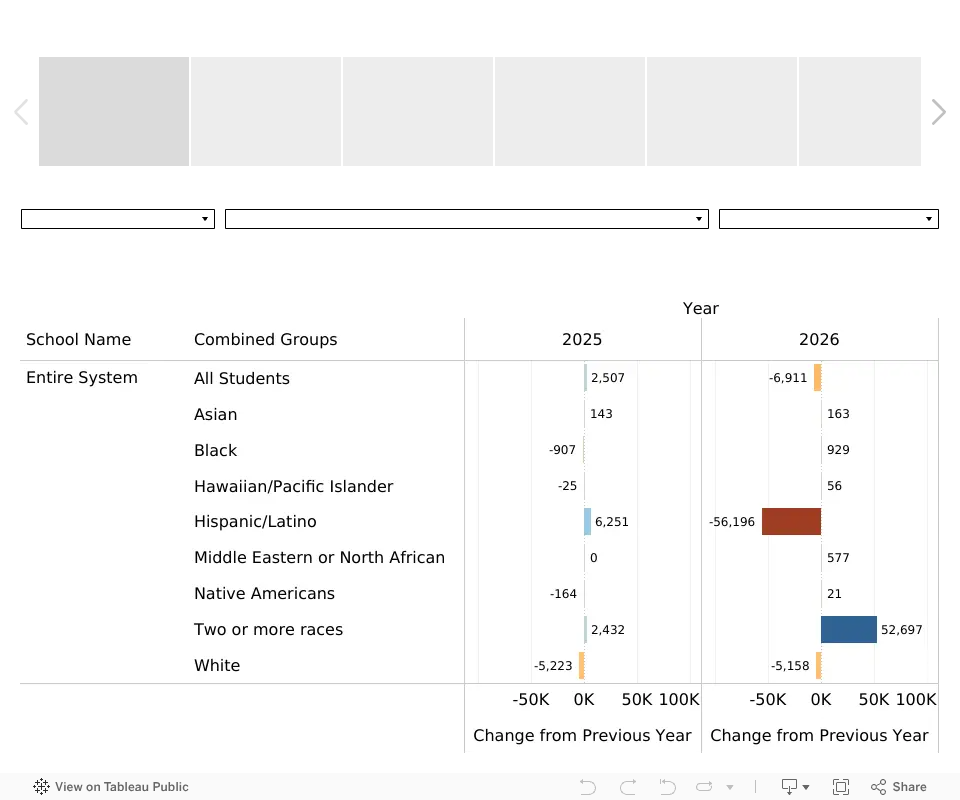
Overall, K-12 public school enrollment was down by 6,911 compared to the previous school year. Among subgroups, the number of students identifying as Hispanic dropped by 56,196, while the number identifying as Two or more races climbed by 52,627. The combined total of the two groups dropped 3,569 between 2025 and 2026. The number of White students also dropped by 5,158. Meanwhile, the number of Asian Students, Black Students, Native American students, and students of other races or ethnicities increased.
According to the data tabulations made to comply with federal reporting guidelines, only 4% of Alabama schoolchildren are classified as Hispanic in the 2025-2026 school year. That compares to 12% of students in the previous year. Meanwhile, the percentage of students identified as two or more races jumped to 11% in 2025-2026 school year, up from 4% the previous year.

Administrative Change
In March, the Alabama State Department of Education issued a memo and new forms describing changes made to comply with new standards published by the Office of Management and Budget in March of 2024. The OMB directive came after a public input process and consultation with experts. The aim was to gather detailed information on the form, allowing individuals to choose a combination of racial and/or ethnic identities. The ONB directive also noted that racial and ethnic categories are “sociopolitical constructs” and when multiple identities are checked one “reporting categories be treated co-equally.”
Previously, the forms asked individuals two separate questions. The first was about ethnicity: whether the student was or was not Hispanic/Latino.
A second separate question asked about racial identity, with options like Black, White, Asian, American Indian or Alaska Native, or Native Hawaiian, or Other Pacific Islander.
The new form asks a single question but allows the respondent to check more than one box. It also adds “Middle Eastern or North African,” as an option.
Hispanics and Latinos vary in how they identify themselves. In addition to their Hispanic identity, they may identify as White, Black, or Native American. Apparently, many of them checked more than one box. As a result, those who checked more than one box were assigned to the “Two or More Races” category in the tabulations produced for federal reporting of education data. Local school systems are responsible for gathering and reporting demographic data to the state.
Generational Changes
Regardless of the classification change, the long-running trend in Alabama public schools is toward greater diversity. The number and percentage of white students in the public schools have been trending down for decades, mostly due to natural change in population.
The Millennial Generation, a larger cohort of students who were the children of the Baby Boom Generation, began entering schools in the late 1980s. This generation and their Baby Boomer parents before them were disproportionately white. The impact of this larger cohort of students peaked in the late 1990s, and the Millennials began exiting schools in the 2000s.
A smaller cohort of students followed them. Generation Z, the children of Generation X. Generation X was a smaller generation and consequently produced fewer children than their Baby Boomer predecessors. In addition to sheer numbers, there has been a long-running trend toward later marriage and fewer children, which continues to put downward pressure on the rate of natural increase.
Changes through Migration
Meanwhile, those declines in natural change have been partially offset by the increase in population through international and domestic migration into the state. As a result, as the number and percentage of white students declined, the number and percentage of Hispanic students grew. Over time, public school enrollment in the state has been relatively stable.
In the late 1990s, about 63% of students in Alabama schools were white, and 36% were black. Today, just under 50% of students are white, and 32% of students are Black.
Meanwhile, Hispanic enrollment went from less than 1% of students in the late 1990s to 12% of enrollment in 2024-2025. Two or more races made up about 4% of enrollment in 2024-2025. In the 2025-2026 school year, two or more races jumped to almost 12%, while Hispanic decreased to 4%.
The visualization below is not precise. It builds on data that is redacted by the state. Small demographic populations of students aren’t reported. Also, categories have changed over time. However, the visualization captures the broad outlines of the trend.

Changes by System
Some school systems that reported the highest percentages of Hispanic students in 2025 saw a plunge in the percentage of students identifying as Hispanic. Systems like Albertville, Tarrant, and Boaz saw their Hispanic population percentage drop 40 or 50 percentage points, while their Two or more races percentage increased by an offsetting amount. In Albertville, for example, 60% of students were Hispanic in 2024-2025, but only 11% were identified as Hispanic in 2025-2026. Albertville’s Student enrollment declined by 207.
Many large systems in urban and suburban areas saw the largest numerical decline in students. Mobile and Jefferson both saw a decline of more 1,000 students compared to last year. Birmingham City, and Montgomery, Baldwin, and Shelby County systems saw enrollment dips of more than 300 students; 111 of the 155 school systems and Charter schools saw overall student enrollment declines. Again, because of the change in the demographic data collection, it is unclear how much of the decline is due to the departure of Hispanic students.
Another factor potentially weighing on public school enrollment is the Choose Act, a state of Alabama program that uses a refundable tax credit subsidy to support students attending private schools. According to an analysis by al.com, about three-quarters of the 23,429 recipients of Choose Act scholarships were already enrolled in private schools. However, 3,032 of the students awarded Choose ACT scholarship support for private schools in 2025-2026 had been enrolled in public schools in 2024-2025.
While the Choose Act may affect the dynamics, private school enrollment has decreased over the long term, according to U.S. Department of Education statistics. In 2009, 95,570 students attended private schools in Alabama, prekindergarten through 12th grade, according to the survey-based estimates.
In 2021, the latest year available, 75,050 students were enrolled in private elementary and secondary schools. Over the shorter term, private schools in Alabama enrolled 70,840 students in 2017. That number climbed to 76,430 in 2019 but fell back to 75,050 in 2021.
Using the tabs and menus in the visualization, you can look for the demographic makeup of your local school system and schools.
