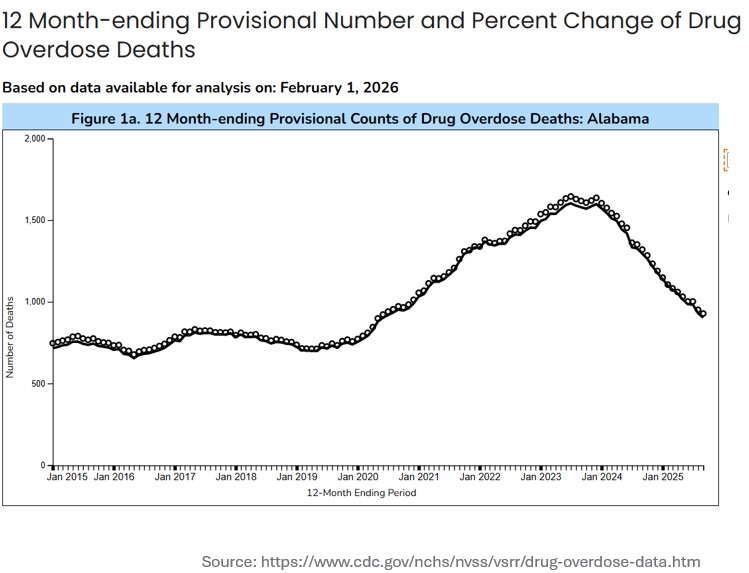
PARCA’s 2026 Annual Forum, “From Crisis to Collaboration: How Data, Policy, and Partnership Saved Lives in Alabama,” spotlighted the multiagency collaboration and bold policy decisions that underpinned a sharp decline in overdose deaths in 2024 and 2025 in Alabama. But an April 24 decision by the Substance Abuse and Mental Health Services Administration
(SAMHSA) that severely limits the use of federal dollars for fentanyl test strips could set back that progress. It also signals a departure from the federal government’s previous embrace of harm reduction as a drug policy priority.
In the context of drug policy, harm reduction is a set of practices and supplies that aim to contain and mitigate the dangers of drug use. Examples of harm reduction supplies include the overdose-reversing nasal spray Naloxone and fentanyl test strips, which are used to determine if a given substance is contaminated with fentanyl. New rules announced in a “Dear Colleague” letter sent to recipients of grants through the Substance Abuse and Mental Health Services Administration (SAMHSA) late last month say that funds from the U.S. Department of Health and Human Services (HHS) can no longer be used to pay for fentanyl test strips and certain other supplies. A carveout exists to allow HHS funding to pay for test strips used by law enforcement, public health, and healthcare professionals in the performance of their duties. However, they can no longer be distributed directly to consumers.
Until recently, Alabama law considered fentanyl test strips to be illegal drug paraphernalia. That changed in 2022, when lawmakers approved a law that removed them from the list of banned items. Test strips increased in importance when fentanyl began to make its way into cocaine, methamphetamines, and marijuana, sometimes killing people who had no idea that the drugs they were buying might be contaminated with the deadly opioid. “The No. 1 reason for deaths due to overdoses is the presence of fentanyl and most of the time the drug user doesn’t know they’re using fentanyl,” Sen. Jim McClendon (R-Springville) told the House Public Safety and Homeland Security Committee in early 2022. Lawmakers legalized fentanyl test strips that June. Since then, HHS funding has defrayed the cost of getting thousands of test strips into the hands of community members. The Alabama Department of Mental Health has distributed a total of 4,000 test strips since 2022, and Birmingham’s Recovery Resource Center has distributed 1,800 since 2022. The Birmingham-based Addiction Prevention Coalition distributed 755 fentanyl test strips in 2025 alone.
Rep. Allen Treadaway (R-Morris), one of the bill’s sponsors, spoke at PARCA’s 2026 Annual Forum about how his experience as a police officer in Birmingham informed his thinking about harm reduction supplies like fentanyl test strips. “I’ve been on the scenes of enough folks dying, especially overdosing, and the medics in Birmingham show up and they’re either on time or they’re not,” he said. Getting harm reduction supplies directly into the hands of the people most likely to need then, Treadaway said, “has saved lives. There’s no question about it.”
Rep. Treadway’s assertion appears to be backed by research work done by researchers at a number of institutes, including UAB and Johns Hopkins Bloomberg School of Public Health. Likewise, there is evidence that access to fentanyl test strips has a positive effect on the behavior of people who use drugs. A 2017 study out of North Carolina found that 81% of people who injected drugs reported testing their supply for fentanyl before using it. Results showing the presence of fentanyl prompted many of them to take steps to avoid overdosing, most often by using less drug than usual. “In contrast to reports claiming that ‘opioid addicts’ lack impulse control and are unable to make healthy decisions,” the authors of the study wrote, “this finding provides additional evidence that [people who inject drugs], when receiving test results indicating potential harm, can change how they inject drugs to prevent adverse health outcomes.”
Under the framework presented in the April 2026 “Dear Colleague” letter, fentanyl test strips, as well as forms of harm reduction that are illegal in Alabama (such as clean syringes), are considered “drug paraphernalia or supplies that promote or facilitate drug use.” SAMHSA funds can be used to pay for overdose reversal supplies like naloxone and infectious disease prevention supplies like wound care, at-home tests for diseases that can be transmitted through needle-sharing, and sharps disposal kits. However, direct-to-consumer harm reduction supplies that aim to contain and mitigate the dangers associated with illicit drug use without explicitly reducing demand for drugs are contrary to the policy orientation of the current administration.
The administration says it will support “public health strategies that focus on prevention, treatment, and long-term recovery,” consistent with President Trump’s Executive Order on Ending Crime and Disorder on America’s Streets.