“Low-hanging fruit” or “blood out of a turnip”? As tax revenue slows, lawmakers in Alabama and across the United States may turn to court costs.
Sluggish tax collections could set the stage nationally for new hikes in court costs, fines, and fees. That’s according to a recent article by The Pew Charitable Trusts, which observes that “many of the fiscal conditions that in recent decades led to this heavy reliance on fines and fees—federal retrenchment, slowing state tax revenue, and widespread property tax cuts—are reemerging.” In Alabama, that could mean people whose disputes only a court can resolve will face steeper filing fees and larger financial penalties.
PARCA has documented the role of court costs, fines, and fees for more than a decade. Here, we explain the landscape lawmakers must navigate if they wish to use court costs to increase public revenue.
Courts and Public Finance: A Primer
Alabama’s Unified Judicial System is funded by multiple mechanisms. Every year, lawmakers allocate money to the Administrative Office of Courts (AOC) through the budgetary process, primarily to cover the salaries of judges, clerks, and other court personnel. Courts supplement that with revenue of their own, which comes from civil fees and assessments against people convicted of crimes.
But funds also flow out of Alabama’s courts. In FY2025 alone, they disbursed $467.2 million to non-court entities. Most of that ($312.7 million, or 67%) went back into the pockets of Alabama residents and businesses as judgments, child support, alimony, and restitution. The second-largest tranche ($127.1 million, or 27%) went to non-court expenses like the state General Fund ($76.4 million), the Department of Corrections ($2 million), and even the American Village in Montevallo, a living-history and education center that educates people about American history ($329,146). Courts retained $24.4 million, or 6%, of their total revenue. Of the total revenue collected ($485.7 million), civil courts generated $373.1 million, and criminal courts generated $112.6 million.
Looking Ahead
Pew predicts that contracting tax revenue growth will prompt states to increase court costs, fines, and fees as supplemental forms of public revenue. Over the past 40 years, Alabama has done just that, adding a myriad of fees and costs at the state level and even more at the local level, often to fund special projects such as jails, treatment courts, or civic engagement initiatives.
However, an August 2026 report from Alabama’s Joint Interim Study Commission on Court Costs cautioned lawmakers against turning to courts to supplement anemic tax revenue. Steep civil filing fees and costs can effectively prevent low-income Alabama residents from using courts to resolve disputes, the report noted. The Commission estimates that criminal court costs, fines, and fees are collected at a rate of 15%-20% of the total assessed across all cases “because most people convicted of crimes have very limited ability to pay, especially while incarcerated.”
Policymakers’ views on the matter differ. In 2025, Rep. Chris Blackshear (R-Smiths Station) described trying to increase collections on criminal fines and fees as “low-hanging fruit,” while J. Langford Floyd, a former judge who consults for AOC, compared the same task to squeezing “blood out of a turnip.” Meanwhile, a 2025 PARCA analysis found that in Alabama, more revenue is collected when criminal costs, fines, and fees are assessed at lower amounts, while steeper assessments result in growing debt, not growing revenue. Our research also found that increasing local fees is associated with increasing local jail detention rates.
Faced with costs associated with new judgeships and case backlogs that date back to Covid-related shutdowns, Sen. Greg Albritton (R-Atmore) in early 2026 stressed the importance of finding stable funding to “keep the judiciary whole.” With court operations and access to justice in the balance, Alabama lawmakers, like their peers across the United States, will have to find stable ways to fund the system.
Joint Interim Court Cost Study Commission Recommends Standardization, Transparency, and Reform to “Patchwork” System of Fees
For over a decade, PARCA has documented the role of court costs as they exist at the intersection of public finance and public safety, sometimes providing the only analysis of this important source of revenue. In a report sent to lawmakers earlier this week, Chief Justice Sarah Stewart writes that Alabama lawmakers should standardize court costs statewide, revise old rules to create flexibility as to how court cost revenue can be spent, and identify more sustainable ways to fund local services that is “separate from the courthouse filing counter.”
The report is a product of the Joint Interim Study Commission on Court Costs, which was created in 2025 by an Act of the Alabama State Legislature and met several times in 2025. As defined by the Interim Study Commission, court costs are “money a person pays when they file a case in court or, in criminal cases, when they are convicted.” Every case type comes with standardized statewide costs. Most counties have layered one or more additional costs on top of those, often to pay for expenses like jails.
Lawmakers tasked Commission, created by Act 2025-244, with evaluating court costs and making recommendations to improve the system. Its key findings include:
There are more than 250 local “add-on” court costs created by statute or local constitutional amendment.
Over a dozen local court costs contain “sunset” language (meaning lawmakers intended them to expire at some point), but may still be assessed today.
Local add-ons for civil filing fees range from $0 in some counties to $182 in the most expensive (Madison County), with a statewide average of $30.
While civil filing fees are collected at nearly 100% of what is assessed, criminal court costs, fines, and fees are collected at 15%-20%,“because most people convicted of crimes have very limited ability to pay, especially while incarcerated.”
Practices around court costs vary in Alabama’s neighboring states, with some having uniform costs across counties and others having an even more patchwork system than Alabama.
The Commission’s recommendations were extensive. The included simplifying and standardizing court costs, creating processes for periodic reviews, adding measures for increased transparency and public accountability, finding other ways to fund non-court functions, and reconsidering the “economic feasibility of relying on often-uncollectible criminal court costs and fees.”
To learn more about Alabama’s patchwork system of local court costs and their association with local jail rates, click here.
For a deep dive into how criminal court costs, fines, and fees operate in one Alabama county, examining both public finance and equity implications, click here.
For PARCA’s 2014 Court Cost Study, which remains the only comprehensive existing public analysis of court costs in Alabama, click here.
Local Court Fee Increases Associated with Increased Jail Detention, New Research Finds
New research led by the Public Affairs Research Council of Alabama (PARCA) and MDRC indicates that each additional $100 in cumulative court fees for criminal cases is associated with an additional 34 jail detentions per 100,000 people at the county level. This small but significant increase suggests that fee increases could increase detention rather than deter it.
Counties often say local fee increases are needed to offset costs associated with processing criminal cases. Counties also pay the cost of housing people in their jails. This research suggests that new revenue from local fee increases should be weighed against the new costs (both social and fiscal) from housing more people in jail.
How a Change in Federal Regulations Could Threaten Life-Saving Progress in Alabama’s Opioid Crisis
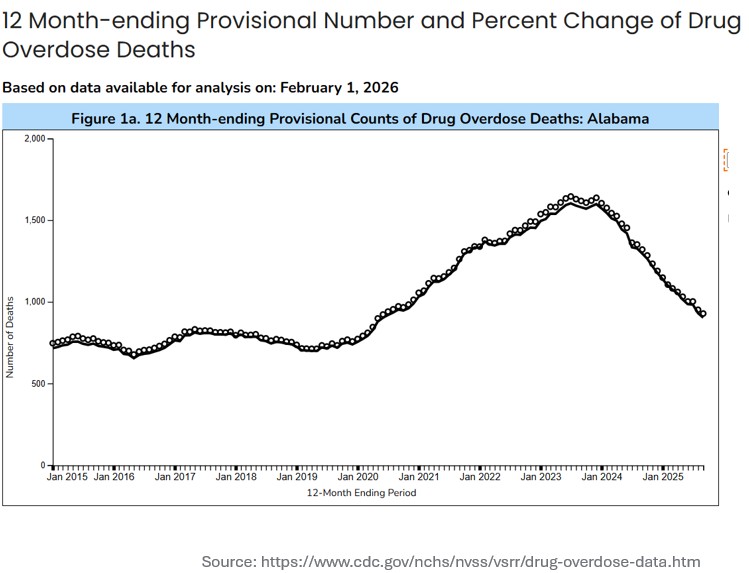
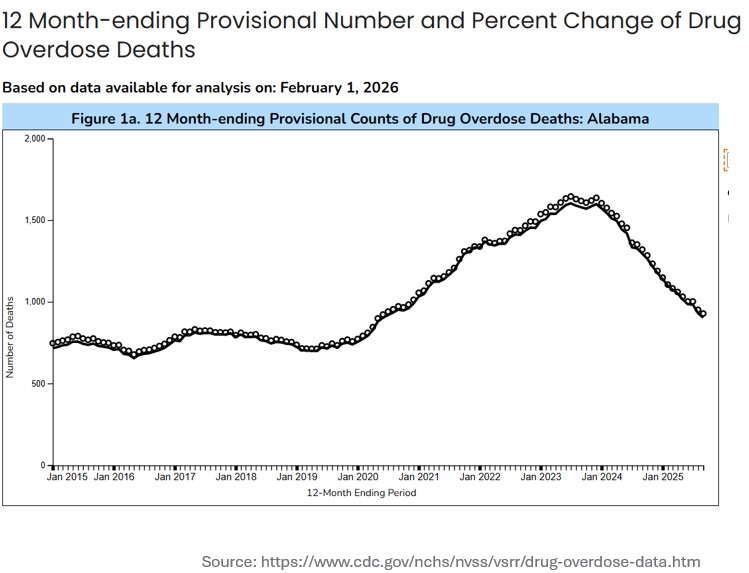
PARCA’s 2026 Annual Forum, “From Crisis to Collaboration: How Data, Policy, and Partnership Saved Lives in Alabama,” spotlighted the multiagency collaboration and bold policy decisions that underpinned a sharp decline in overdose deaths in 2024 and 2025 in Alabama. But an April 24 decision by the Substance Abuse and Mental Health Services Administration
(SAMHSA) that severely limits the use of federal dollars for fentanyl test strips could set back that progress. It also signals a departure from the federal government’s previous embrace of harm reduction as a drug policy priority.
In the context of drug policy, harm reduction is a set of practices and supplies that aim to contain and mitigate the dangers of drug use. Examples of harm reduction supplies include the overdose-reversing nasal spray Naloxone and fentanyl test strips, which are used to determine if a given substance is contaminated with fentanyl. New rules announced in a “Dear Colleague” letter sent to recipients of grants through the Substance Abuse and Mental Health Services Administration (SAMHSA) late last month say that funds from the U.S. Department of Health and Human Services (HHS) can no longer be used to pay for fentanyl test strips and certain other supplies. A carveout exists to allow HHS funding to pay for test strips used by law enforcement, public health, and healthcare professionals in the performance of their duties. However, they can no longer be distributed directly to consumers.
Until recently, Alabama law considered fentanyl test strips to be illegal drug paraphernalia. That changed in 2022, when lawmakers approved a law that removed them from the list of banned items. Test strips increased in importance when fentanyl began to make its way into cocaine, methamphetamines, and marijuana, sometimes killing people who had no idea that the drugs they were buying might be contaminated with the deadly opioid. “The No. 1 reason for deaths due to overdoses is the presence of fentanyl and most of the time the drug user doesn’t know they’re using fentanyl,” Sen. Jim McClendon (R-Springville) told the House Public Safety and Homeland Security Committee in early 2022. Lawmakers legalized fentanyl test strips that June. Since then, HHS funding has defrayed the cost of getting thousands of test strips into the hands of community members. The Alabama Department of Mental Health has distributed a total of 4,000 test strips since 2022, and Birmingham’s Recovery Resource Center has distributed 1,800 since 2022. The Birmingham-based Addiction Prevention Coalition distributed 755 fentanyl test strips in 2025 alone.
Rep. Allen Treadaway (R-Morris), one of the bill’s sponsors, spoke at PARCA’s 2026 Annual Forum about how his experience as a police officer in Birmingham informed his thinking about harm reduction supplies like fentanyl test strips. “I’ve been on the scenes of enough folks dying, especially overdosing, and the medics in Birmingham show up and they’re either on time or they’re not,” he said. Getting harm reduction supplies directly into the hands of the people most likely to need then, Treadaway said, “has saved lives. There’s no question about it.”
Rep. Treadway’s assertion appears to be backed by research work done by researchers at a number of institutes, including UAB and Johns Hopkins Bloomberg School of Public Health. Likewise, there is evidence that access to fentanyl test strips has a positive effect on the behavior of people who use drugs. A 2017 study out of North Carolina found that 81% of people who injected drugs reported testing their supply for fentanyl before using it. Results showing the presence of fentanyl prompted many of them to take steps to avoid overdosing, most often by using less drug than usual. “In contrast to reports claiming that ‘opioid addicts’ lack impulse control and are unable to make healthy decisions,” the authors of the study wrote, “this finding provides additional evidence that [people who inject drugs], when receiving test results indicating potential harm, can change how they inject drugs to prevent adverse health outcomes.”
Under the framework presented in the April 2026 “Dear Colleague” letter, fentanyl test strips, as well as forms of harm reduction that are illegal in Alabama (such as clean syringes), are considered “drug paraphernalia or supplies that promote or facilitate drug use.” SAMHSA funds can be used to pay for overdose reversal supplies like naloxone and infectious disease prevention supplies like wound care, at-home tests for diseases that can be transmitted through needle-sharing, and sharps disposal kits. However, direct-to-consumer harm reduction supplies that aim to contain and mitigate the dangers associated with illicit drug use without explicitly reducing demand for drugs are contrary to the policy orientation of the current administration.
Lower Fines and Fees Raise MORE Revenue than Higher Fines and Fees, Study Finds
New research indicates that lower fines and fees raise more revenue than higher ones, and that a “collections fee” that is supposed to incentivize payment is instead associated with greater debt.
The report, Findings from the Jefferson County Equitable Fines and Fees Project from MDRC, provides insight into an issue the Legislature is struggling to address: Alabama’s patchwork system of fees and court costs. Earlier this year, the Legislature established a Joint Interim Study Commission on Court Costs to examine ways to reform and standardize the court cost system. The Commission will report to the Legislature in its upcoming session early next year.
The new report, a Jefferson County case study, uses five years of case-level data to examine drivers of court debt accumulation over time. PARCA Senior Research Associate Leah Nelson was co-founder and co-principal investigator on the project.
What are fines and fees?
Every year, criminal courts in Alabama assess an unknown amount in fines, fees, court costs, and restitution. Fines are intended as punishment, while fees (including court costs) are meant to cover the expenses associated with the case. Some people are also assessed restitution if the offense they were convicted of resulted in a financial loss to a victim.
Although the total amounts assessed and outstanding across Alabama’s criminal courts are unknown, annual collections are substantial. Criminal courts drew a total of nearly $114 million in 2024 alone, including $6.1 million that remained within the court system, while $80 million was disbursed to non-court entities such as the General Fund, the Alabama Department of Economic and Community Affairs, the State Department of Education, and American Village at Montevallo. And, finally, $12.7 million in restitution was distributed to victims.
Fines are supposed to deter involvement in the criminal justice system, while fees exist to recoup the cost of court involvement, while also generating revenue for the state. New research suggests that higher fines and fees are counterproductive: producing less revenue, creating higher levels of unpaid debt, and prolonging individuals’ involvement with the criminal justice system.
People assessed lower amounts at the time of sentencing paid more money and were more likely to pay their debt down to zero, as compared to people assessed higher amounts (who typically saw their balances increase over time). In other words, people who were assessed less debt were not only more likely to finish paying, but they paid more money.
A 30% collection fee assessed when people are 90 days late with their payments resulted in higher unpaid balances and a decreased likelihood of paying off their fines and fees.
Indigent people were assessed higher financial penalties than their more affluent peers.
Victims may never receive, or fully receive, financial restitution because of how fines and fees revenue is distributed.
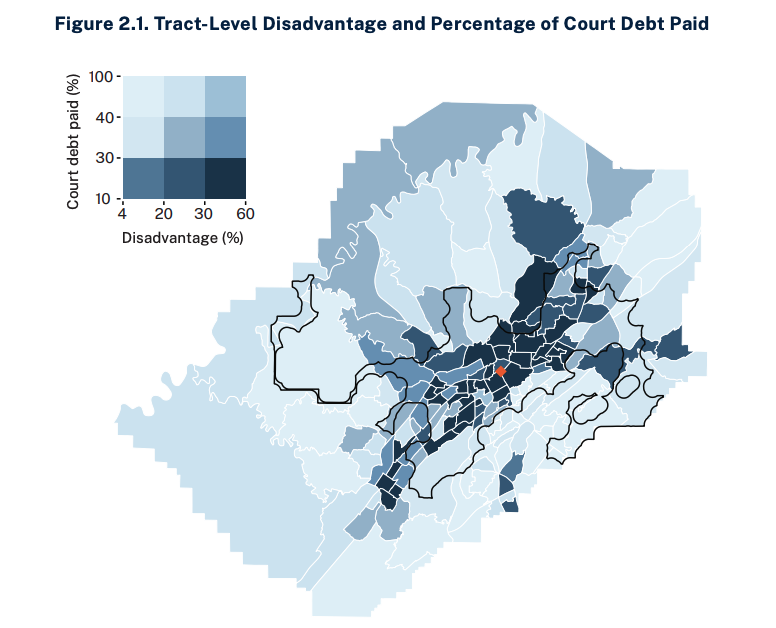
Court debt was concentrated in census tracts marked by high levels of concentrated disadvantage, a composite metric that measures a given location’s level of socioeconomic challenges.
How does the system work?
Assessment of debt
Fines, fees, and costs are assessed at the time of sentencing in nearly all criminal cases where a person is found guilty. Amounts are set by statute. A typical sentence simply includes a note that the defendant is to pay fines, fees, and costs, along with any restitution that may be due. Judges do not typically say the amount out loud at the time sentencing, so it is common for people to agree to pay as part of a plea without knowing exactly how much they will owe. While judges are required to assess fines and fees, under the Alabama Rules of Criminal Procedure (Rule 26.11), they have broad discretion to set payment plans or even forgive debt if a person is unable to pay. The same rule allows judges to incarcerate people who willfully refuse to pay.
Fines and fees may be the only sanction a person faces in a low-level case. In more serious cases, fines and fees are imposed in addition to supervision or incarceration. Many people who are assessed fines and fees are unable to pay them all at once, and it is common for judges to allow them to pay in installments.
Research shows that Alabama residents who owe fines and fees over long periods of time often make desperate choices as they seek to stay current on their debt. A 2018 survey showed that 83% gave up a basic need like rent, car payments, or medication; 44% took out a payday loan; and 38% percent admitted to engaging in unlawful activity – usually selling drugs, stealing, or sex work – in order to keep up with their court payments.
Even so, half of those surveyed told researchers they had been jailed in connection with unpaid debt. “Every time I turn around, they got a warrant out because I can’t pay,” one man said. “Having to fear the police is not right because of debt.”
Distribution of revenue
Alabama Code sections related to fees name the entity or entities to which revenue collected from fees must be disbursed. However, the order in which money is disbursed falls to the discretion of the Chief Justice of the Alabama Supreme Court. Over the decades, default priorities have been programmed into the State Judicial Information System (SJIS), which is the software used by district and circuit courts to docket and track cases.
Disbursements operate on a “cascade” basis, meaning the top priority entity must be paid in full before the next entity in line gets a single dollar. Under the current default priority system, court costs are paid first, and victims who are owed restitution are paid last. If a person who owes fines and fees falls behind on their payments by more than 90 days, they are automatically assessed a “collections fee” of 30% of what they owe. If assessed, the collections fee becomes the top priority and must be satisfied in full before any other fund receives a share of revenue. Judges have the authority to re-order priorities (for instance, to put restitution at the top of the list), but must issue reprioritization orders on a case-by-case basis.
Findings from the Jefferson County Equitable Fines and Fees (JEFF) Project
Following the money
The average initial amount assessed in cases included in the JEFF sample was $1,253.52.
42% of people pay nothing at all toward their fines and fees.
People were more likely to pay who were:
Not indigent
50% of non-indigent people paid off their full debt, compared to 16% of people who were represented by public defenders due to low income)
Facing lower fines
People in the lowest quartile of court debt assessed (a median debt of $121) tended to pay off their debt. By contrast, people in the top quartile (with a median initial assessment of $1,827) saw their debt nearly double over the five-year period studied.
Over 60% of cases in the sample were assessed a 30% collections fee, which is added to the balance when a person fails to pay anything toward their balance for 90 days.
Collections fees were associated with an average $827 increase in unpaid balances, with only $262 in payments on average after the fee was imposed. Those assessed the fee were less likely to pay off their debt.
In other words, the collection fee, which is intended to increase revenue, is more associated with increased debt.
Geographic Concentration
Geographically, debt was concentrated in the central valley area of Jefferson County, which is also home to a disproportionate percentage of Jefferson County’s Black residents.
People who lived in census tracts marked by concentrated disadvantage were much less likely to pay down their debt as compared with people in more affluent areas of the county. A one-percentage-point increase in concentrated disadvantage corresponds with 13% less court debt paid.
The human consequences of fines and fees
Most people (71%) in the sample were defended by a public defender, meaning that a judge determined they were indigent at the time of trial. Unsurprisingly, people who were indigent paid less toward their court debt than those who could afford to hire a lawyer. More surprisingly, JEFF researchers found that across all charges, indigent people were assessed higher financial penalties than their more affluent peers.
In interviews, court practitioners expressed frustration with the system. They described administrative headaches associated with attempting to keep up with debtors who often have unstable housing situations and don’t receive notices reminding them to pay. They felt that the 30% collections fee was deeply problematic, but worried that the district attorney’s office couldn’t operate without the revenue it generates. They expressed a broad desire to see court and law enforcement operations fully funded by the legislative branch, rather than being tasked with generating their own revenue.
Meanwhile, people who owed court debt described feelings of fear. Few were aware that they were allowed to ask for their court debt to be forgiven, and many thought the money was kept by local police or courts. (In fact, most of it flows back to the state.) Discussing the dread associated with owing court debt, one person said, “It’s like drawing an X on your back and I got you forever.”