Huntsville Continues to Surge, Remaining Big 3 Cities Jockey for Position, while Rural Areas Lose Population in 2024
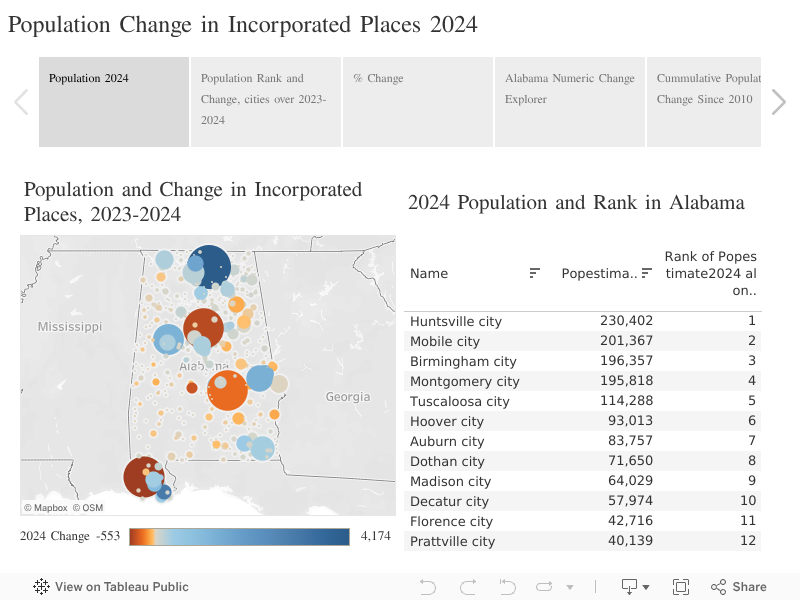
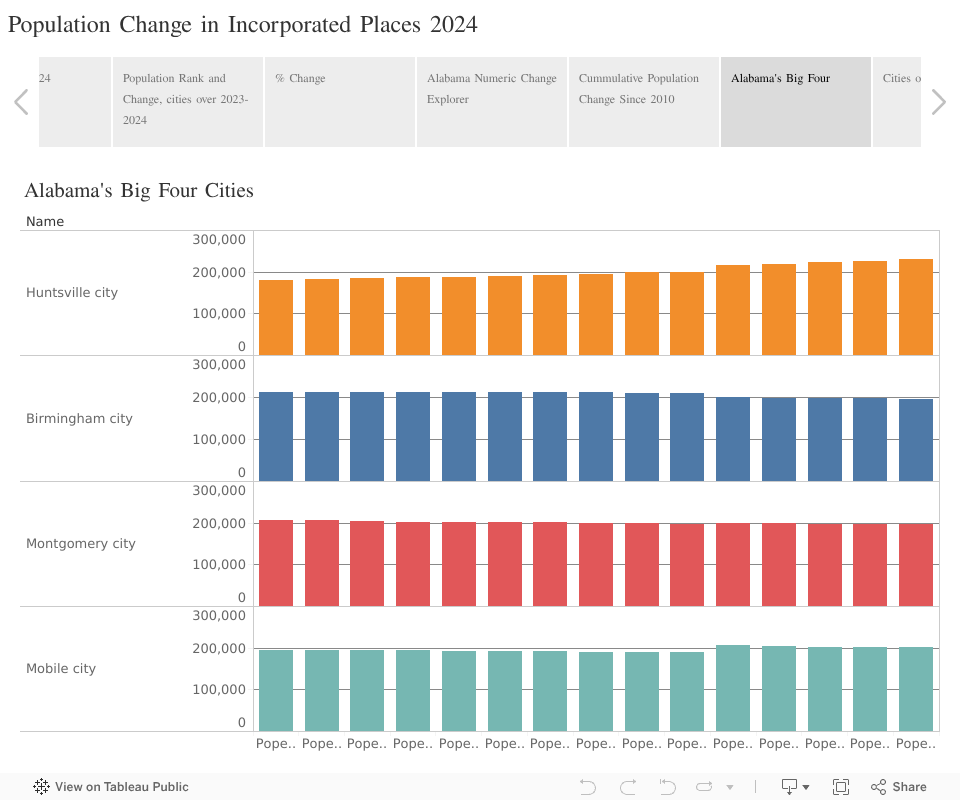
New population estimates from the U.S. Census Bureau place Mobile as the state’s second-largest city, behind booming Huntsville and ahead of Birmingham and Montgomery, both of which saw population declines according to the most recent estimates from the U.S. Census Bureau.
Mobile’s new status takes into account the city’s 2023 annexations of neighborhoods in Mobile County that were expected to add about 20,000 to the city’s population. According to revised Census estimates, the city jumped from less than 190,000 before 2020 to almost 210,000, pushing it well ahead of Birmingham which, for 2024, had an estimated population of 196,818.
However, despite its annexation bump, Census estimates show Mobile is still losing population, dropping by over 500 over the past year to an estimated 201,367. Birmingham and Montgomery are also continuing to see population declines. If current trends prevail, the three cities seem destined to continue jockeying back and forth. Currently, the population estimates have Birmingham in third, just in front of Montgomery, at 195,818.
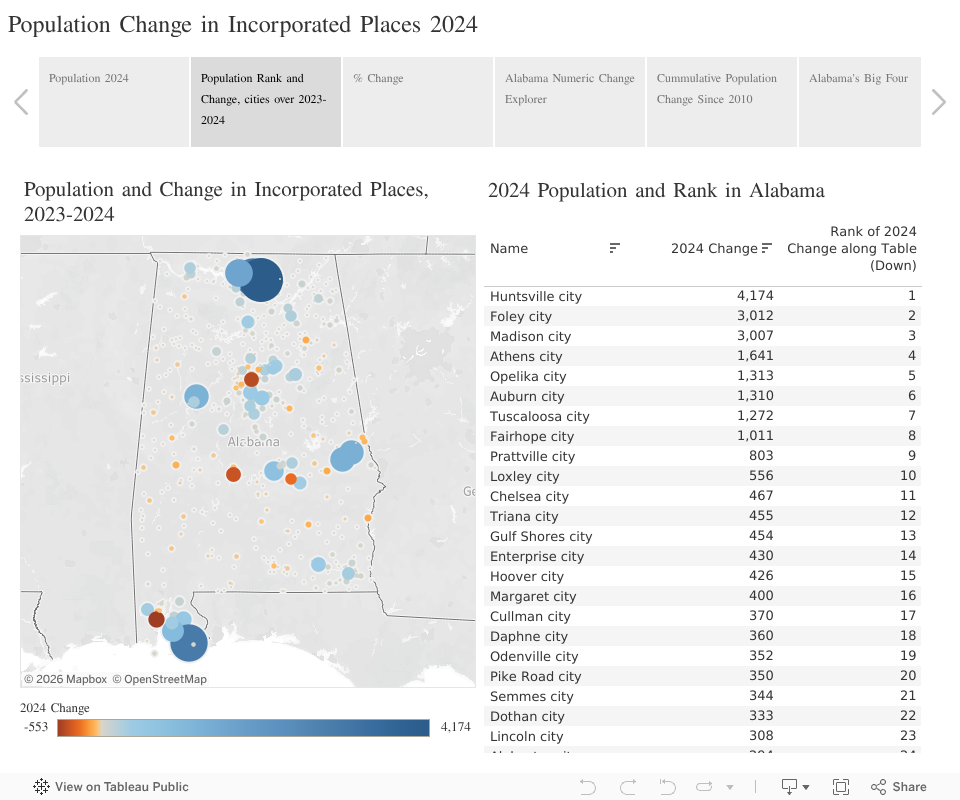
The biggest surprise of the estimates was the small Jefferson County hamlet of Brookside, which had the highest population growth rate of any municipality in the state at 13.2%. The town added 158 residents, bringing its total to 1,357 residents. The town has a new neighborhood under construction that appears to be drawing new residents. Small towns and cities around Huntsville and in Shelby and St. Clair counties, outside of Birmingham, saw higher rates of growth in percentage terms, as did suburban cities around Montgomery. Small towns in Wiregrass surrounding Dothan and Enterprise also showed growth in percentage terms. And several Baldwin County communities ranked near the top in terms of percentage growth.
In terms of growth in numbers, the city of Huntsville is the state champ, drawing in another 4,174 new residents in 2024. The City of Madison, Huntsville’s suburban neighbor, added 3,007, ranking third in the state in numeric growth, and Athens, which also borders Huntsville, added 1,641, ranking fourth.
The City of Foley in Baldwin County grew by 3,012, ranking second in the state in numeric terms and tying for second in percentage growth at 12%. Foley’s fellow Baldwin County city of Loxley also grew 12%. Fairhope added 1,011 according to the estimates, ranking 8th in the state. Gulf Shores and Daphne also ranked in the state’s top 20 in the number of residents added.
Cross state rivals Tuscaloosa and Auburn continue to grow with Auburn adding 1,310 to edge out Tuscaloosa’s gain of 1,272 new residents. Auburn also has the secret weapon of Opelika next door, which added 1,313 new residents in 2024. That far outpaces Northport which grew by 280. Together, Tuscaloosa and Northport have about 150,00 residents compared to Auburn and Opelika’s 120,000.
Data-informed Decision Making Helps Drive Down Overdose Deaths in 2024
The sharp drop in overdose deaths in 2024, both nationally and in Jefferson County, wasn’t an accident, according to members of the task force that works to combat the epidemic of drug-related deaths. Instead, it resulted from public policy changes and the geographically targeted deployment of resources.
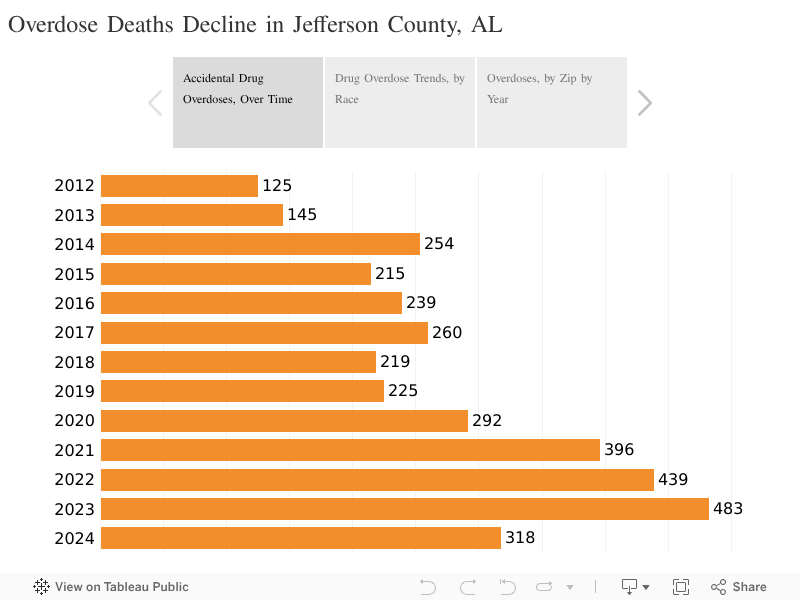
Figure 1. Trends in Accidental Drug and Opioid Overdose Deaths in Jefferson County, 2012-2024. Source: Jefferson County Coroner’s Office data.
Thanks to those interventions, Jefferson County saw its first decline in overdose deaths since 2018. According to data from the Jefferson County Coroner’s Office, drug overdose deaths peaked in the county in 2023, with 483 accidental drug-related deaths. That is more than double the number of people who died by homicide (197) in Jefferson County in 2023. And it is more than triple the number of overdose deaths Jefferson County experienced in 2012.
Accidental overdose deaths from opioids began rising in the 1990s with the proliferation of prescription pills. That was followed by a resurgence in heroin use, which was in turn followed by the arrival of fentanyl, an extremely potent synthetic opioid. Beginning in 2020, traffic fentanyl surged into Jefferson County, resulting in a skyrocketing death toll from overdoses.
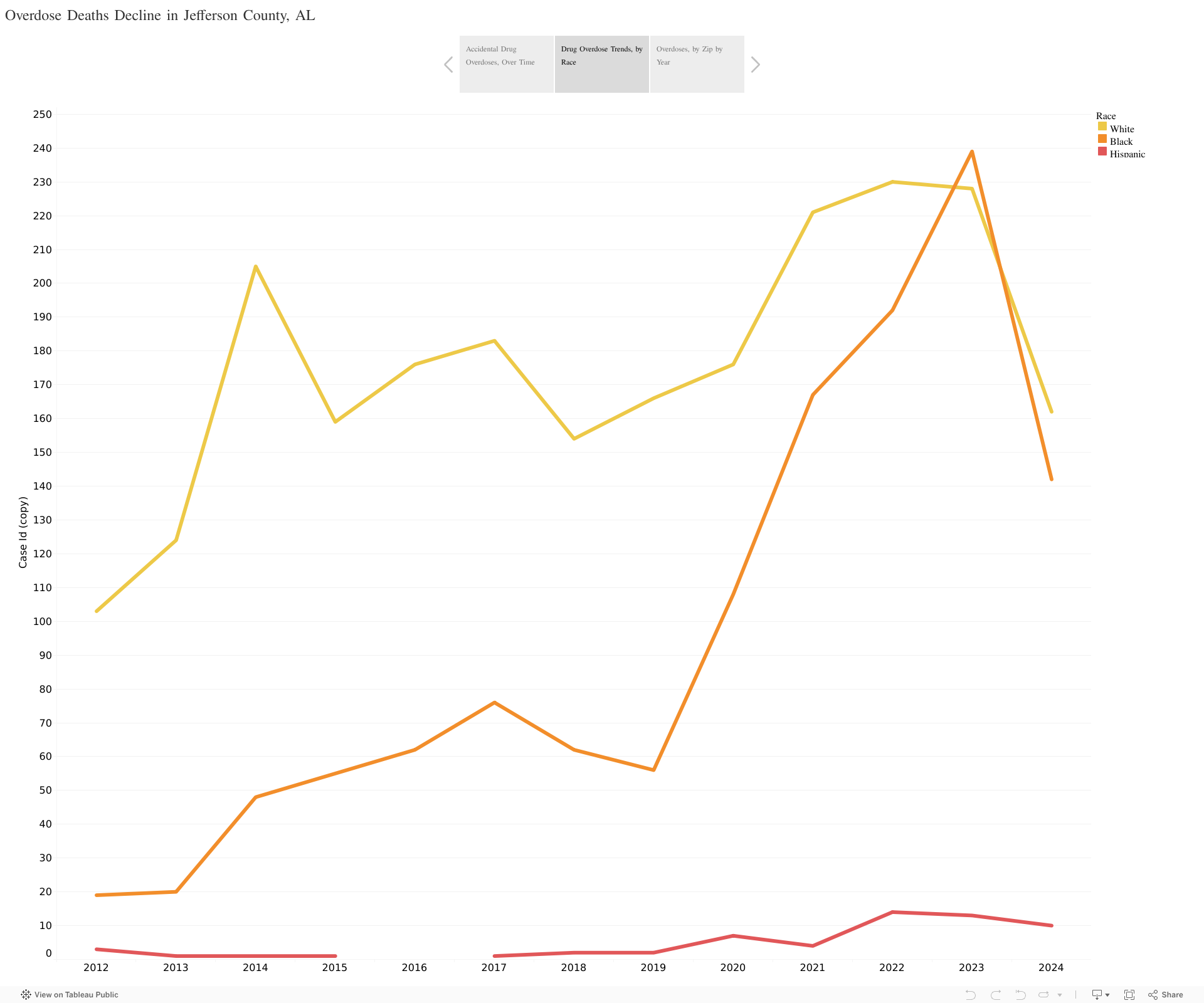
In Jefferson County, the arrival of fentanyl hit the Black community especially hard. Historically, White deaths from drug overdoses had greatly outnumbered Blacks. But by 2023, Black overdose deaths eclipsed whites.
Figure 2. Trends in Overdose Deaths By Race, Jefferson County. Source: Jefferson County Coroner’s Office data.
Health officials nationally and in Alabama have been working to catch up with the epidemic. In 2017, Governor Kay Ivey established the Alabama Opioid Overdose and Addiction Council, which pulled together the state departments of Public Health and Mental Health, local health providers, and a broad coalition of health care providers, drug treatment non-profits, and first responders. Much of the coordinating and data-gathering work has been funded by the Centers for Disease Control and Prevention and its Overdose Data to Action grant program. According to the CDC, factors driving the decline in overdose deaths include the “widespread, data-driven distribution of naloxone, which is a life-saving medication that can reverse an overdose; better access to evidence-based treatment for substance use disorders; shifts in the illegal drug supply; a resumption of prevention and response after pandemic-related disruptions; and continued investments in prevention and response programs like CDC’s flagship Overdose Data to Action (OD2A) program.”
OD2A funding to the Alabama Department of Public Health and the Jefferson County Department of Health has supported the creation of a data-gathering and sharing program that is providing real-time information about where overdoses are occurring. Emergency medical services providers and hospitals are reporting overdose encounters as they happen, allowing public health officials to zero in on communities and even specific neighborhoods where overdoses are on the rise. Jefferson County’s Health Department has worked with the Jefferson County Coroner’s Office, health care providers, and researchers at the University of Alabama at Birmingham and other local agencies to gather, analyze, and act on the data.
With the data mapped and analyzed, partners from the healthcare and treatment community, first responders, and public health officials routinely meet to discuss patterns and develop a concerted approach to overdose prevention. Figure 3 shows the concentration of overdose deaths by zip code, for the peak year, 2023. Using the slider and directional arrows, you can cycle through years of data to see the rising numbers and shifting geographic concentration.
Figure 3. Mapping Overdose Deaths By Zip Code, by Year. Source: Jefferson County Coroner’s Office data.
Policy changes identified and lobbied for by the Overdose and Addiction Council set the stage for the interventions that appear to be driving down deaths. First, in June of 2022, the Alabama Legislature decriminalized Fentanyl test strips. Before the change, the strips that allow the detection of potentially fatal levels of the drug were considered drug paraphernalia, discouraging their availability and use. Then, in March 2023, naloxone was made an over-the-counter medication, increasing access to the overdose-reversing treatment and allowing for distribution in the community.
In the wake of the changes and with an influx of funding from both federal and state opioid settlement money, a coalition of groups pushed out resources and training to make the life-saving resources available. The Alabama Department of Mental Health significantly increased naloxone distribution, distributing 46,482 kits at Back-to-School events, End Addiction Walks, and conferences and trainings for treatment providers serving high-risk individuals, local and rural law enforcement officers, and first responders. JCDH has an online Naloxone education portal on its website, www.jcdh.org, and sends Naloxone Kits and Fentanyl Test Strips by mail at no cost to people who request the kits through the website. In addition, JCDH provides both products through dispensing boxes at its health centers and at distribution boxes in other community locations. JCDH also partners with local EMS, police, fire and rescue, and some independent pharmacies to provide the supplies as well.
Using Jefferson County Coroner’s data, the Jefferson County Health Department identified particular neighborhoods where overdose deaths were on the rise. To counter the trend, the department found avenues to distribute free Naloxone and Fentanyl test strips. They also launched public information campaigns, advertising the dangers of the drugs and resources for treatment services, in some cases, displaying the messages on the public transit buses that served the affected areas.
Jefferson County Health Officer Dr. David Hicks applauded the cooperation and the progress but stressed the need to sustain the effort.
“As we continue to address the challenges posed by overdose deaths in our community, it is crucial to recognize the progress we have made and the work that still lies ahead,” Hicks said. “Our collective efforts in prevention, education, and treatment are making a difference, but we must remain vigilant and committed to saving lives. Together, we can build a healthier and safer Jefferson County.”
PARCA is involved in an effort to encourage similar efforts to share, analyze, and act on data. The Birmingham-Jefferson County Justice Governance Partnership brings together county government, municipalities, multiple law enforcement agencies, schools, health providers, non-profits, and community groups to develop a common understanding and cooperative solutions to community challenges. For more information, visit the BJC-JGP website.
Alabama’s $60 Billion Question
Alabama relies on federal spending—Alabama residents do, too.
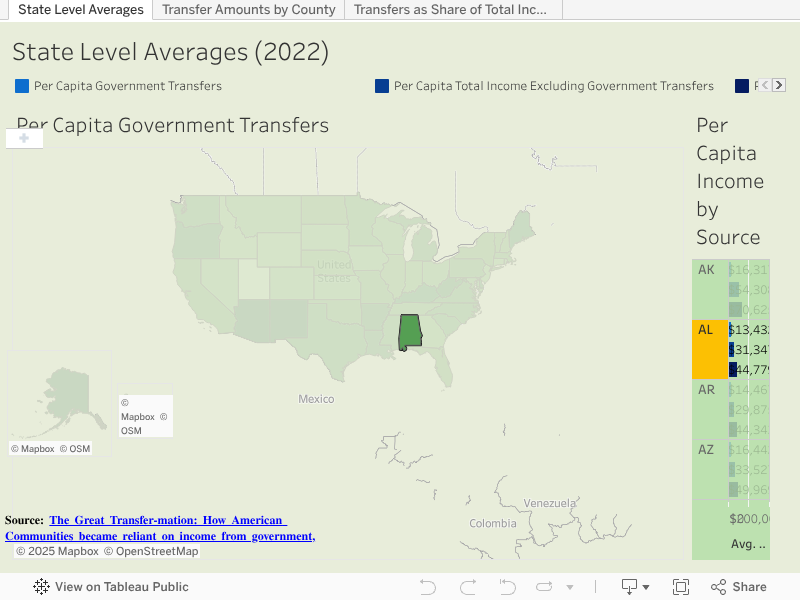
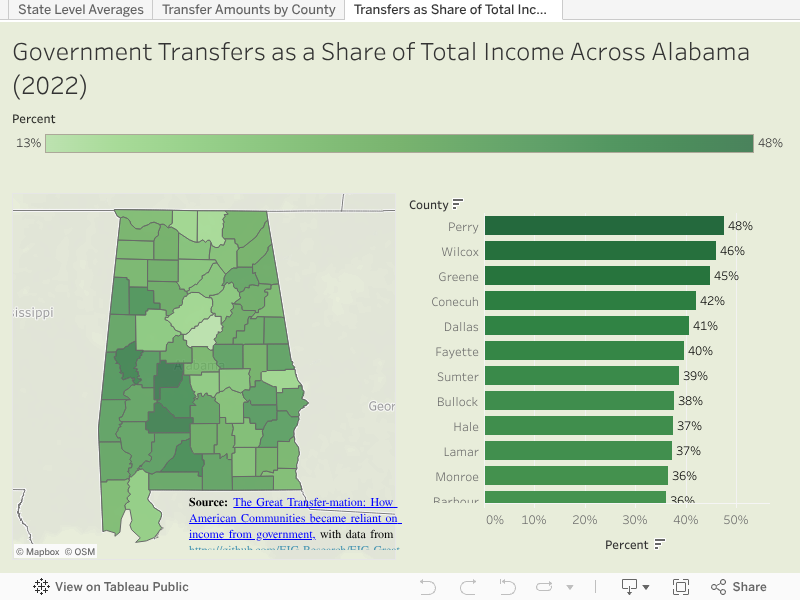
Alabama residents receive over $60 billion from the federal government—23% of all personal income.
These payments, known as transfer payments, include Social Security, Medicare, Medicaid, veteran’s benefits, unemployment, Pell Grants, and others.* The report explains how an aging population and shrinking economic opportunities have shifted many communities into reliance on these transfer payments.
To put the $60 billion in perspective, Alabama’s four automakers generate $6.4 billion in total compensation, according to a report from Autos Drive America and the American International Automobile Dealers Association, as reported by al.com. That’s about one-tenth of the amount received from federal transfer payments.
In other words, a 10% reduction in these payments would have a similar economic effect on personal income as shuttering Alabama’s entire auto industry.
These trends evolved over decades, having a widespread economic impact that has grown steadily as the population ages.
Meanwhile, these programs are under increasing scrutiny in the current administration. Reducing them would have a profound impact on local communities.
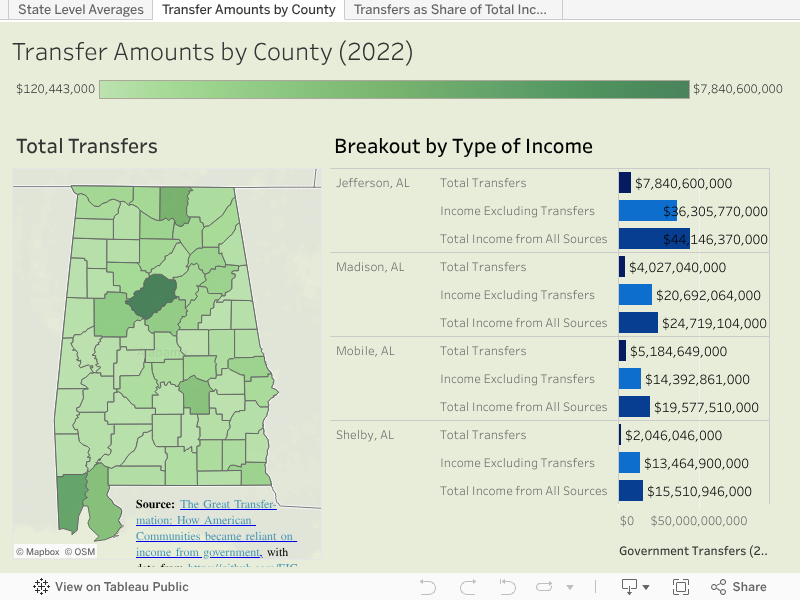
Explore the chart below to see the amount of transfer payments in each county and the share of total income those payments represent.
*Some of these payments, like Social Security, are made directly to individuals. Other payments, such as Medicare and Medicaid, are made to providers to pay for services on behalf of individuals.
The Alabama Constitution’s Impact on Taxes and Spending
PARCA is re-examining Alabama’s Constitution in light of the 2022 passage of a revised and reorganized version of the state’s fundamental law.
The approval of the Constitution of 2022 was the culmination of decades of advocacy. Some important changes were achieved, including a substantial reorganization and the removal of racist and unconstitutional provisions central to the spirit of the state’s 1901 Constitution.
And yet, the Alabama Constitution of 2022 maintains the fundamental shackles on government from the 1901 Constitution. Embedded in the Constitution is a tax system that is inadequate, inefficient, and inequitable.
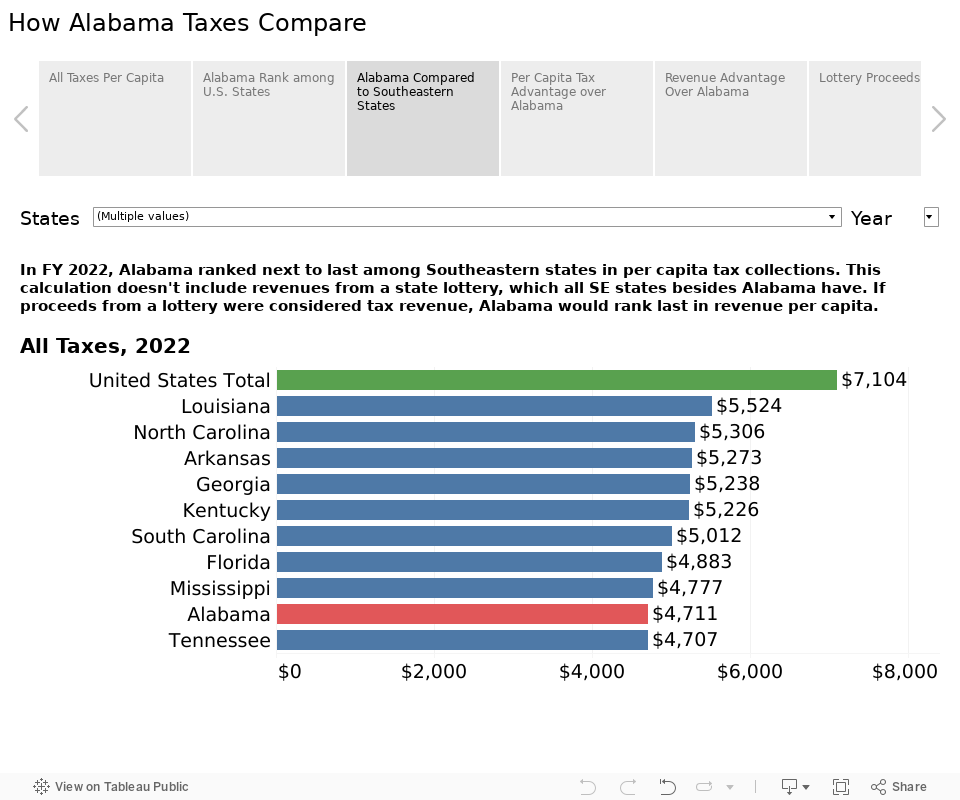
Since the early 1990s, PARCA’s How Alabama Taxes Compare analysis has found that Alabama state and local governments consistently collect less per capita in taxes than almost all other states. After occupying the bottom spot for most of the past 30 years, Alabama has traded back and forth with Tennessee for last place since 2018. This year, Tennessee’s per capita collections came in $4 lower than Alabama’s, resulting in a rank for Alabama of No. 49.
Alabama continues to collect less per capita in state and local property taxes than any other state. Property taxes are strictly limited by provisions in the state constitution.
Low taxes create some advantages. Low property taxes on land and homes are attractive in some regards, decreasing the cost of homeownership and shielding rural land and farms from development pressure. Lower taxes also can be attractive to businesses and individuals moving to the state.
However, low property taxes come at a cost, creating a greater reliance on other taxes, mainly sales taxes. Those sales taxes put a particular burden on low-income Alabamians. Low tax collections also mean that Alabama state and local governments have less to invest in services such as education, health, public safety, and the justice system. That is in a state with high poverty rates, low educational attainment, poorer health outcomes, and higher rates of violent crime than most other states. In turn, high poverty and less economic activity mean less wealth to tax and, thus, lower tax collections.
Inadequate
In contrast to other states, where the state legislature and local governments generally have the power to adjust tax rates, Alabama’s constitution sets limits, rates, and procedural restraints on state and local taxes. That makes taxes hard to raise, adjust, or rebalance. In the end, Alabama’s lower base of wealth and structural and cultural resistance to taxes mean that governments here have less to spend on providing vital public services, placing Alabama in the bottom ten states in most spending categories.
The project is supported, in part, by the Alabama Citizens for Constitutional Reform (ACCR). Both ACCR and PARCA are nonpartisan organizations, and our members and supporters are Republicans, Democrats, and independents. Former Governor Albert Brewer and former Samford University President Thomas Corts, both deceased, were founding leaders in both organizations.
Birmingham-Jefferson County Justice Governance Partnership Launched to Strengthen Justice and Opportunity
Leaders from city and county government, education, philanthropy, social services, and community are launching a new partnership to decrease violence and increase health and opportunity in Jefferson County.
Coming in the wake of a record-setting year for homicides in the City of Birmingham, the Birmingham-Jefferson County Justice Governance Partnership (BJC-JGP) seeks to build a coordinated and sustained effort to understand and address the conditions that give rise to violence and the underlying vulnerabilities of the neighborhoods where violence is concentrated. The partnership grows out of a recognition that law enforcement alone cannot solve the problem and that community members and an array of agencies play a part in the solution.
Birmingham City Councilor LaTonya Tate and Jefferson County Commissioner Sheila Tyson co-chair the BJC-JGP and convened the partnership’s leadership council last week at the Women’s Foundation of Alabama. Other members of the JGP Leadership Council in attendance included Jefferson County Health Officer David Hicks, Jefferson County District Attorney Danny Carr, Bessemer District Attorney Lynneice Washington, Jefferson County Chief Deputy Coroner Bill Yates, as well as representatives from the offices of Birmingham Mayor Randall Woodfin and Sherriff Mark Pettway, and philanthropic leaders.
The effort spans multiple government agencies, non-profit service providers, as well as researchers and care providers from the University of Alabama at Birmingham. The Public Affairs Research Council of Alabama serves as the partnership’s Local Justice Intermediary, a role that includes coordinating data collection across agencies and collaborating to provide research and analysis that supports the work of the Partnership.
The Justice Governance Partnership is being launched with the support of the Aspen Institute’s Criminal Justice Reform Initiative (CJRI). The Aspen Institute is a nonpartisan educational and policy studies organization based in Washington, DC. Aspen is known for convening thought leaders from across the country to address complex public policy problems. Its Criminal Justice Reform Initiative brings together national experts in criminal justice, education, and budgeting with the aim of helping local communities develop more effective approaches to public safety.
Birmingham is among a handful of communities piloting the Justice Governance Partnerships model. Aspen’s CJRI is also working with Grand Rapids, Michigan, and in rural South Carolina, and North Charleston, S.C.
The formal launch of the JGP follows the release of the Birmingham Crime Commission Report, commissioned by Mayor Woodfin. The commission’s report called for the implementation of evidence-based violence reduction strategies, community engagement and investment, and sustainable governance to implement, monitor, and maintain short-term and long-term solutions.
The Justice Governance Partnership serves as a vehicle for cooperating around implementation and monitoring progress. Partners across the cooperating organizations provide wide-ranging data to produce a Justice Audit, which quantifies conditions and identifies needs. The Audit is regularly updated to track progress.
Meanwhile, the ultimate goal is to devise a Justice Reinvestment Plan, which identifies preventive investments that can improve neighborhood conditions and drive down the need for costly emergency responses. The Audit and Reinvestment Plan are tools that aim to identify actionable solutions to improve economic conditions, address violence, and mitigate other risk factors at the local level, focusing on under-served neighborhoods.
About the Birmingham-Jefferson County Justice Governance Partnership
The Birmingham-Jefferson County Justice Governance Partnership is a coalition dedicated to fostering a transparent, equitable, and effective justice system in Birmingham and Jefferson County. Through collaboration, policy innovation, and community engagement, the BJC-JGP seeks to address systemic challenges and create lasting change for the benefit of all residents. For more information, visit parcalabama.org/bjc-jgp.
How Alabama Taxes Compare, 2024
Each year, PARCA uses data from the U.S. Census Bureau’s Annual Survey of State and Local Finances to compare Alabama’s tax collections to the other 50 states. The most recent data comes from the 2022 Fiscal Year.
In FY 2022, adjusted for population, Alabama collected less in state and local taxes than all but one other state, Tennessee.
Alabama’s per capita property tax collections are the lowest in the nation. That helps owners of homes, farms, and timberland but creates a revenue deficit, leaving state and local governments with less to spend on providing government services such as education, health, and public safety.
Alabama’s state and local sales tax rates are among the highest in the U.S., compensating for low property taxes.
Alabama’s income tax does not provide the balancing effect income taxes in other states do. Low-income workers begin paying taxes at a lower threshold than any other state. At the other end of the spectrum, Alabama is the only state that allows a full deduction for federal income taxes paid, a tax break that benefits high-income earners.
Alabama’s rankings in per capita state and local tax collections were generally consistent with rankings in prior years.
For most of the past thirty years, Alabama has consistently ranked last in the Southeast and last in the U.S. in terms of per capita tax collections. In recent years, Alabama has traded that last-place spot back and forth with Tennessee, thanks to tax-cutting measures in that state. This year, according to the Census survey, Tennessee returned to the bottom spot, collecting $4 less per capita than Alabama. Tennessee’s income tax on dividends continues to decrease as the state phases it out.
Alabama voters adopted a revised and reorganized Constitution in 2022.
However, the “new” Constitution preserved the fundamental attitudes and mechanics of the previous Constitution.
Adopted in 1901, that constitution was designed for an agrarian state, strictly limiting government power to tax land. It forbade the state from engaging in “internal improvements” and disenfranchised blacks and poor whites. Some of those provisions were loosened through amendments over time. Others were found unconstitutional and struck down by the federal courts.
But one of the essential elements remains its concentration of power in the state government, the Legislature in particular.
Local governments were granted only the powers the Legislature or the Constitution explicitly permitted.
The ruling elite of the time looked with disdain at local government officials. Thomas L. Bulger of Dadeville, a delegate to the Constitutional Convention of 1901, expressed the prevailing attitude during the constitutional debates:
“No gentleman on this floor will contend that his Commissioners’ Court at home is more capable of legislating for the people of his county than the General Assembly, composed of 100 select men,” Bulger said.
And thus, to this day, a sizeable portion of the state Legislature’s business pertains to matters that are specific to particular counties or cities, not the state itself.
More than 35,000 local laws govern everything from local taxes to whether a sheriff’s deputy can keep his gun and badge upon retirement. Over time, in a confusing and convoluted process, the Constitution was amended over 1,000 times to meet the needs of modern life, swelling the document into the longest state constitution in the nation. It is believed to be the world’s longest constitution, and even with the 2022 reorganization, it will continue to grow.
The bulk of the state’s fundamental law is now made up of exceptions and exemptions to the general framework and principles a constitution is supposed to enumerate. Two-thirds of Alabama’s constitutional amendments apply to individual cities and counties. In effect, every county has its own version of the Constitution. And counties and cities still must ask the Legislature for the tools they need to manage basic affairs.
In many ways, though, the lack of home rule in Alabama reflects how Alabamians feel about government. They want limited government. They want limits on taxation. They do not trust governments to carry out their wishes. And they want to be left alone.
That is, until they demand that government step in and solve a problem. And, often, that requires a trip to Montgomery.
The balance of power and responsibility between state and local officials is an eternal struggle.
In the 1901 debates, Bulger was answered by John A. Rogers of Gainesville in Sumter County, who asked:
“Why is it that these people can select such fine representatives to the Legislature, and yet it is feared that they won’t be able to select satisfactory County Boards to handle these matters?”
Perhaps in the 21st century, it is time to revisit Roger’s thoughts and consider whether the same voters who elect Alabama legislators to enact state policy can be trusted to vote for local officials from their own communities who will reflect citizen wishes on local matters.
This report is one of a series of reports examining Alabama’s current constitutional framework, identifying remaining obstacles to a modern constitution and possible paths forward in areas such as education, economy, healthcare, democracy, liberty & justice, finances, and related areas.
The project is supported, in part, by the Alabama Citizens for Constitutional Reform (ACCR). Both ACCR and PARCA are nonpartisan organizations, and our members and supporters are Republicans, Democrats, and independents. Former Governor Albert Brewer and former Samford University President Thomas Corts, both deceased, were founding leaders in both organizations.
A Final Upside Surprise, Signs of Slower Growth Ahead, Alabama Tax Collections, 2024
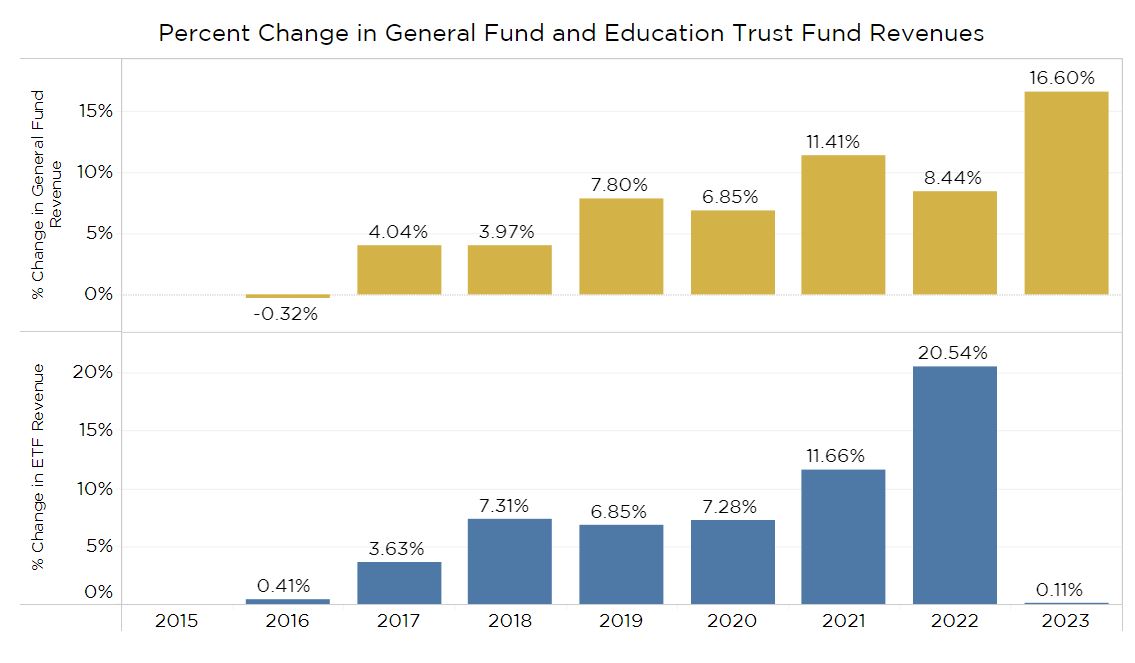
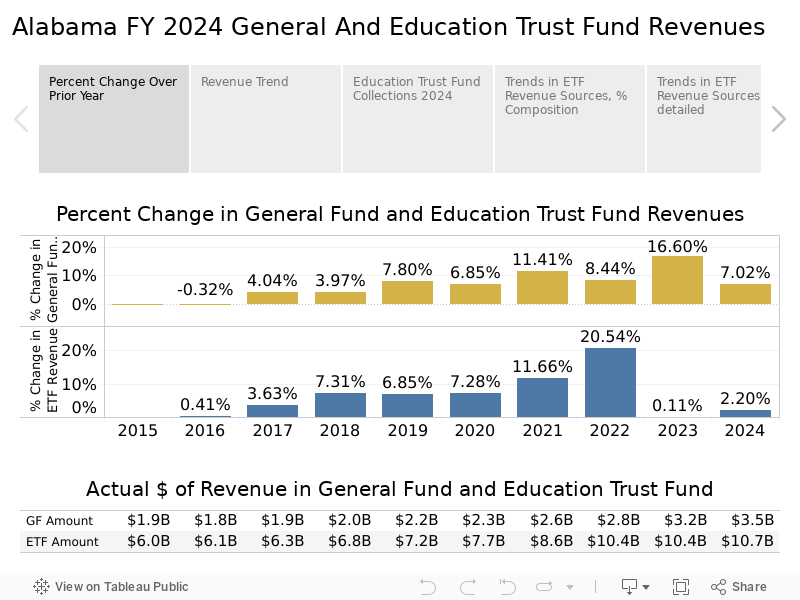
Alabama tax revenues continue to trend toward more normal patterns after a wild post-pandemic ride. The Education Trust Fund, powered by state income and sales taxes, grew modestly, collecting 2.2% more than the previous year. Meanwhile, growth in the General Fund cooled but still posted an unusually high increase of 7%, boosted by high interest earned on state deposits and continued growth in tax revenue from online sales, insurance, and property taxes.
The General Fund (GF) supports non-education spending, while the Education Trust Fund (ETF) supports spending on K-12 schools, colleges and universities. From FY 2021 through FY 2023, the two funds saw unusual surges of growth related to post-pandemic economic conditions and shifting patterns of consumption.
In 2024, the GF maintained its winning streak. Thanks to budget surpluses, replenished stockpiles of rainy day reserves, and federal relief and investment funds deposited in state accounts, Alabama has a growing body of cash in its accounts, which earn interest. At the same time, interest rates have stayed high as the Federal Reserve tries to cool inflation. As a result, the state revenues from interest grew by more than $150 million, up to $557 million.
An Analysis of the Proposed Statewide Amendment for the 2024 General Election
When Alabamians vote on November 5, they will be asked to vote on one statewide amendment.
“Proposing an amendment to the Constitution of Alabama of 2022, to grant certain sixteenth section and indemnity school lands that are owned in fee simple by the Franklin County School System, are located in Fayette County and Walker County, and are for the exclusive use of schools in the Franklin County School System to the Franklin County Board of Education; and to provide for the distribution of any proceeds and interest generated by this land.”
Proposed by Act No. 2024-301 (House Bill 302, 2024 Regular Legislative Session) Bill Sponsor: Representative Kiel
This proposal seeks to amend the Constitution of Alabama of 2022 to address the management of a piece of land in Fayette and Walker Counties that is to benefit the Franklin County Board of Education.
Since this Amendment concerns land owned in two counties and a school board in a third county, it requires a statewide vote.
The land in question is designated to support public education and stems from an eighteenth-century practice where the federal government designated land in each county for the support of public education in that county. These designations predate Alabama’s statehood.
In the late nineteenth century, the Alabama Legislature gave some school boards, including Franklin County, additional land, sometimes outside their home county, to ensure each school board owned land of approximately equal value.
State law stipulates that such lands are held in trust by the Alabama State Department of Education and managed by the Alabama Department of Conservation and Natural Resources. The Department is empowered to lease or sell the land, with revenue provided to the school system the land is designed to support.
Amendment 1 concerns land located in Fayette and Walker Counties that is to benefit the Franklin County Board of Education. The Board cannot independently manage the land and cannot sell the land without the approval of the State Superintendent of Education and the Governor.
Amendment 1, if approved, enables the Franklin County Board of Education to manage and sell the land without prior approval and retain all revenue.
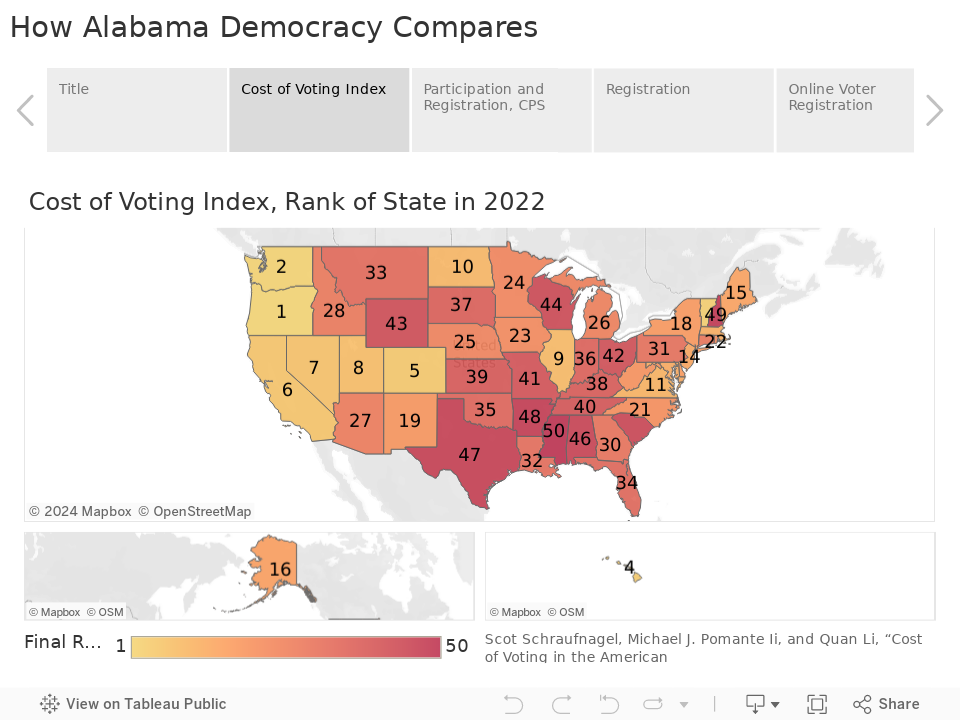
In recent years, Alabamians’ rate of participation in elections has lagged behind other states as electoral competition has decreased and as the state has failed to adopt measures other states have that increase the convenience and access to voting. According to political scientists, Alabama “cost of voting” is among the highest in the country, ranking No. 46 among the 50 states. Meanwhile, most other states now provide measures like early in-person voting and no-excuse absentee voting, measures that correlate with increased participation.
A new report by PARCA, How Alabama Democracy Compares, provides a detailed comparison of Alabama’s approach to voter registration, access to ballots, and democratic participation with those of other states.
Alabama has a history of limiting participation in the democratic process. The state’s 1901 Constitution disenfranchised blacks and poor whites for more than half a century, until, inspired by the Civil Rights Movement, the U.S. Congress and federal court swept away discriminatory barriers to voting.
In 2022, Alabama adopted a revised and reorganized state constitution, deleting the last written relics of the original discriminatory language on voting rights. However, the report makes clear that Alabama has not kept pace with other states’ adoption of measures that make it easier and more convenient to register and vote.