
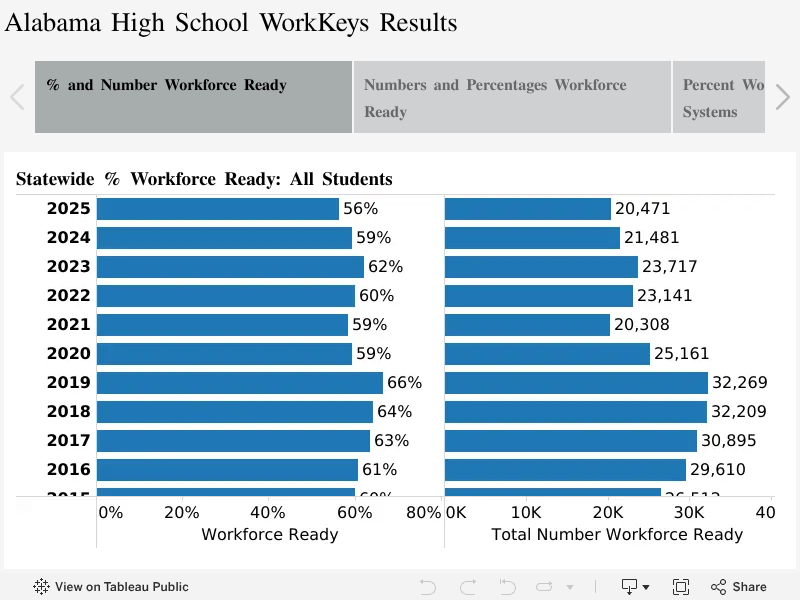
Despite the increasing emphasis on college and career readiness in Alabama high schools, fewer students are earning work-readiness certifications through the standardized test known as WorkKeys. It’s unclear whether results reflect a change in performance or a change in the pool of students taking the test in light of shifting strategies to ensure all students earn a college and career ready (CCR) designation.
Designed by the same company that produces the ACT college readiness test, WorkKeys gauges “foundational workplace skills” through three ACT WorkKeys assessments: Applied Math, Graphic Literacy, and Workplace Documents. ACT developed the test by researching how reading, math, and comprehension skills are applied in the workplace, rather than in a college class. Some industries test applicants with WorkKeys and consider the test results in hiring decisions. Since 2015, Alabama has offered the test to high school seniors as one of the ways students can demonstrate college and career readiness.
Beginning this spring, students must have earned at least one college and career-ready designation to graduate from high school.
Prior to 2020, more students earned a WorkKeys certificate than earned any of the other measures of college and career readiness. But schools are no longer required to offer the test, and some systems appear to be emphasizing other strategies for demonstrating college and career readiness.
For instance, since 2020, participation in dual enrollment and career technical education has risen sharply, meaning more students are earning a CCR designation through those routes.
Also, in systems where most students earn college and career readiness through benchmarking on the ACT, WorkKeys is sometimes de-emphasized. Since a student who earns a benchmark score in one subject on the ACT qualifies as college- and career-ready, the WorkKeys test is, to some extent, redundant.
Bearing all that context in mind, PARCA’s analysis of the WorkKeys results finds the following:
- A slightly higher number of students took WorkKeys, but the total tested represented a smaller percentage of the 2025 senior class, than the previous year.
- A smaller number and percentage of students tested scored high enough to be considered career-ready. To be considered career-ready through WorkKeys, a student needs to have scored high enough to earn a silver, gold, or platinum WorkKeys certificate.
- Among systems, Cullman City Schools had the highest percentage of students score workforce ready, with 87% earning certificates of silver or above.

Cullman High School Principal Allison Tuggle said the students’ high performance stems from systematic preparation and clear communication about the value of the test. In 2022, Cullman City School won grant funding to introduce the WorkKeys assessment to 9th grade students.
“Prior to the assessments, we conduct informative meetings with 9th-grade students to emphasize the significance of achieving a College and Career Readiness Indicator (CCRI). Additionally, we highlight the correlation between these assessments, job placement opportunities, educational advancement, and our commitment to supporting the local workforce.”
The daughter of an electrician, Tuggle appreciates the critical importance of developing skilled workers, connecting them to local opportunities, and putting them on a path to well-paying, in-demand careers in their home community.
“By ensuring our students achieve passing scores, we not only enhance their career prospects but also contribute positively to the community we serve,” she said.

- At the school level, 100% of students tested at Meek High School in Winston County and Montgomery County’s Loveless Academic Magnet Program (LAMP) scored workforce-ready. Meek, however, only tested 33% of students in 2025, while LAMP tested all students.

- 58% of LAMP students earned platinum certificates, the highest level of distinction on the test. That was 20 percentage points higher than any other school in the state. Statewide, only 8% of students scored at the Platinum level.

According to ACT, students scoring at the bronze level have the skill level needed to perform in 35% of the profiled jobs. Scoring Silver indicates a level of skill needed for 65% of ACT’s profiled jobs. Gold certificate earners should be ready for entry into 90% of jobs, while a Platinum certificate indicates the individual has the foundational skills needed to perform 99% of the jobs ACT has profiled.
The percentage of tested students scoring at Platinum, Gold, or Silver declined, while the percentage of students at the bronze level or not earning a certificate rose. The Class of 2025 also posted lower scores on the college readiness test, the ACT.
To develop WorkKeys, ACT built a database of jobs and assessed the foundational skills required to perform them. In some areas of the state, economic developers and employers have promoted the use of the test to increase the efficiency of evaluating candidates and making hiring decisions. West central Alabama, for instance, including Tuscaloosa and surrounding counties have maintained high rates of participation in the WorkKeys exam. Jefferson and Shelby County, on the other hand, see less participation.
