
The average ACT score for 2025 Alabama public high school graduates decreased slightly compared to 2024, stalling what had been an incremental recovery from a post-Covid score drop. Nationwide, the average composite score was unchanged. Like in Alabama, the national average score remains below scores posted prior to the pandemic.
Scores declined in all four tested subjects of the college readiness test. The average composite score for Alabama public high school graduates went from 17.9 to 17.8 on a 36-point scale. Pre-pandemic, Alabama’s scores peaked at 19.2 in 2017, which is also the year the national score peaked. Average ACT scores dropped by a full point between 2020 and 2022, before ticking back up in 2023 and 2024.

Significance
The ACT test is designed to measure a student’s readiness to successfully complete college-level coursework. According to ACT, earning a benchmark score “is associated with a 50% chance of earning a B or higher grade in typical first-year credit-bearing college courses. The Benchmarks also correspond to an approximate 75% chance of earning a C or higher grade in these courses.”
Earning a benchmark score on one subject of the ACT qualifies a student as college and career ready (CCR), one of several ways a high school student can be designated CCR under guidelines established by the Alabama Board of Education. All graduating students must earn at least one marker of college and career readiness. About 41% of seniors in the Class of 2025 scored above the college readiness benchmark in English, but only 16% scored college-ready in Math; 12% of seniors passed the benchmark in all four subjects.

The Pandemic’s Lingering Effects?
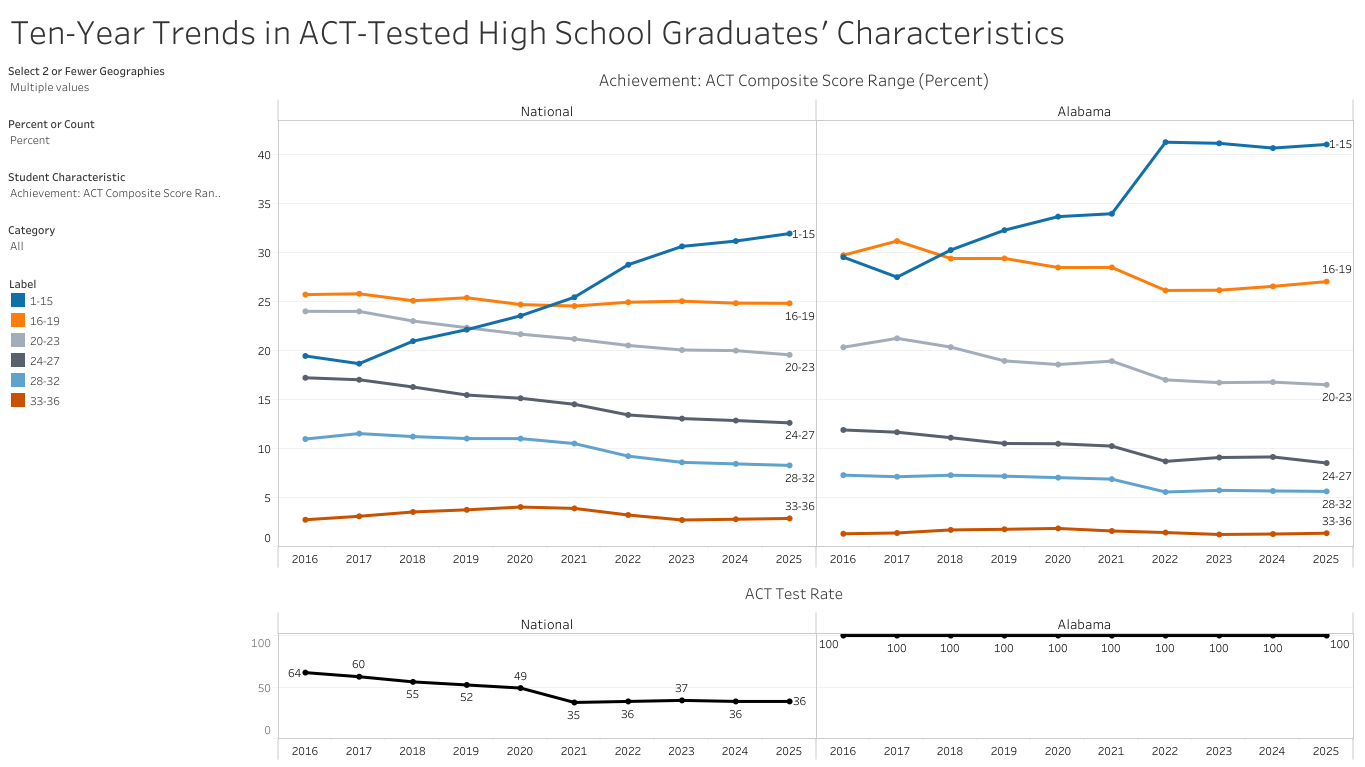
Both in Alabama and nationally, average ACT scores peaked around 2017 and were declining incrementally until a steep drop in the wake of the pandemic. Several factors may have contributed to the drop.
Some of the drop could be attributed to disrupted teaching and preparation practices. Students from the Class of 2025 would have been in 8th grade in 2021 and would have experienced disrupted, remote schooling that year. Eighth grade is a crucial transition year that introduces the more advanced courses offered in high school and colleges, the kind of academic skills that the ACT measures.
When that cohort took the state standardized test in 2021, its scores were significantly lower than those posted by the cohorts that followed.
All Alabama public high school students take the ACT in school during their junior year. When the Class of 2025 took the ACT in 2024, they didn’t perform as well as the previous class or the succeeding class.
Changes in Motivation and the Test-Taking Pool
The post-pandemic score shifts might also be due to changes in who is taking the test, how many times they take it, and their motivation for taking the test.
Many colleges and universities suspended requiring the ACT in the college admissions process, which decreased the number of students taking the test nationally and also decreased the number of times students took the test in order to improve their scores. Some students, particularly those seeking admission to competitive colleges, take the test multiple times during their junior and senior years. The scores reported in this dataset are based on the best score students achieved over multiple attempts at the test.
Data from ACT indicates that, in the wake of the pandemic, the percentage of Alabama students with scores in the lowest tier increased from 34% of students to 41%. Students in this lowest tier scored 15 or below. Traditionally, most colleges have required scores above 15 for admission. Average entering ACT scores range from 18-20 for regional universities to 25 or above for the state’s flagships. When the test was required, students who scored in the lowest band would have retaken the test in order to qualify for admission. With test-optional admissions, they are less motivated to retake the test.
Students’ motivations may soon change. Auburn and the University of Alabama system will resume requiring the ACT for Class of 2027 applicants. That’s part of a national trend as more colleges and universities return to using scores for admissions and scholarship awards.
Below State-Level
While economically disadvantaged students still posted lower scores, non-poverty students in Alabama lost more ground on the ACT than economically disadvantaged students between 2024 and 2025.

In each subject, the percentage of non-poverty students scoring at or above the college-ready benchmark declined compared to 2024.
System-Level
In general, suburban systems with low rates of economic disadvantage post the highest average ACT scale scores, but a handful of systems with elevated rates of economic disadvantage outperform. Piedmont City Schools, where 61% of students are economically disadvantaged, and Winfield City Schools, where 49% of students are economically disadvantaged, both placed in the top 10 in average scale scores.

School Level
At the school level, magnet schools also tend to generate high average ACT scale scores. Montgomery County’s Loveless Academic Magnet Program (LAMP) continues to lead the state. A Huntsville magnet, New Century High Technology High School, also places among the top five.

Most improved
Attalla City Schools showed the most improvement among school systems this year, with Scottsboro, Jacksonville, and Winfield city school systems and Winston and Clay County systems improving their average composite scores by 1 point or more.

Use the tabs to move between different views of the data and use the menus to focus in on the systems, schools, or subjects that you are most interested in.
Comparisons to other states
Alabama’s ACT scores should not be compared to the national average score. Across the country, the percentage of students who take the ACT varies widely by state. Alabama and eight other states use the ACT to test all public high school students. Six more states test more than 90% of students. Among those states, Alabama ranks ahead of Mississippi, Arizona, Oklahoma, and Nevada. In terms of the percentage of students scoring above the benchmark, Alabama is strongest in English and weakest in math.
