

Mental Health and Substance Abuse Ranks #4 Among Alabama Voter Priorities

In late 2017, the Public Affairs Research Council of Alabama (PARCA) surveyed Alabama voters to determine their thoughts about the general direction of the state and the issues that most concern them. PARCA partnered with Samford University to survey policy professionals from across the state including academics, journalists, business and nonprofit leaders, and lobbyists. Their responses provided a list of 17 critical issues facing Alabama. PARCA partnered with USA Polling at the University of South Alabama to ask registered voters about these 17 issues. The voters’ responses generated the Top Ten list of voter priorities. Details about the survey and its methodology can be found in the full Alabama Priorities report.

Alabama Priorities

1. K-12 Education
2. Healthcare
3. Government Corruption and Ethics
4. Mental Health and Substance Abuse
5. Poverty and Homelessness
6. Jobs and the Economy
7. Crime and Public Safety
8. Job Training and Workforce Development
9. Improving the State's Image
10. Tax Reform

Key Findings

  • Voters broadly agree on the critical issues facing the state.
  • Voters are not polarized along traditional political, ideological, racial, or generational lines. There is a significant gap between the priorities of experts and the priorities of voters.
  • Policymakers have an opportunity to inform and educate voters on critical and systemic challenges facing the state.
  • Policymakers have an opportunity to respond to immediate, often highly personal issues that concern voters.
  • Elected officials and candidates have an opportunity to show leadership and to build broad coalitions to address Alabama’s most pressing challenges.

This summer and fall, PARCA will produce summary briefs on each of the top ten priorities chosen by Alabama voters. Each brief will answer four critical questions: what is the issue, why it matters, how Alabama compares, and what options are available to Alabama policymakers.

#4: Mental Health and Substance Abuse

What is the issue?

Alabama voters rank mental health and substance abuse as the 4th most important issue facing Alabama, with 56% of respondents indicating they were very concerned about the issue. A plurality of Millennials and majority of voters of every other generation are very concerned about the issue. These findings are in keeping with the State’s Community Health Improvement plan, which found Alabamians rank mental health as the second greatest health concern.[1]

Mental illness includes a range of mental health conditions from mild anxiety, treatable with counseling, all the way to major psychiatric issues requiring psychotropic medication and long-term hospitalization.

An estimated 43.6 million Americans from all backgrounds suffer from mental illness or substance abuse. If current trends continue, by 2020, there will be more people suffering from mental and substance abuse disorders than people suffering from all physical diseases worldwide.[2]

Mental illness and substance abuse disorders share some underlying causes, including changes in brain composition, genetic vulnerabilities, and early exposure to stress or trauma.[3] Individuals that suffer from drug addiction frequently experience one or more symptoms of mental health issues.[4]

Experiencing both mental illness and substance abuse, what professionals call a dual-diagnosis, is very common.

Why Does it Matter?

Mental illness and substance abuse can alter reasoning skills, coping mechanisms, emotions, and behavior. This can have a profound impact on the individual and family, but also on the broader society.

Serious and untreated mental health concerns, including substance abuse, can place a strain on the communities by increasing unemployment, crime, and healthcare costs. Substance abuse alone has been estimated to cost $504 billion in direct and indirect costs, including lost productivity, in 2015 alone.[5]

Left untreated, mental health and substance abuse disorders can hinder an individual’s ability to live a healthy, confident life, and the ability to be productive members within the community. Untreated mental health and substance abuse issues can be significant contributing factors to job loss, homelessness, criminal behavior, and premature death. Suicide and drug-related deaths have increased in the nation in recent years with suicide ranked 11th in 2014 as the leading cause of death.[6]

More than one in four adults living with a severe mental health issue is also struggling with substance abuse issues. The effects on the communities can have direct and indirect consequences. “Direct consequences can include injuries, social and legal problems, impaired health, overdose, deaths, and babies born with neonatal abstinence syndrome. Indirect consequences include higher health care costs, the spread of infectious diseases, drug-related crime, interpersonal violence, unintended pregnancy, and stress within families.”[7]

How Does Alabama Compare?

Mental health care and substance abuse are critical issues in Alabama. In 2014, Mental Health America ranked the fifty states and Washington, D.C. in a number of mental health categories.[8] Overall, in the composite ranking of 15 mental health metrics, Alabama ranked 41st, ahead of neighboring states South Carolina, Tennessee, Mississippi, but behind North Carolina, Florida, Arkansas, and Louisiana. Georgia led all Southeast states at 26. Alabama ranked 27th in overall adult mental health and 28th in overall youth mental health. Looking at individual components, Alabama ranked:

  • 30th in the number of adults suffering from any mental illness;
  • 18th in the number of adults suffering from acute suicidal ideation;
  • 9th in the number of youth suffering from a major depressive episode in the previous year;
  • 42nd in the number of adults diagnosed with any mental illness without insurance, representing 20.8% of the adult population; and
  • 48th in overall access to care, ahead of only Texas, South Carolina, and Mississippi.

In spite of all this, less than half (43.5%) of adults in Alabama living with mental illness have received any form of treatment.[9]

Alabama now faces the daunting task of combating the opioid crisis. In 2013, Alabama had the highest per capita number of opioid prescriptions in the country – 141.1 per 100 compared to the national average of 79.3 per 100 people. Since then, the rate has dropped to 120.3 per 100 in 2015 – but this number still represents 1.2 prescriptions for every man, woman, and child in Alabama.[10]

While Alabama ranks 34th in deaths from drug overdose, the number of overdose deaths continue to climb: from 169 in 1999 to 756 in 2016, a 347% increase.[11]

Lack of accessible care and lack of sufficient insurance coverage for substance users exacerbates the issue. There is a high correlation between availability of preventative mental health services and mental health treatment. Alabamians have less access to mental health services than do residents of many other states.

What Can We Do?

Access to Care

One of the most significant factors facing mental health and addiction treatment in Alabama is simply the lack of access. Alabama has one mental health provider for every 1,180 people. Mental health providers include psychiatrists, psychologists, licensed clinical social workers, counselors, marriage and family therapists, and advanced practice nurses who specialize in mental health. However, at the county level, the ratio ranges from 270:1 (Macon County) to 33,840:1 (Chambers County).[12] Focusing on just substance abuse, statewide, there are 505 beds for residential and high-intensity residential substance abuse treatment – and these beds are located in just 13 counties. There is a waiting list of 319 people.

Individuals without insurance may wait for months to see a mental health professional. More often than not, this results in a crisis that ends with the individual in the hospital or jail. In effect, Alabama’s hospital emergency departments, jails, and prisons serve as de facto mental health providers. At the same time, while most people know how to access physical health care, people may be less familiar with when and how to access mental health care.

  • The state could expand Mental Health First Aid, described as ‘CPR’ for mental health, and Crisis Intervention Training for law enforcement personnel.
  • The state could also explore a waiver, which would allow Medicaid to fund treatment of substance abuse.
  • The state could explore expanding access to substance abuse treatment, particularly residential treatment. There are currently no substance abuse facilities, public or private, in Autauga, Bullock, Coosa, Lawrence, Lowndes, Perry, Washington, or Wilcox Counties.

Mental Health Workforce

Access is largely, but not exclusively, a function of size of the mental health workforce. Alabama faces a growing workforce shortage in many industries, including mental health services. There is a particular shortage for trained professionals serving the elderly. Unaddressed, this shortage will escalate as the senior population is growing faster than other age groups.

  • The state could explore incentives to attract and retain mental health professionals.
  • The state could explore licensure regulations to allow all medical professionals to practice at the highest levels of their training and certification.

Social Stigma

Mental health experts recognize that even if there were sufficient mental health providers, there is still a significant stigma attached to accessing treatment for mental health or substance abuse issues. Moreover, often when treatment is sought, the individual is already in a state of crisis, rather than seeking care earlier.

  • The state could seek to reduce the stigma by promoting and expanding peer programs—mental health services led by, or in conjunction with a person who has experienced mental illness himself or herself.
  • The state could develop an awareness campaign for the general public.

Standards of Care

There are a number of evidence-based and standards of care treatments that could be considered for expansion or modification in Alabama.

  • The use of medication to treat opioid addiction could be expanded.
  • The state could require healthcare professionals who prescribe medication treatment for addiction, do so only in consultation with a trained mental health professional.
  • The number of state-funded residential beds for substance abuse treatment could be expanded.
  • The number of nonprofit or low-cost methadone clinics for those with heroin addictions who suffer multiple relapses could be expanded.
  • The state could create a harm reduction program for opioid users, which includes education, counseling, referrals to treatment, and needle services and which has been shown to reduce the spread of HIV and Hepatitis C and increase the likelihood an individual will seek treatment.
  • The state could expand mental health and substance abuse treatment in the corrections system, which could also help reduce recidivism rates.

Drafted by Anita Perry, graduate student, Department of Social Work, Samford University, and the staff of the Public Affairs Research Council of Alabama.

Full PDF report available here.

[1] Alabama Department of Public Health, State of Alabama Community Health Improvement Plan (2015), http://www.adph.org/accreditation/assets/CHIP_2015_RevAugust.pdf.

[2] Rosenberg, L. 2012. “Behavioral disorders: the new public health crisis.Journal of Behavioral Health Services & Research 39(1):1-2.

[3]  U.S. Department of Health and Human Services, “Mental Health and Substance Use Disorders” (2017), https://www.mentalhealth.gov/what-to-look-for/mental-health-substance-use-disorders.

[4]  U.S. Department of Health and Human Services, “Mental Health and Substance Use Disorders” (2017), https://www.mentalhealth.gov/what-to-look-for/mental-health-substance-use-disorders.

[5] U.S. Department of Health and Human Services, Substance Abuse and Mental Health Services Administration, Facing Addiction in America: The Surgeon General’s Report on Opioids (2018), https://addiction.surgeongeneral.gov/sites/default/files/surgeon-generals-report.pdf.

[6] U.S. Department of Health and Human Services, Substance Abuse and Mental Health Services Administration, Facing Addiction in America: The Surgeon General’s Report on Opioids (2018), https://addiction.surgeongeneral.gov/sites/default/files/surgeon-generals-report.pdf.

[7] Walden, Nicole. “The Opioid Crisis in Alabama” Alabama Department of Mental Health, November 27, 2017, http://www.alabamapublichealth.gov/alphtn/assets/112717handouts.pdf.

[8] Mental Health America, “The State of Mental Health in America, 2018” (2018), http://www.mentalhealthamerica.net/issues/state-mental-health-america.

[9] U.S. Department of Health and Human Services, Substance Abuse and Mental Health Services Administration, Behavioral Health Barometer Alabama, 2015, (2015), https://www.samhsa.gov/data/sites/default/files/2015_Alabama_BHBarometer.pdf.

[10] National Institute on Drug Abuse, “Alabama Opioid Summary” (2018), https://www.drugabuse.gov/drugs-abuse/opioids/opioid-summaries-by-state/alabama-opioid-summary

[11] U.S. Department of Health and Human Services, Centers for Disease Control, “Drug Overdose Mortality by State: 2016” (2018), https://www.cdc.gov/nchs/pressroom/sosmap/drug_poisoning_mortality/drug_poisoning.htm

[12] Robert Wood Johnson, 2018 County Health Rankings, (2018), http://www.countyhealthrankings.org/app/alabama/2018/measure/factors/62/map


Poverty and Homelessness Ranks #5 Among Alabama Voter Priorities

In late 2017, the Public Affairs Research Council of Alabama (PARCA) surveyed Alabama voters to determine their thoughts about the general direction of the state and the issues that most concern them. PARCA partnered with Samford University to survey policy professionals from across the state including academics, journalists, business and nonprofit leaders, and lobbyists. Their responses provided a list of 17 critical issues facing Alabama. PARCA partnered with USA Polling at the University of South Alabama to ask registered voters about these 17 issues. The voters’ responses generated the Top Ten list of voter priorities. Details about the survey and its methodology can be found in the full Alabama Priorities report.

Alabama Priorities

1. K-12 Education
2. Healthcare
3. Government Corruption and Ethics
4. Mental Health and Substance Abuse
5. Poverty and Homelessness
6. Jobs and the Economy
7. Crime and Public Safety
8. Job Training and Workforce Development
9. Improving the State's Image
10. Tax Reform

Key Findings

  • Voters broadly agree on the critical issues facing the state.
  • Voters are not polarized along traditional political, ideological, racial, or generational lines. There is a significant gap between the priorities of experts and the priorities of voters.
  • Policymakers have an opportunity to inform and educate voters on critical and systemic challenges facing the state.
  • Policymakers have an opportunity to respond to immediate, often highly personal issues that concern voters.
  • Elected officials and candidates have an opportunity to show leadership and to build broad coalitions to address Alabama’s most pressing challenges.

In the following months, PARCA will produce summary briefs on each of the top ten priorities chosen by Alabama voters. Each brief will answer four critical questions: what is the issue, why it matters, how Alabama compares, and what options are available to Alabama policymakers.

#5: Poverty and Homelessness

What is the issue?

Poverty and homelessness is the 5th most important issue for Alabama voters, with 58% of voters indicating they are very concerned about the issue. Poverty and homelessness averaged 4.192 on 1–5 scale where 1 is “not at all concerned” and 5 is “very concerned.” The majority of every demographic and political group indicated they were very concerned about this issue.

Why are Poverty and Homelessness Important?

The standard measure of poverty is the percentage of people earning less than a specific dollar amount: the federal poverty line. The federal poverty line is adjusted for the number of people in a household and is revised annually. In 2018, the federal poverty line for a family of four is $25,100. Although the percent of the population living in poverty is in decline, over 39 million people were still in poverty in the U.S. in 2017. Poverty often creates a vicious cycle that can last generations. Poverty complicates and is complicated by almost every other challenge facing Alabama and the nation.

The U.S. Department of Housing and Urban Development defines homelessness, in part, as lacking a fixed, regular, and adequate nighttime residence or a primary residence that was not designed for or ordinarily used as a regular sleeping accommodation for people. On a single night in 2017, an estimated 553,742 people were homeless in the United States. Homeless experts and advocates question the appropriateness of the definition and the accuracy of the number, some suggesting the number to be almost double.[1]

Homelessness can:

  • create new health problems and exacerbate existing ones;[2]
  • increase the chances of entering the criminal justice system and increase the recidivism rate;[3]
  • increase substance misuse;[4] and
  • have a negative economic impact on the larger community.

How Does Alabama Compare?

Population in Poverty

The percent of the population in Alabama living below the federal poverty level has declined from 19% in 2010 to 16.9% in 2017, mirroring declines at the national level. However, the percent of people living below the poverty level in Alabama is still higher than that of the nation. In 2017, Alabama had the 6th highest poverty rate in the U.S. and the fourth highest poverty rate among 10 southeastern states.

Poverty sees no color – while black Alabamians are disproportionately poorer, with 27% living in poverty, white Alabamians are deeply affected as well, with 12% living below the poverty line.[5] Approximately thirty-one percent of Hispanics in Alabama live below the poverty line.

Children in Poverty

Similar to poverty in the total population, the percent of children living in poverty in Alabama is consistently higher than that of the nation. During the period 2010 to 2017, childhood poverty declined for the state, reaching 24.6% in 2017. When compared to southeastern states, the percentage of children in poverty in Alabama ranked higher than all states except Louisiana at 28% and Mississippi at 26.9%.

Homelessness

In 2017, there were an estimated 3,793 homeless people in Alabama, a decrease of 7.7% over the previous year and more than 37% since 2010. In the ten-year period between 2007 and 2017, Alabama’s homeless rate decreased at a faster rate than the national average – a 30% decrease in the state compared to a 14.4% decrease nationally. However, Alabama’s percentage change has been lower than a majority of its southeastern neighbors. Also, while homelessness in Alabama is trending in a positive direction, those still struggling with homelessness are sometimes those facing the most profound challenges, including addictions and mental health issues.

What Can We Do?

There is no single solution to reducing poverty or homelessness. As the causes are varied, complex, and differ from region to region across the state, so too must the responses. Private philanthropy and the faith community can do much to assist individuals and families, but the challenge is too large to be left to the private sector alone. Alabama could consider policy responses and interventions that have demonstrated success around the country, some of which are highlighted below.

  • Increased investment in education: in 2016, Alabama was 39th among U.S. states in per student spending.[6]
  • Expanded student and family support for students in Pre-K through 12th
  • Expanded investment in workforce development for under-employed and unemployed adults.
  • Expanded educational opportunities and supportive services for low-income adults.
  • Expanded access to primary healthcare, especially in rural parts of Alabama.
  • Increase family income for those in poverty through expanded employment (24% of survey respondents indicated the number of available jobs was their top economic priority) or increased wages (32% of respondents said increasing the minimum wage was their top economic priority).
  • Implement a statewide housing first model to address homelessness.

Read full PDF report here.       

[1] National Coalition for the Homeless. “Current State of Homelessness” April 2018 http://www.nationalhomeless.org/

[2] National Health Care For The Homeless Council. “Homelessness & Health: What’s The Connection?”, Fact Sheet, June 2011 https://www.nhchc.org/wp-content/uploads/2011/09/Hln_health_factsheet_Jan10.pdf

[3] Volunteers of America, “Homelessness and Prisoner Re-Entry”, https://www.voa.org/homelessness-and-prisoner-reentry

[4] National Coalition for the Homeless, “Substance Abuse and Homelessness” July 2009. http://www.nationalhomeless.org/factsheets/addiction.pdf

[5] Census Bureau’s Population Estimates Program. (2017). 2017 American Community Survey 1-Year Estimates. [Data file]. Retrieved from https://factfinder.census.gov/faces/tableservices/jsf/pages/productview.xhtml?pid=ACS_15_1YR_S1701&prodType=table

[6] “Annual Survey of School System Finances” U.S. Census Bureau https://www.census.gov/programs-surveys/school-finances.html


PARCA Annual Survey Addresses Representation in State Government, Public Education and Payday Loans

PARCA collaborated with Samford University to conduct our annual telephone survey of Alabama citizens between June 4 and July 18, 2018. The survey was directed by Dr. Randolph Horn and was under the field direction of Grace Okoro.

The survey addressed topics including the quality of representation in state government, and, in partnership with the Alabama Association of School Boards, questions about public education in Alabama, and, in partnership with the Community Foundation of Greater Birmingham, questions about payday loans.

Many trends remained the same from previous years, but some of the results were surprising.

Read the full report here. (PDF)


Jobs and the Economy Ranks #6 Among Alabama Voter Priorities

In late 2017, the Public Affairs Research Council of Alabama (PARCA) surveyed Alabama voters to determine their thoughts about the general direction of the state and the issues that most concern them. PARCA partnered with Samford University to survey policy professionals from across the state including academics, journalists, business and nonprofit leaders, and lobbyists. Their responses provided a list of 17 critical issues facing Alabama. PARCA partnered with USA Polling at the University of South Alabama to ask registered voters about these 17 issues. The voters’ responses generated the Top Ten list of voter priorities. Details about the survey and its methodology can be found in the full Alabama Priorities report.

Alabama Priorities

1. K-12 Education
2. Healthcare
3. Government Corruption and Ethics
4. Mental Health and Substance Abuse
5. Poverty and Homelessness
6. Jobs and the Economy
7. Crime and Public Safety
8. Job Training and Workforce Development
9. Improving the State's Image
10. Tax Reform

Key Findings

  • Voters broadly agree on the critical issues facing the state.
  • Voters are not polarized along traditional political, ideological, racial, or generational lines. There is a significant gap between the priorities of experts and the priorities of voters.
  • Policymakers have an opportunity to inform and educate voters on critical and systemic challenges facing the state.
  • Policymakers have an opportunity to respond to immediate, often highly personal issues that concern voters.
  • Elected officials and candidates have an opportunity to show leadership and to build broad coalitions to address Alabama’s most pressing challenges.

In the following months, PARCA will produce summary briefs on each of the top ten priorities chosen by Alabama voters. Each brief will answer four critical questions: what is the issue, why it matters, how Alabama compares, and what options are available to Alabama policymakers.

#6: Jobs and the Economy

What is the issue?

Alabama voters ranked jobs and the economy as the 6th most important issue, with 56% of respondents indicating they were very concerned about this issue. The issue ranked highly across all subgroups: political affiliations, generations, gender, and  education level, and race. The only substantive difference in subgroups found was in ideology, where the issue ranked lower for liberals than for conservatives or moderates.

Voters were also asked to identify their top priorities regarding jobs and the economy, selecting from the number of available jobs, availability of qualified workers, wage growth, or increasing the minimum wage. Thirty-two percent of respondents selected increasing the minimum wage as their top priority; 24% identified number of available jobs, followed by availability of qualified workers at 22%. Wage growth was found to be least important and was selected by 18% of respondents.

Why are Jobs and the Economy Important?

 A growing economy and a high employment rate support many measures of overall well-being, including household income, health, housing stability, tax revenue, and more.[1]  Economic growth:

  • is the most fundamental indicator of an economy’s health,[2]
  • is an important indicator contributing to poverty reduction;[3]
  • can create job opportunities and hence stronger demand for labor;[4]
  • can improve standards of living and health;[5]
  • can improve educational attainment;[6] and
  • can improve technology and infrastructure.[7]

How Does Alabama Compare?

There are numerous indicators used to determine jobs and economic growth. We consider four of the most commonly used measures, although there is much debate that these measures tell the entire story.

Gross Domestic Product

Economic health is most typically measured by the growth rate of the Gross Domestic Product (GDP), a comprehensive value of all goods and services produced.[8] Like the U.S., Alabama has enjoyed GDP growth every year between 2009 and 2017, although the state has grown at a slower rate than the nation. The state saw its lowest percentage increase of 1.9% from 2013 to 2014 and ranked only higher than Mississippi (1%) among southeastern states. Alabama’s GDP increased 3.3% from 2016 to 2017, exceeding the growth rate in Arkansas and Mississippi, but trailing other southeastern states.

Median Household Income

Median household income is the income figure that divides all households into two equal groups, with half earning more than the income and half earning less. Median income in Alabama increased annually since 2010. In 2016, according to American Community Survey 1-year estimates, Alabama’s median household income was $46,257 – 46th among all states, more than $10,000 below the national average. When compared to other Southeastern states, Alabama fared worse than all except Louisiana ($45,146), Arkansas ($44,334) and Mississippi ($41,754).

Poverty

Poverty is measured as the percentage of people earning less than a specific dollar amount: the federal poverty line. The federal poverty line is adjusted for the number of people in a household and is revised annually. The percent of population in Alabama living below the federal poverty level has declined from 19% in 2010 to 17.1% in 2016, mirroring declines at the national level. However, the percent of people living below the poverty level in Alabama is still higher than that of the nation. When compared to 10 states in the Southeast, Alabama’s poverty rate ranked 5th highest in 2016 and 7th highest among all states.

Unemployment Rate

Alabama’s unemployment rate is also decreasing, as is the national rate. In 2013, Alabama’s unemployment rate was 7.2%. By 2017, the figure had declined to 4.4%. The state’s rates are comparable to that of the U.S. during this same period. Nationally, unemployment fell from 7.4% in 2013 to 3.8% at the end of 2017. Alabama’s unemployment rate (4.4%) ranked 5th lowest among 10 Southeastern states, where Arkansas had the lowest unemployment rate of 3.7% and Mississippi had the highest of 5.1%.

What Can We Do?

The state has numerous options to support a robust economy and a strong job market, including:

  • increased investment in education: in 2016, Alabama was 39th among the states in per student spending;[9]
  • increased investment in healthcare; in 2014, state-level per capita healthcare spending was 9% lower than the national average, suggesting lower levels of insurance coverage and healthcare access;[10]
  • increased investment in infrastructure: Alabama’s infrastructure was graded a C- in a recent study by civil engineers[11]. For more in infrastructure, see PARCA’s 2017 report, How Alabama Roads Compare.[12]
  • developing an adequate, fair, and efficient tax structure: Alabama collects the least amount in state and local revenue per capita of any state in the nation. See How Alabama Taxes Compare.[13]
  • continuing ongoing work to align K-12 and post-secondary education and training offerings with the needs of employers, increasing opportunities for students and workforce quality for employers.

Although we considered four of the most commonly used measures, we cannot ignore the fact that economic growth is difficult to measure or even define. Many studies have shown both pros and cons of using the above indicators to measure growth. For example, authors have argued the validity of using unemployment rate as a measure of growth, considering the increasing number of part-time jobs versus full-time jobs.[14]  Others have argued the difficulty of measuring growth based on indicators such as standard of living, given the lack of, or consistency of data. However, this article seeks only to highlight a snapshot of Alabama’s economy and how the state compares nationally, using consistent data for all states. More comprehensive research should be done to gain more insight into changes in the state’s jobs and economy over time.

Drafted by Kenesha Reynolds-Allie, Ph.D. and the Staff of the Public Affairs Research Council of Alabama

Read the full PDF report here.


[1] Good Growth for Cities 2017, A report on urban economic wellbeing from PWC and Demos, November 2017. https://www.pwc.co.uk/government-public-sector/good-growth/assets/pdf/2017-good-growth-for-cities.pdf

[2] Bolton, S. and Khaw S., “Economic Growth”, July 2006. https://www.theguardian.com/business/2006/jul/10/ukeconomy.globalrecession

[3] Adams Jr., Richard. H, “Economic Growth, Inequality, and Poverty”, The world Bank, Poverty Reduction and Economic Management Network, February 2003.

[4] Department for International Development (DFID), “Growth: Building Jobs and Prosperity in Developing Countries” https://www.oecd.org/derec/unitedkingdom/40700982.pdf

[5] Weil, D.N. “Economic Growth”, 3rd Edition, Harlow Pearson Education Limited, 2013. Rivera IV, B., and Currais, L., “Economic Growth and Health Direct Impact or Reverse Causation”, Applied Economics Letters, 6(11), 761-764.

[6] The World Bank (2007), “Education Quality and Economic Growth”

[7] Canning, D., and Pedroni, P., “Infrastructure and Long Run Economic Growth”, Consulting Assistance on Economic Reform II Discussion Paper, 57.

[8] Bureau of Economic Analysis, U.S. Department of Economic Analysis. https://www.bea.gov

[9] “Annual Survey of School System Finances” U.S. Census Bureau https://www.census.gov/programs-surveys/school-finances.html

[10] A state-by-state breakdown of per capita healthcare spending. https://www.beckershospitalreview.com/finance/a-state-by-state-breakdown-of-per-capita-healthcare-spending.html

[11] American Society of Civil Engineers, “Report Card for Alabama’s Infrastructure”, 2015. https://www.infrastructurereportcard.org/wp-content/uploads/2016/10/ASCE-AL-Report-Card-2015-Full-Report-FINAL-web.pdf

[12] How Alabama Roads Compare. 2017. Public Affairs Research Council of Alabama. https://parcalabama.org/how-alabama-roads-compare-ninth-edition-2017/

[13] How Alabama Taxes Compare. 2017. Public Affairs Research Council of Alabama. https://parcalabama.org/how-alabama-taxes-compare/

[14] Jericho, Greg, “Why unemployment is no longer the best indicator of the economy’s health” https://www.theguardian.com/business/grogonomics/2016/aug/22/why-unemployment-is-no-longer-the-best-indicator-of-the-economys-health


Crime and Public Safety Ranks #7 Among Alabama Voter Priorities

In late 2017, the Public Affairs Research Council of Alabama (PARCA) surveyed Alabama voters to determine their thoughts about the general direction of the state and the issues that most concern them. PARCA partnered with Samford University to survey policy professionals from across the state including academics, journalists, business and nonprofit leaders, and lobbyists. Their responses provided a list of 17 critical issues facing Alabama. PARCA partnered with USA Polling at the University of South Alabama to ask registered voters about these 17 issues. The voters’ responses generated the Top Ten list of voter priorities. Details about the survey and its methodology can be found in the full Alabama Priorities report.

Alabama Priorities

1. K-12 Education
2. Healthcare
3. Government Corruption and Ethics
4. Mental Health and Substance Abuse
5. Poverty and Homelessness
6. Jobs and the Economy
7. Crime and Public Safety
8. Job Training and Workforce Development
9. Improving the State's Image
10. Tax Reform

Key Findings

• Voters broadly agree on the critical issues facing the state.
• Voters are not polarized along traditional political, ideological, racial, or generational lines. There is a significant gap between the priorities of experts and the priorities of voters.
• Policymakers have an opportunity to inform and educate voters on critical and systemic challenges facing the state.
• Policymakers have an opportunity to respond to immediate, often highly personal issues that concern voters.
• Elected officials and candidates have an opportunity to show leadership and to build broad coalitions to address Alabama’s most pressing challenges.

In the following months, PARCA will produce summary briefs on each of the top ten priorities chosen by Alabama voters. Each brief will answer four critical questions: what is the issue, why it matters, how Alabama compares, and what options are available to Alabama policymakers.

#7: Crime and Public Safety

What is the Issue?

Alabama voters ranked crime and public safety as the 7th most important issue among the priorities, with approximately 58% of voters indicating they were very concerned about the issue. The issue averaged 4.10 on a 1 – 5 scale where 1 is “not at all concerned” and 5 is “very concerned.”

Majorities of every racial group are very concerned about this issue. Approximately three-quarters of African-Americans say they are very concerned. Respondents with lower incomes are more likely to say they are very concerned than respondents with higher incomes. While majorities of conservatives and liberals say they are very concerned, only a plurality (more than any other category but not a majority) of self-described moderates holds this view.

Survey respondents were also asked about their top policy responses to crime and public safety. Twenty-seven percent of voters were more concerned about the number of police, 24% civil liberties, and lesser percentages identifying sentencing reform and conditions of state prisons as their top priority.

Why Is Crime and Public Safety Important?

In previous generations, a basic high school education was sufficient for entry into the workforce. Today, an increasing share of entry-level jobs require a level of training beyond a high school diploma. To generate a prepared workforce, there is continued need to improve preparation for and access to two and four-year colleges. However, the demand for advanced training is also being addressed by K-12 schools, where students are increasingly presented with options for earning industry-recognized credentials while still in high school. Certificate programs are being expanded for new graduates and current workers.

Alabama has enjoyed an unprecedented run of industrial recruitment and new job creation. According to the Alabama Department of Commerce, the state has added or announced 138,197 new jobs between 2010 and 2017. In that same time, employment in Alabama has grown from 1,893,169 to 2,081,176 – an increase of 188,007, and the unemployment rate has fallen to 3.8% (December 2017). Recent monthly unemployment rates for the state have hovered between 3.7 and 4.1%, the lowest numbers since at least 1976. Despite the surging demand for labor, Alabama’s population growth has been sluggish, creating a tight labor market and a pending shortage of workers.

How Does Alabama Compare?

Crime has many negative impacts on a community.

Crime and the response to crime create a large economic and social cost, including the direct economic losses suffered by victims and the costs of police protection, legal services, and corrections.

Crime data and perceptions of public safety are widely used in quality of life rankings, which can impact the perceived livability and desirability of a community.[1]

High crime rates deter business. Crime can reduce the size and skills of the labor force. Crime can have a negative impact on education and training, diminishing the long-term creativity and innovative capacity of a community. Crime can deter business investment and location.

The economic, societal, familial, and personal costs of incarceration are immense.

Public safety plays a crucial role in supporting economic growth and vitality by reducing the cost of crime and enhancing the desirability of communities as places to live and locate businesses and has a direct impact on the levels of societal trust and interaction.[2]

How Does Alabama Compare?

The Crime Rate

Alabama reported 532.3[3] violent crimes per 100,000 residents in 2016, placing Alabama 8th highest in the nation for violent crimes. Alabama fared worse than most Southeastern states, except Tennessee, Louisiana and Arkansas. The state fared somewhat better in terms of property crimes, ranking 14th in the nation. Alabama’s property crime index for 2016 was 2,947.8 per 100,000 residents but was lower than that of only four Southeastern states. When violent and property crimes are considered together, Alabama ranked 9th in the nation with a crime index of 3,480.1 per 100,000 residents.

According to the Alabama Law Enforcement Agency’s annual crime report[4], total crime in the state has decreased from 2011 to 2015 but increased roughly 2% from 2015 to 2016.

However, during this same period, the number of violent crimes increased every year except between 2012 and 2014. Violent crime in the state increased from 405.5 per 100,000 residents in 2014 to 518.2 in 2016.

Although the number of violent crimes increased significantly over that two-year period, the number of crimes cleared has been decreasing.[5] In 2014, 45% of violent crimes were cleared, but that percentage decreased to 39% in 2016. The clearance rate for total crime in the state has also been declining over the same period.

The Incarceration Rate

In 2016, there were 27,799 inmates in Alabama prisons, a rate of 633 people per 100,000 – the 3rd highest incarceration rate in the U.S. The state’s incarceration rate is significantly higher than the national rate of 471 per 100,000 residents and lower than only Oklahoma and Louisiana; 700 and 816 per 100,000 residents, respectively.

The high number of incarcerations makes the state’s prisons the most overcrowded in the country; housing almost twice the number of inmates the facilities were designed to house.

In addition to a high incarceration rate, the ratio of supervising probation and parole officers to probationers, parolees, and offenders poses a significant problem for the state’s system. At the end of fiscal year 2017, the total caseload average per officer on any given day was measured at 169 to 1. When broken down by total and active caseloads, the active caseload average per officer was 110 to 1. The American Probation and Parole Association (APPA) recommended caseload is 20 probationers per probation officer for intensive supervision, 50 to 1 for moderate to high-risk offenders, and 200 to 1 for low-risk offenders.

The Recidivism Rate

Recidivism, which refers to a person’s relapse into criminal behavior and is measured by criminal acts that result in rearrests, reconviction, or return to prison within three years, is a major driver of incarceration rates.

In 2017, the recidivism rate in Alabama was 31.5%, including all cohorts.[6] The high percent of recidivists continues to negatively impact the state’s prison system which is already overburdened. It also sheds light on the need for more effective programs to help released prisoners readjust to their communities and rebuild their lives.

Juvenile Detention

The percentage of violent crimes and property crimes committed by juveniles in Alabama decreased since 2013. As of 2016, juveniles account for 6% of violent crimes and property crimes.

Despite the decline in juvenile crime, the number of detained juveniles is also a cause for concern. Alabama’s juvenile custody rate of 184 per 100,000 youths places the state 20th in the nation. When compared to Southeastern states, the state ranked 3rd with only Arkansas and Virginia having higher rates.

There is a long-term impact on juveniles with criminal convictions that goes beyond the immediate effect to individual and family. A study from University of Pittsburgh found that 52% to 57% of juvenile delinquents continue to offend up to the age of 25, and about 16 – 19% up to the age of 30.[7]

Funding

Like many parts of state government, Alabama’s corrections and justice systems struggle with funding. Alabama spends less on corrections than a majority of states across the country.

According to the Alabama Department of Corrections 2017 Annual Report, Alabama spent $52.07 per day per inmate, compared to the national average of $99.45.

Alabama’s low per inmate spending may be seen as a positive by some. However, it is important to remember that with this level of spending comes a Department of Corrections that is understaffed, pays the lowest of any public safety agency in the state, and which suffers from very high turnover rates. The state’s corrections spending also contributes to legal issues facing the state. Alabama is currently engaged in two different lawsuits concerning the healthcare and conditions of Alabama’s prisons. It is highly likely that the outcome of these cases will result in court-mandated increases in Alabama’s corrections budget.

Beyond funding Alabama’s prison system, Alabama’s funding for judicial, legal and police protection is also low. Based on 2016 expenditure data from the Bureau of Justice Statistics, Alabama’s justice system expenditures, which include police protection, judicial and legal, and corrections, were low when compared to more than 30 states across the country and most Southeastern states. In 2016, the state spent $2.5 billion, while other southeastern states spent a significantly higher amount (example Florida’s 2016 expenditures totaled roughly $14 billion and Georgia approximately $6 billion).

What Can We Do?

The state has made recent attempts to address overcrowding in prisons, the high rate of supervision caseloads, and the lack of treatment in the community. In 2015, the state passed the Justice Reinvestment Act (Act 2015-185), which strengthened community-based supervision as an alternative to prison, while prioritizing prison space for violent and dangerous offenders. The legislation also took steps to ensure supervision for everyone upon release from prison. Since then, the state’s prison population has decreased by 15%, and more than 100 new probation and parole officers have been hired to help reduce officers’ caseloads.

In June 2018, the Alabama Department of Corrections announced pay raises of 5% for correctional officers at medium security facilities and 10% for officers at maximum security facilities.

Further reductions of the inmate population will be challenging, and additional investment in the prison system will be fiscally and politically difficult – although court orders may leave the state with no choice.

There are additional options the state can explore, including:

  • Continued expansion of day reporting facilities[8] and related programs designed to reduce recidivism;
  • Explore recommendations of the Alabama Juvenile Justice Task Force[9] designed to reform the retention of juvenile offenders; and
  • Expand mental health and drug treatment options both inside state prisons and in local communities.


Drafted by Kenesha Reynolds-Allie, Ph.D. and the Staff of the Public Affairs Research Council of Alabama

View the full PDF report here.


[1] Blair, J.P., “Quality of life and economic development policy”, Economic Development Review 16, 1998.

[2] Keeling, Mary and Mark Cleverly, “Accelerating economic growth and vitality through smarter public safety management”, IBM Institute for Business Value, Executive Report.

[3] Crime index (violent and property crimes) was calculated using 2016 Crime in the United States (CIUS) data from the Federal Bureau of Investigation (FBI) Uniform Crime Reporting (https://ucr.fbi.gov/crime-in-the-u.s)  and 2016 population estimates from the U.S. Census Bureau, Population Division (https://www.factfinder.census.gov)

[4] http://www.alea.gov/Home/wfContent.aspx?PLH1=plhACJIC-CrimeInAlabama

[5] A clearance is a measure of law enforcement activity whereby enough evidence is found to charge a suspect and take him into custody (an arrest) or when a crime is solved but no formal charges are brought against a suspect (clearance by exceptional means).

[6] Alabama Department of Corrections – FY2017 Annual Report (http://www.doc.state.al.us/StatReports)

[7] Stouthamer-Loeber, Magda, “Persistence and Desistance in Offending” (unpolished report, Pittsburg, Pa.: Life History Research Program, University of Pittsburg, 2010).

[8] Board of Pardons and Paroles, 2017 Annual Report http://www.pardons.state.al.us/Reports.aspx

[9] Alabama Juvenile Justice Task Force Final Report, December 2017. http://dys.alabama.gov/images/task_force/AL%20JJ%20Task%20Force%20Report_FINAL.pdf


Job Training and Workforce Development Ranks #8 Among Alabama Voter Priorities

In late 2017, the Public Affairs Research Council of Alabama (PARCA) surveyed Alabama voters to determine their thoughts about the general direction of the state and the issues that most concern them. PARCA partnered with Samford University to survey policy professionals from across the state including academics, journalists, business and nonprofit leaders, and lobbyists. Their responses provided a list of 17 critical issues facing Alabama. PARCA partnered with USA Polling at the University of South Alabama to ask registered voters about these 17 issues. The voters’ responses generated the Top Ten list of voter priorities. Details about the survey and its methodology can be found in the full Alabama Priorities report.

Alabama Priorities

1. K-12 Education
2. Healthcare
3. Government Corruption and Ethics
4. Mental Health and Substance Abuse
5. Poverty and Homelessness
6. Jobs and the Economy
7. Crime and Public Safety
8. Job Training and Workforce Development
9. Improving the State's Image
10. Tax Reform

Key Findings

• Voters broadly agree on the critical issues facing the state.
• Voters are not polarized along traditional political, ideological, racial, or generational lines. There is a significant gap between the priorities of experts and the priorities of voters.
• Policymakers have an opportunity to inform and educate voters on critical and systemic challenges facing the state.
• Policymakers have an opportunity to respond to immediate, often highly personal issues that concern voters.
• Elected officials and candidates have an opportunity to show leadership and to build broad coalitions to address Alabama’s most pressing challenges.

In the following months, PARCA will produce summary briefs on each of the top ten priorities chosen by Alabama voters. Each brief will answer four critical questions: what is the issue, why it matters, how Alabama compares, and what options are available to Alabama policymakers.

#8: Job Training & Workforce Development

What is the Issue?

Job training and workforce development is the 8th most important issue for Alabama voters with 51% of voters indicating they were very concerned about the issue. Job training and workforce development averaged 3.9 on a 1 — 5 scale where 1 is “not at all concerned” and 5 is “very concerned.”

The workforce development system is a diverse mix of public and private organizations working to prepare people for the workforce and help those already in the workforce to develop new skills. Workforce development efforts range from organizing large-scale hiring fairs, to designing and delivering industry and employer-specific training, to helping a single mother secure childcare while she takes GED classes.

The workforce development system serves job seekers and employees in need of developing and maintaining marketable skills, as well as employers, in need of a sufficient supply of future employees with the necessary skills. The system involves educators tasked with teaching basic skills to industry- and employer-specific training. It involves communities focused on talent attraction and retention. And it involves government agencies tasked with managing public funds and providing general workforce development oversight and coordination.

Taken together, the diverse components of the state’s workforce system work to provide a ready supply of labor, a healthy tax base, and a stable economy.

Why Does Workforce Development Matter?

In previous generations, a basic high school education was sufficient for entry into the workforce. Today, an increasing share of entry-level jobs require a level of training beyond a high school diploma. To generate a prepared workforce, there is continued need to improve preparation for and access to two and four-year colleges. However, the demand for advanced training is also being addressed by K-12 schools, where students are increasingly presented with options for earning industry-recognized credentials while still in high school. Certificate programs are being expanded for new graduates and current workers.

Alabama has enjoyed an unprecedented run of industrial recruitment and new job creation. According to the Alabama Department of Commerce, the state has added or announced 138,197 new jobs between 2010 and 2017. In that same time, employment in Alabama has grown from 1,893,169 to 2,081,176 – an increase of 188,007, and the unemployment rate has fallen to 3.8% (December 2017). Recent monthly unemployment rates for the state have hovered between 3.7 and 4.1%, the lowest numbers since at least 1976. Despite the surging demand for labor, Alabama’s population growth has been sluggish, creating a tight labor market and a pending shortage of workers.

How Does Alabama Compare?

Size of the Workforce

Between 2010 and 2017, Alabama’s net population growth was 2%. Alabama’s population is projected to surpass 5 million by 2025.1 Yet, the Pew Research Center projects it is unlikely that the Millennial labor force will reach the size of the Baby Boomer labor force. 4 The Generation X and Millennial generations are smaller in number than the Baby Boomer generation that is now reaching retirement age. In fact, 2017 Census estimates show that 51% of the working-age population (25 – 64) are older than 45. With the youngest Baby Boomers reaching age 65 in 2029, Alabama’s job growth is projected to surpass growth in its labor force. The University of Alabama’s Center for Business and Economic Development Research (CBER), project a workforce shortage in Alabama as high as 225,320 workers by 2024 with conditions continuing to worsen through 2040.

Skills of the Workforce

By 2020, 65% of all jobs in the United States will require education and training beyond high school. . As of 2017, only 43% of Alabama’s workforce has completed postsecondary education. Data on workers with in-demand credentials and training other than a post-secondary degree is unreliable, but the experience of business and industry leaders suggest that the number of workers with these credentials is insufficient.

Alabama workers face a gap in needed skills.

Alabama’s employers voice the need for improvement in employees’ skills, including basic and soft skills, such as communications and punctuality, needed to properly function in a work environment. A May 2017 CBER report defined six different skill types essential in the modern workforce: basic skills, complex problem-solving, resource management, social, systems, and technical skills. Already, many employers report that simply finding dependable workers with basic soft skills is an increasing challenge.

These challenges are by no means unique to Alabama. However, comparing workforces across states is complicated and ultimately unhelpful.

The Workforce System

State agencies, including the departments of Commerce, Education, Human Resources, Labor, the Community College System, and four-year institutions, distribute funds for workforce development from at least 18 different federal programs managed by three different federal agencies. The state agencies support, collaborate, or direct regional and local efforts, including regional workforce councils, workforce development boards, county and municipal governments, and nonprofits.

This diffuse network is tasked with serving the current and future workforce; including youth aged 14 – 24, adults in need of basic skills or with physical, mental, or financial obstacles, and workers looking for work or additional skills.

This basic structure is in place across the United States. However, the goals, requirements, funding, and schedules of these programs do not necessarily align.

What Can Alabama Do?

Redesigning the Workforce System

Recognizing the sometimes conflicting goals and requirements of the existing workforce system, Alabama has been at work realigning its overarching workforce structure. The Alabama Department of Commerce now includes a Workforce Development Division, composed of the Alabama Industrial Development Training (AIDT), the Alabama Workforce Council (AWC), and seven regional workforce councils representing all 67 counties. The role of those components is as follows:

AIDT: Alabama’s workforce training agency assists new and expanding companies with recruitment, assessment and training of potential employees, development and production of job-related training materials, provision of training facilities, and delivery of job-specific services for pre-employment and on-the-job training.5

AWC: The Council is composed of business executives from industries and organizations across the state. It facilitates collaboration between government and industry to help Alabama develop a sustainable and skilled workforce. In 2018, the AWC secured $55 million in federal funds for workforce training. These funds are designated to develop workforce training starting with colleges that pair with local industries to meet the demands of the current and future workforce. The AWC allows workforce and education resources to meet specific needs identified by business and industry exclusive to each region.

Regional Workforce Councils: Alabama has replaced its former structure of three workforce regions, with seven regions, each with its own workforce council. Each council supports its local economy by creating a strategic plan and workforce development system. Within each region, local boards are appointed to implement local strategy and to oversee the distribution of state and federal funds.

With the change in structure comes a greater role for business and industry in creating and executing workforce strategy. Previously, educators guided the conversation. Under the current structure, business and industry have a greater voice.

Alabama’s new workforce structure is still in its infancy. There are, however, encouraging signs. With seven regions compared to the previous three, decisions and initiatives can be targeted with greater precision. This structure also creates an unanticipated, but hopefully, productive culture of innovation and competition, with each of the seven regions looking to both learn from and compete with each other.

The work of one workforce region, West Alabama Works, is highlighted in the Business Education Alliance’s 2018 report Leadership Matters, produced by PARCA with guidance from A+ Education Partnership. State leaders can learn from successes in West Alabama Works and the other six regional councils and work to replicate and expand strategies that prove effective.

Focus on Soft Skills

Responding to the identified need for a workforce better equipped with the basic knowledge of how to function in the workplace, Alabama public schools have added career preparedness as a one-credit course required for graduation. Students cover topics including personal decision making, academic planning, career development, and other social and financial skills.

Adding to that, in 2018, Alabama’s Department of Education began seeking applications for Alabama’s Industrial Development Training’s (AIDT) High School Direct Ready to Work pilot program. Ready to Work’s curriculum instructs students on workplace skills as well as expected behavior in the workplace, including the importance of punctuality and teamwork. Through High School Ready to Work, students can earn an “Alabama Certified Worker” certificate widely recognized by industry in Alabama. In addition, those who complete the program earn a tuition waiver for one college course at an Alabama Community College.

Attainment Goals

State and local leaders are beginning to speak the language of attainment – the need for workers to attain the necessary skills and credentials for the jobs and careers they seek. Credentials include traditional two-year, four-year, and post-graduate degrees, but also industry-recognized certification and training earned before, alongside, or instead of traditional academic degrees.

In 2018, the state set a goal to increase attainment. Alabama’s Success Plus plan lays out strategies to help meet the state’s goal of adding 500,000 highly skilled workers statewide by 2025.
Local areas are responding to the call. In Mobile, the Mobile Area Education Foundation has set a local goal of adding 75,000 new credentialed workers to its workforce by 2030.

In central Alabama, the Bold Goals Coalition of Central Alabama has established a goal of adding 125,000 highly skilled workers by 2025.

The new language and measurable goals provide a means to measure progress.

Additional Opportunities

The National Skills Coalition, a national group working to increase the skills of American workers, has articulated four broad policy areas that can expand workforce training: Integrated Education and Training (IET), stackable credentials, job-driven financial aid, and greater alignment of public and private projects.

Alabama has made positive steps in some of these areas, notably through the Ready to Work program and new stackable credentials provided by community colleges, but in no area has the state achieved the recommendations of the National Skills Coalition.

Additionally, state and local leaders can explore options, policies, and procedures to expand and stabilize the workforce, including strategies that:

• Improve retention of older workers;
• Increase the number of career coaches in Alabama schools;
• Expand educational opportunities in lower-income communities;
• Develop support systems for special populations, including veterans and workers with disabilities;
• Improve data sharing between state agencies;
• Align workforce systems with support systems, such as TANF, SNAP, and childcare;
• Remove employment barriers for ex-offenders;
• Expand Alabama’s Ready to Work program, currently offered in 75 locations; and
• Expand efforts to provide soft skills training.

With the demand for 225,000 additional workers by 2024 and an educational attainment goal of 60%, Alabama must be innovative to meet its workforce demand.

Conclusion

The value of developing a healthy workforce is vital for Alabama’s economy and its people. Employed individuals with skills matched to available jobs are more likely to live productive lives that contribute positively to their local communities. Conversely, an unstable workforce fails to support local industry and economic development, and is often associated with more crime, increased costs for healthcare, homelessness, family stress, substance abuse, and other factors associated with poverty. A strategically aligned workforce development system is vital for the success of individuals and Alabama businesses.

Drafted by Natalie Millar and the Staff of the Public Affairs Research Council of Alabama

Read full report in PDF version here.

[1] Fry, Richard. (2018, April). Millennials are the largest generation in the U.S. labor force. Retrieved April 30, 2018, from http://www.pewresearch.org/fact-tank/2018/04/11/millennials-largest-generation-us-labor-force/

[2] Center for Business and Economic Research, The University of Alabama. (2017, May). State of Workforce Report XI: Alabama, Retrieved May 15, 2018, from http://www2.labor.alabama.gov/workforcedev/WorkforceReports/Alabama.pdf

[3] Ibid.

[4] AlabamaWorks! (2018, April). 2018 Alabama Success Plus Report. Retrieved April 30, 2018, from https://alabamaworks.com/wp-content/uploads/2018.04.30_SuccessPlus.pdf

[5] Center for Business and Economic Research, The University of Alabama. (2017, May). State of Workforce Report XI: Alabama, Retrieved May 15, 2018, from http://www2.labor.alabama.gov/workforcedev/WorkforceReports/Alabama.pdf


PARCA Wins National Award for Research on Regional Cooperation

The Public Affairs Research Council of Alabama’s research report Together We Can: Charting a Course to Cooperation for Greater Birmingham received national recognition by the Governmental Research Association (GRA) at the GRA’s annual conference in Detroit last week.

PARCA received the GRA award for “Most Distinguished Research” on a regional government issue for its ongoing work to examine the current structure of government in Greater Birmingham, with Jefferson County as its primary focus. The study sought to answer three questions. Is the region fragmented? If yes, does fragmentation produce negative consequences? If yes, are there viable options to reduce fragmentation and increase regional cooperation? In all three questions, we found the answer to be yes.

Together We Can was commissioned by the Community Foundation of Greater Birmingham in conjunction with their ongoing project Together We Prosper, a campaign to get the people of the Birmingham metro area talking about how we can work together better to help our entire community prosper and compete in a global economy.

The award was given based on several criteria, including the use of new and/or innovative research methods, or new and/or innovative uses of existing methods; usefulness of the study to other states and/or municipalities; and, whether or not the subject is one of critical national, regional, or local concern or costs.

This is the 11th national award that PARCA has received from the GRA, which was founded in 1914 as the national organization of individuals involved in government research. GRA’s annual awards competition is conducted to “recognize exceptional individuals involved in government research.”


An Evening with The Capitol Steps

Join us for an uproarious night of musical political satire with The Capitol Steps, benefiting the Public Affairs Research Council of Alabama.

THURSDAY, SEPTEMBER 27 AT 7:30 P.M. AT BIRMINGHAM’S HISTORIC LYRIC THEATRE

Reserve your seats here!

At PARCA, working to inform and improve government in Alabama is serious work—and we’ve been doing it for almost 30 years. But sometimes you just need to laugh.

Cue The Capitol Steps!

The Capitol Steps have elevated political satire to an art form. Before The Daily Show, The Colbert Report, and features on NBC, CBS, ABC, PBS and NPR, this Washington, DC-based comedy troupe gave audiences laugh cramps with their bipartisan lampooning. The Capitol Steps began in 1981 as a group of Senate staffers who set out to satirize their employers, and haven’t let up with their hilarious skits and musical comedy. It doesn’t matter if you’re a Republican or Democrat, neither side is safe from the group that puts the “MOCK” in Democracy!

Seats are available at three levels:

  • Balcony – General Admission ($50)
  • Floor Level – General Admission ($75)
  • Preferred Floor Seating & Pre-Show Reception ($100)


Newly released “Leadership Matters” report examines reinventing schools through key leaders

Last weekend at the Business Council of Alabama’s Governmental Affairs Conference, the Business Education Alliance unveiled its latest report, produced by the Public Affairs Research Council of Alabama. The report, titled Leadership Matters: A Blueprint for Reinventing Schools for Student Success, looks at the role of state, school and community leaders in driving our schools towards success.

Alabama public schools are producing more high school graduates, but more of them need to be graduating prepared for and connected to education and training beyond high school. Alabama’s economy has the potential for impressive growth, but to capitalize on that potential, business and industry will need a new generation of better-educated Alabamians.

To capitalize on this moment of opportunity for students and for Alabama’s economy, creative and energetic leadership is needed at the state and local levels.

With a new state superintendent of education in place and November elections set to determine leadership in the Governor’s office, the State Legislature, and the State School Board, a new class of leaders will be called on to craft a plan for closing gaps in preparation and paving pathways to career opportunities.

In this report, we examine the crucial role leadership plays in shaping educational outcomes, and we showcase six examples where leadership is making a difference and where data indicate students are achieving higher levels of success.

Change-making leaders in education are not exclusively school administrators. Leaders are also stepping forward from government, business, higher education, and from community and civic groups. In fact, in all instances showcased, successful leaders have forged partnerships to accomplish their goals for better student outcomes.

Leaders show a passion for change. Sheffield’s Superintendent Keith Lankford describes having a “fire in his belly” to capitalize on his community’s hunger for higher expectations for their children.

Leaders empower teachers and students to believe in themselves.  As Talladega County fifth-grader Annslee Shaddix explained, she’s learned talents aren’t fixed; they’re mastered through effort. “If you had a fixed mindset,” she said, “you’d never improve.”

Leaders see possibility beyond conventions. Pike County’s Superintendent Mark Bazzell knew many of his high school students were capable of college-level work. In 2018, 23 Pike County students earned not just a high school diploma, but a college associate degree at the same time.

Leaders may be as ambitious as those in West Alabama, where a new, employer-driven training and recruitment system is replacing traditional educational models, matching student interests and ambitions with employer needs in partnership with area school systems

Or leaders may focus on the basics, like in Brewton, where the community pools money for scholarships, and every senior is required to devise a plan for college or financial independence after high school, referred to in Brewton’s down-home vernacular as a “Get Off Your Momma’s Payroll Plan.” Those resources and plans are among the factors that help that community produce some of Alabama’s highest college and career readiness rates.

“Finishing high school is not our goal. Our goal is getting them to the next level,” explained T.R. Miller High School Assistant Principal Doug Gerety.

Leaders across Alabama would do well to embrace those higher aspirations and pursue them with the strategic thinking, dedication, and innovation shown by dynamic communities.

Click here to read full report here.


The State’s Image Ranks #9 among Alabama Voter Priorities

In late 2017, the Public Affairs Research Council of Alabama (PARCA) surveyed Alabama voters to determine their thoughts about the general direction of the state and the issues that most concern them. PARCA partnered with Samford University to survey policy professionals from across the state including academics, journalists, business and nonprofit leaders, and lobbyists. Their responses provided a list of 17 critical issues facing Alabama. PARCA partnered with USA Polling at the University of South Alabama to ask registered voters about these 17 issues. The voters’ responses generated the Top Ten list of voter priorities. Details about the survey and its methodology can be found in the full Alabama Priorities report at www.parcalabama.org

Alabama Priorities

1. K-12 Education
2. Healthcare
3. Government Corruption and Ethics
4. Mental Health and Substance Abuse
5. Poverty and Homelessness
6. Jobs and the Economy
7. Crime and Public Safety
8. Job Training and Workforce Development
9. Improving the State's Image
10. Tax Reform


Key Findings

Voters broadly agree on the critical issues facing the state.

Voters are not polarized along traditional political, ideological, racial, or generational lines. There is a significant gap between the priorities of experts and the priorities of voters.

Policymakers have an opportunity to inform and educate voters on critical and systemic challenges facing the state.

Policymakers have an opportunity to respond to immediate, often highly personal issues that concern voters.

Elected officials and candidates have an opportunity to show leadership and to build broad coalitions to address Alabama’s most pressing challenges.

In the following months, PARCA will produce summary briefs on each of the top ten priorities chosen by Alabama voters. Each brief will answer four critical questions: what is the issue, why it matters, how Alabama compares, and what options are available to Alabama policymakers.

#9: The State’s Image

What is the Issue?

The state’s image is the 9th most important issue for Alabama voters, with 57% of survey respondents indicating they are very concerned about improving the state’s image.

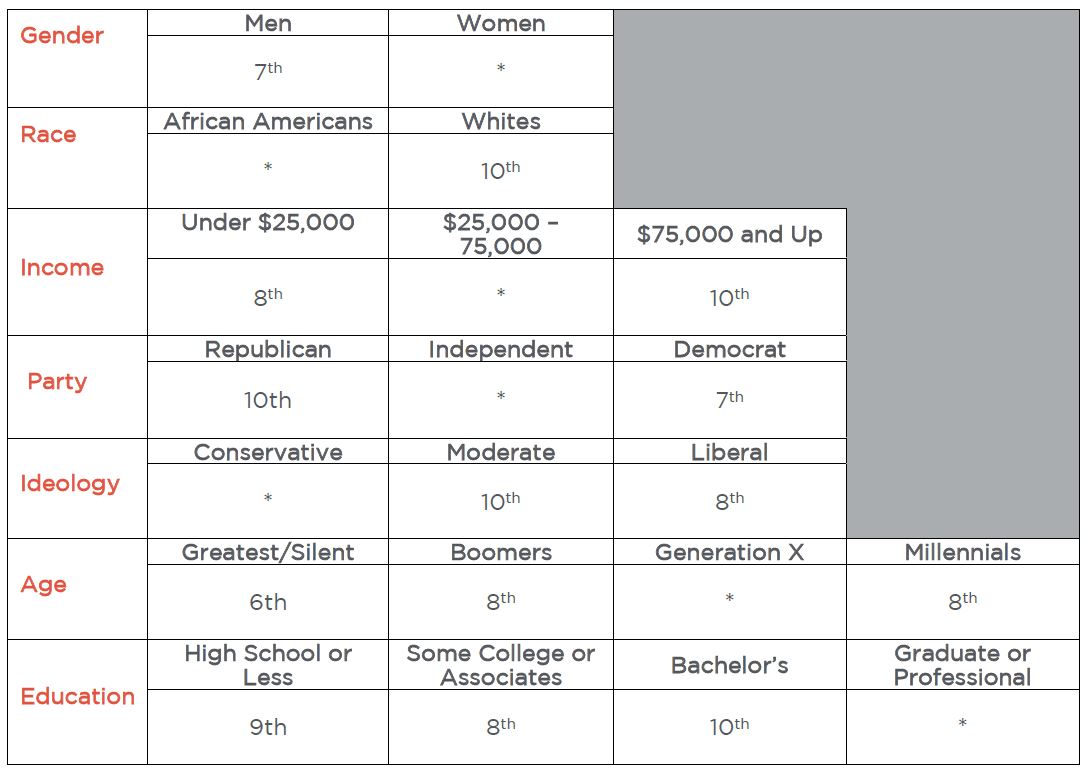
When examining the top ten priorities by population, the state’s image made the top ten for most groups. Interestingly, the issue ranked higher for older voters and for those with lower incomes and levels of education.

Some would say that Alabama’s image is well earned. Alabama ranks poorly compared to other states in many measures of corruption, education, health, income, and general well-being – issues that will be explored more fully in future briefs.

The State’s Image by Group – asterisks (*) indicates the issue did not rank in the top ten

Alabamians are reminded of this fact frequently. Every few days there is a story in the media highlighting how Alabama compares to other states on some measure. A simple web search generates many such rankings – some concerning more substantive issues than others and some rankings compiled with more rigor than others. In just the last few weeks, Alabama has been ranked as:

  • 42nd in child-well being[1]
  • schools rank 42nd in the nation[2]
  • #3 in speed-related deaths[3]
  • #1 for fast-food restaurants per capita[4]
  • 41st in places to start a business[5]
  • 40th in children’s health[6]
  • 49th in hiring people with disabilities[7]

Rankings such as these do not tell the whole story, but as has been said, perception is reality.

Why is the State’s Image Important?

Perception

Alabama, like other southern states, labors under stereotypical and outdated assumptions about the rural south: remote, uneducated, and uncivilized. This narrative continues to be nurtured in popular culture and, sometimes by the state and its people. Alabamians, however, and those that visit, know that these descriptions do not reflect the state.

Fairly or not, Alabama must contend with its reputation when attracting new industry and new investment to Alabama. At the same time, the state has been relatively successful on this front in recent years, suggesting that perceptions can be challenged.

Economic developers know that quality of life is fast becoming one of the most important factors businesses consider when choosing a new location. When recruiting a new industry or a new employee, business leaders in Alabama often say, ‘if we can get them to visit, we can get them to stay.’

Reality

At the same time, while some aspects of the state’s image might be misguided or stereotypical, other aspects are based in reality. On average, Alabama students do lag behind their peers in most states. On average, Alabamians are more unhealthy than residents in many other states. Alabama’s median income is in the bottom five in the country, and the state’s recovery from the Great Recession has been slower than many other states.

These are real issues affecting real people, every day – regardless of the state’s reputation.

As noted, the state’s image emerged as a higher priority for voters with lower levels of income and education. The issue also ranked higher for voters generally (9th) than for policy professionals (16th). This could be because policy professionals believe that the best way to change the state’s image is indirectly, by addressing the individual factors that create the image. They are not wrong.

However, that the issue ranks so highly for voters underscores the extent to which voters believe the state’s image affects them personally. We suggest that people with more resources – more education, skills, and income – are held less captive by the state’s reputation. They also have more ability to relocate to other parts of the state or to leave the state altogether to seek other opportunities. Conversely, those with fewer resources – less education, skills, and income – may be, or feel, stuck. In other words, their prospects and those of their families may be more intimately tied with those of the state, their county, and their town.

How Does Alabama Compare?

Rather than attempting to measure Alabama’s image compared to other states, we look at three indicators as proxies: job creation, economic growth, and population. These metrics do not constitute image – but we suggest that the same factors that drive these metrics also drive the larger concept of image.

Job Creation

According to the Alabama Department of Commerce, the state has added or announced 138,197 new jobs and $35.2 billion in investment between 2010 and 2017. This suggests Alabama is increasingly attractive to business. However, as with many issues, the distribution of new jobs is not equal. In 2017, 19 counties reported zero jobs from new industry and three counties reported no new jobs from industry expansion.

Economic Growth

The effects of job growth – and decreasing unemployment – are beginning to show in the state’s GDP. Alabama experienced 3.3% growth between 2016 and 2017, outpacing recent trends, but below its southeastern neighbors. For the period 2010 to 2017, Alabama’s compounded annual growth rate is estimated at 2.7%, lower than every other southern state except Mississippi and Louisiana – and far behind regional leaders Tennessee (4.6%), Georgia (4.3%), and South Carolina (4.2%).

Population

The state may be adding jobs and seeing a positive trend in GDP, but these trends are not correlating to population growth. The state’s image surely plays a large role in people’s decisions to move to, or remain in, Alabama – and in recent years, Alabama has struggled to compete with surrounding states.

Between 2010 and 2017, the population of southern states has grown an average of 5.6%. Florida leads the pack at 11.6%. More comparable to Alabama however, are South Carolina, North Carolina, and Georgia. These states have grown 8.6%, 7.7%, and 7.6% respectively.

Comparatively, in this same period, Alabama grew at 2.0%. This translates to a net population increase of 95,000 people in seven years – compared to an increase of 398,988 in South Carolina – a state that was approximately the same size as Alabama in 2010.

Moreover, the source of our population growth is telling. In the past seven years, Alabama has added population through natural growth (number of births minus number of death) and international migration. Alabama’s rate of international in-migration is much slower than most states, and its rate of domestic migration is lower than most other Southeastern states. Domestic migration – people moving from other states to Alabama – has accounted for a net increase of 1,153 people – less than 1% of the state’s population growth since 2010.

Alabama is adding jobs – but not people.  Alabama did see a larger year-over-year population increase in 2017. Perhaps this is the beginning of a new trend.

What Can We Do?

What, then, does this suggest for policy makers?

We suggest that policy makers recognize and prioritize the issues that give rise to a negative reputation. They have a real and profound impact on real people’s lives. As Alabama finds and implements effective responses to education, healthcare, jobs and the economy, crime and more – the state’s image will improve. More importantly, the lives of Alabamians will improve.

At the same time, leaders have an opportunity to remind Alabamians, and a larger national and international audience, of a broader story.

Alabama is emerging as a leader in advanced manufacturing and enjoys a growing reputation in research and innovation, as well as arts, culture, and cuisine.

Successes such as these should be celebrated. At the same time, the state’s challenges should be addressed in a straightforward manner, with an inclusive, broad-based program for expanding opportunity for all.

For the PDF version of the State’s Image summary brief, click here.

1] http://www.gadsdentimes.com/news/20180729/alabama-ranks-42nd-in-child-well-being

[2] http://www.waaytv.com/content/news/New-study-Alabama–489500431.html

[3] http://www.waff.com/story/38728591/alabama-ranks-no-3-in-speed-related-deaths

[4] https://whnt.com/2018/07/03/alabama-ranks-number-one-for-the-most-fast-food-restaurants-per-capita/

[5] https://www.bizjournals.com/birmingham/news/2018/07/02/alabama-ranks-low-for-best-places-to-start-a.html

[6] https://www.bizjournals.com/birmingham/news/2018/04/26/alabama-ranks-near-bottom-for-childrens-health.html

[7] https://www.al.com/business/index.ssf/2018/03/alabama_ranks_49th_among_state.html