
Lower Fines and Fees Raise MORE Revenue than Higher Fines and Fees, Study Finds

New research indicates that lower fines and fees raise more revenue than higher ones, and that a “collections fee” that is supposed to incentivize payment is instead associated with greater debt.

The report, Findings from the Jefferson County Equitable Fines and Fees Project from MDRC, provides insight into an issue the Legislature is struggling to address: Alabama’s patchwork system of fees and court costs. Earlier this year, the Legislature established a Joint Interim Study Commission on Court Costs to examine ways to reform and standardize the court cost system. The Commission will report to the Legislature in its upcoming session early next year.

The new report, a Jefferson County case study, uses five years of case-level data to examine drivers of court debt accumulation over time. PARCA Senior Research Associate Leah Nelson was co-founder and co-principal investigator on the project.

What are fines and fees?

Every year, criminal courts in Alabama assess an unknown amount in fines, fees, court costs, and restitution. Fines are intended as punishment, while fees (including court costs) are meant to cover the expenses associated with the case. Some people are also assessed restitution if the offense they were convicted of resulted in a financial loss to a victim.

Although the total amounts assessed and outstanding across Alabama’s criminal courts are unknown, annual collections are substantial. Criminal courts drew a total of nearly $114 million in 2024 alone, including $6.1 million that remained within the court system, while $80 million was disbursed to non-court entities such as the General Fund, the Alabama Department of Economic and Community Affairs, the State Department of Education, and American Village at Montevallo. And, finally, $12.7 million in restitution was distributed to victims.

Fines are supposed to deter involvement in the criminal justice system, while fees exist to recoup the cost of court involvement, while also generating revenue for the state. New research suggests that higher fines and fees are counterproductive: producing less revenue, creating higher levels of unpaid debt, and prolonging individuals’ involvement with the criminal justice system.

 Insights provided by Findings from the Jefferson County Equitable Fines and Fees Project include:

  • People assessed lower amounts at the time of sentencing paid more money and were more likely to pay their debt down to zero, as compared to people assessed higher amounts (who typically saw their balances increase over time).  In other words, people who were assessed less debt were not only more likely to finish paying, but they paid more money.
  • A 30% collection fee assessed when people are 90 days late with their payments resulted in higher unpaid balances and a decreased likelihood of paying off their fines and fees.  
  • Indigent people were assessed higher financial penalties than their more affluent peers.
  • Victims may never receive, or fully receive, financial restitution because of how fines and fees revenue is distributed.
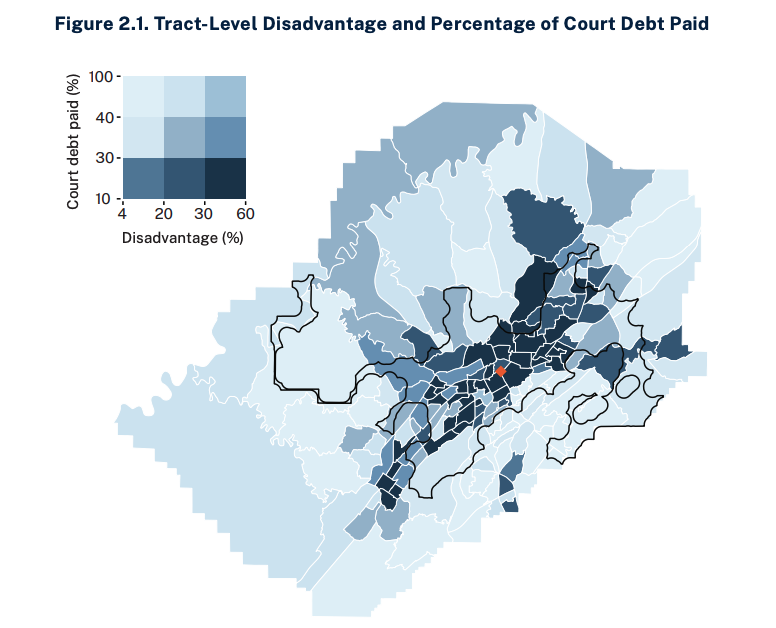
  • Court debt was concentrated in census tracts marked by high levels of concentrated disadvantage, a composite metric that measures a given location’s level of socioeconomic challenges.

How does the system work?

Assessment of debt

Fines, fees, and costs are assessed at the time of sentencing in nearly all criminal cases where a person is found guilty. Amounts are set by statute. A typical sentence simply includes a note that the defendant is to pay fines, fees, and costs, along with any restitution that may be due. Judges do not typically say the amount out loud at the time sentencing, so it is common for people to agree to pay as part of a plea without knowing exactly how much they will owe. While judges are required to assess fines and fees, under the Alabama Rules of Criminal Procedure (Rule 26.11), they have broad discretion to set payment plans or even forgive debt if a person is unable to pay. The same rule allows judges to incarcerate people who willfully refuse to pay.

Fines and fees may be the only sanction a person faces in a low-level case. In more serious cases, fines and fees are imposed in addition to supervision or incarceration. Many people who are assessed fines and fees are unable to pay them all at once, and it is common for judges to allow them to pay in installments.

Research shows that Alabama residents who owe fines and fees over long periods of time often make desperate choices as they seek to stay current on their debt. A 2018 survey showed that 83% gave up a basic need like rent, car payments, or medication; 44% took out a payday loan; and 38% percent admitted to engaging in unlawful activity – usually selling drugs, stealing, or sex work – in order to keep up with their court payments.

Even so, half of those surveyed told researchers they had been jailed in connection with unpaid debt. “Every time I turn around, they got a warrant out because I can’t pay,” one man said. “Having to fear the police is not right because of debt.”

Distribution of revenue

Alabama Code sections related to fees name the entity or entities to which revenue collected from fees must be disbursed. However, the order in which money is disbursed falls to the discretion of the Chief Justice of the Alabama Supreme Court. Over the decades, default priorities have been programmed into the State Judicial Information System (SJIS), which is the software used by district and circuit courts to docket and track cases.

Disbursements operate on a “cascade” basis, meaning the top priority entity must be paid in full before the next entity in line gets a single dollar. Under the current default priority system, court costs are paid first, and victims who are owed restitution are paid last. If a person who owes fines and fees falls behind on their payments by more than 90 days, they are automatically assessed a “collections fee” of 30% of what they owe. If assessed, the collections fee becomes the top priority and must be satisfied in full before any other fund receives a share of revenue. Judges have the authority to re-order priorities (for instance, to put restitution at the top of the list), but must issue reprioritization orders on a case-by-case basis.

Findings from the Jefferson County Equitable Fines and Fees (JEFF) Project

Following the money

  • The average initial amount assessed in cases included in the JEFF sample was $1,253.52.
  • 42% of people pay nothing at all toward their fines and fees.
  • People were more likely to pay who were:
    • Not indigent
      • 50% of non-indigent people paid off their full debt, compared to 16% of people who were represented by public defenders due to low income)
    • Facing lower fines
      • People in the lowest quartile of court debt assessed (a median debt of $121) tended to pay off their debt. By contrast, people in the top quartile (with a median initial assessment of $1,827) saw their debt nearly double over the five-year period studied.
  • Over 60% of cases in the sample were assessed a 30% collections fee, which is added to the balance when a person fails to pay anything toward their balance for 90 days.
    • Collections fees were associated with an average $827 increase in unpaid balances, with only $262 in payments on average after the fee was imposed. Those assessed the fee were less likely to pay off their debt.

 In other words, the collection fee, which is intended to increase revenue, is more associated with increased debt.

Geographic Concentration

  • Geographically, debt was concentrated in the central valley area of Jefferson County, which is also home to a disproportionate percentage of Jefferson County’s Black residents.
  • People who lived in census tracts marked by concentrated disadvantage were much less likely to pay down their debt as compared with people in more affluent areas of the county. A one-percentage-point increase in concentrated disadvantage corresponds with 13% less court debt paid.

The human consequences of fines and fees

Most people (71%) in the sample were defended by a public defender, meaning that a judge determined they were indigent at the time of trial. Unsurprisingly, people who were indigent paid less toward their court debt than those who could afford to hire a lawyer. More surprisingly, JEFF researchers found that across all charges, indigent people were assessed higher financial penalties than their more affluent peers.

In interviews, court practitioners expressed frustration with the system. They described administrative headaches associated with attempting to keep up with debtors who often have unstable housing situations and don’t receive notices reminding them to pay. They felt that the 30% collections fee was deeply problematic, but worried that the district attorney’s office couldn’t operate without the revenue it generates. They expressed a broad desire to see court and law enforcement operations fully funded by the legislative branch, rather than being tasked with generating their own revenue.

Meanwhile, people who owed court debt described feelings of fear. Few were aware that they were allowed to ask for their court debt to be forgiven, and many thought the money was kept by local police or courts. (In fact, most of it flows back to the state.) Discussing the dread associated with owing court debt, one person said, “It’s like drawing an X on your back and I got you forever.”

Jefferson County Sees Lower Homicides and Drug Overdose Deaths So Far in 2025

Halfway through 2025, Birmingham’s homicide total is half what it was midyear 2024, a dramatic turnaround after a year of record-setting violence.   

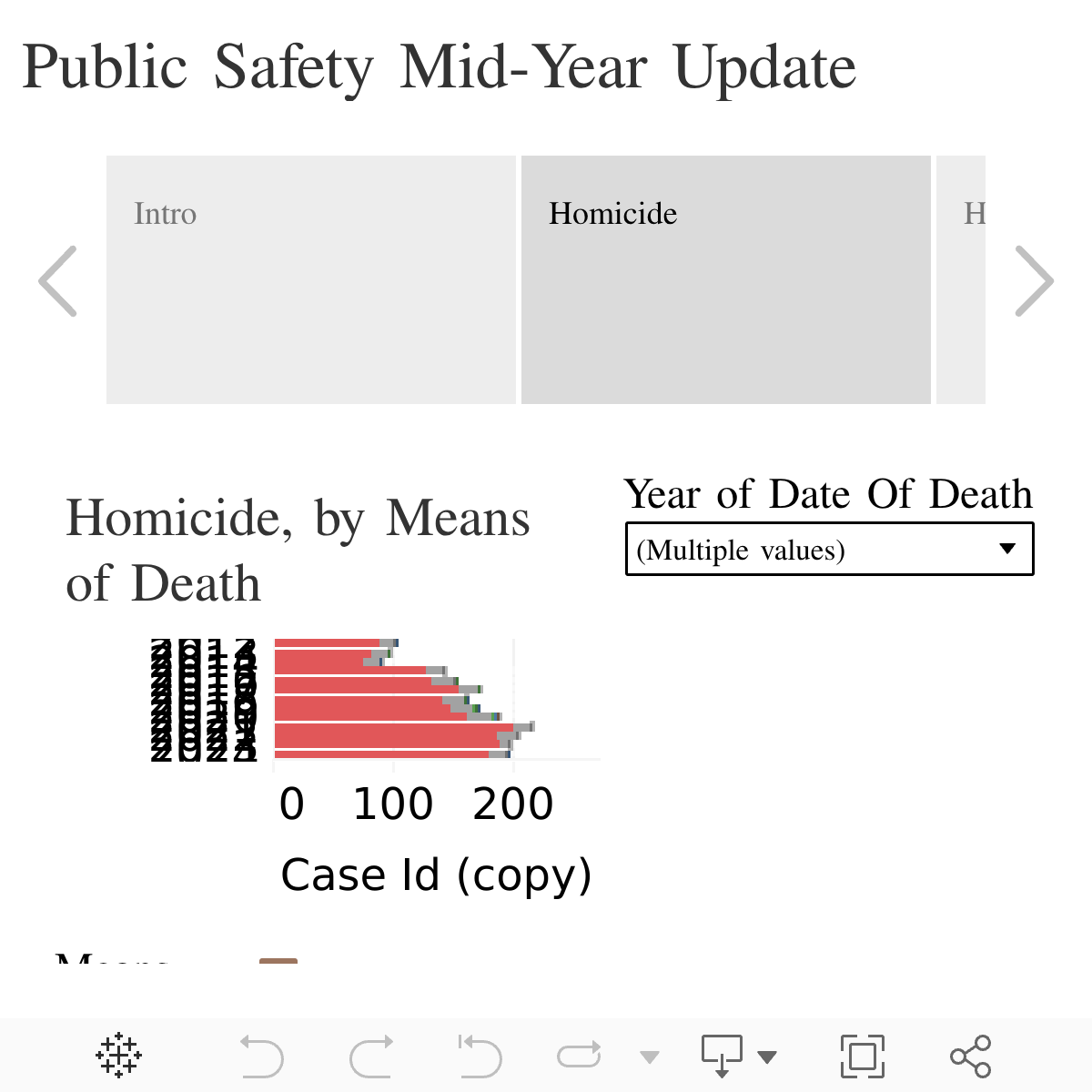
According to data from the Jefferson County Coroner’s Office, total homicides in Jefferson County have been trending down from a peak in 2021, despite the record number of homicides in the City of Birmingham in 2024. Countywide, there were 196 murders in 2024. In 2021, there were 216.

Excluding Birmingham, homicides in the rest of the county dropped from 87 in 2021 to 47 in 2024, marking a return to pre-pandemic levels.

Figure 1 shows total homicides by year. The bar is shaded by the means of death. The red-shaded portion of the bar represents homicides involving guns. Most homicides in Jefferson County involve guns.

Figure 1. Jefferson County Homicide Trends, by Means of Death

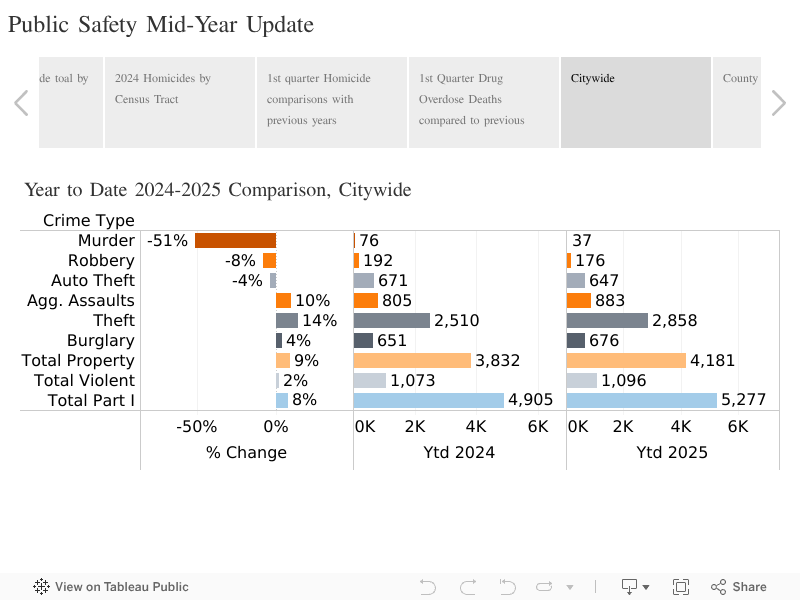
In the first half of 2025, Birmingham saw a precipitous drop in the number of murders, with 37 murders in the first six months of the year, compared to 76 by midyear 2024, according to data provided by the Birmingham Police Department.

While murders, robberies, and auto theft were all down compared to the first six months of 2024, aggravated assaults, theft, and burglary were up.

Taking the statistics together, Birmingham police have recorded more total criminal incidents in 2025 than for the same period in 2024.

Figure 2. Birmingham Part I Crime Trends

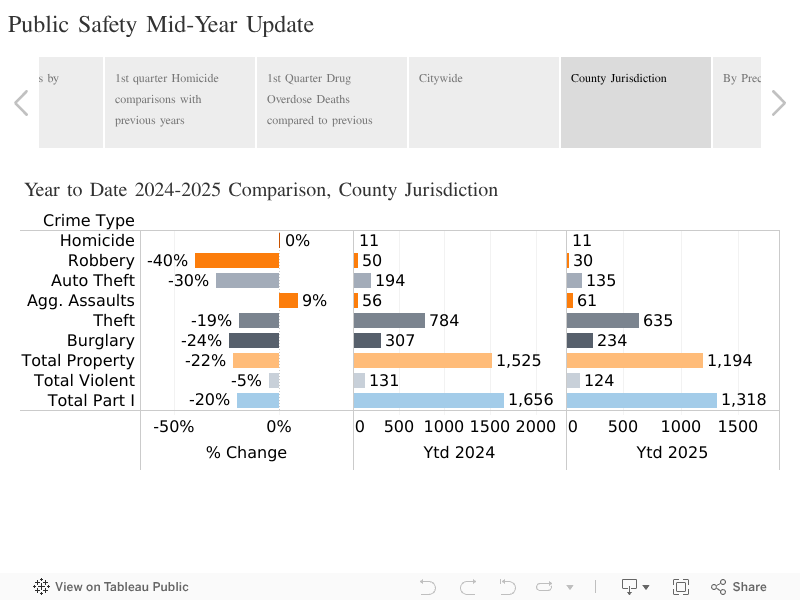
Beyond Birmingham, in the portions of Jefferson County patrolled by the Sheriff’s Office, homicides in the first half of 2025 were even with the total for the first half of 2024.

Aggravated assaults were up, but other Part 1 crimes were down.

Figure 3. Jefferson County Sheriff’s Office Patrol Area

PARCA’s data analysis stems from the Birmingham-Jefferson County Justice Governance Partnership, a collaboration between Birmingham, Jefferson County, the Jefferson County Health Department, the Sheriff’s Office, the District Attorney, and a wide array of other public agencies, nonprofits, and community groups. The BJC-JGP brings stakeholders together around a common pool of community and public safety data. The aim is to increase public safety through effective response and by improving underlying conditions that leave communities more vulnerable to crime.

Context

Homicides began rising in Jefferson County in 2015, which paralleled a national rise in homicides. Then in 2020, the number of murders in Jefferson County and around the country leapt sharply.

Each year from 2020 through the end of 2024, the total number of murders in Jefferson County has been twice that of the total recorded in 2014. Across the country, homicides began dropping in 2022, though in some cities, including Birmingham, the homicides continued to climb. By the end of 2024, homicides nationally were below pre-pandemic levels. Homicides were below the 2019 level in the rest of Jefferson County, excluding Birmingham, in 2024. However, Birmingham’s record total, which included multiple mass shootings in which four or more victims died, kept the county’s overall rate elevated.

The Council on Criminal Justice (CCJ) has been tracking trends in 40 cities across the U.S. and, in a 2024 year-end report published in January, found that homicides had decreased 6% from a 2019 baseline.

Figure 3. 40 U.S. City Homicide Trend

Theories on the National Rise and Fall of Violence

There have been various theories advanced about why murders began increasing in 2015 and continued to rise until recently. The CCJ’s Crime Trends Working Group cited various theories on what led to the rise in homicides. What follows is a summary of the points mentioned. The full text is available at the link above.

  • Undermined Police Legitimacy: Beginning with the police-killing of Michael Brown in 2014 in Ferguson, MO, and increasing with the murder of George Floyd by Minneapolis police officer Derek Chauvin, decreased respect for law enforcement led to a surge in murders.
  • De-Policing: In the light of the pandemic and protests, law enforcement and the criminal justice system generally decreased interaction and criminal case processing.
  • Routine Activity Theory: This theory argues that crime stems from the combination of a motivated offender, a suitable target, and the absence of capable guardians. Covid-19 disrupted normal structures of support and engagement, and, at the same time, decreased protective services, leading to a rise in crime.
  • Gun Sales: A spike in gun sales during the pandemic may have had an effect. However, other research suggests the consumers driving the spike in gun sales were largely already gun owners, and thus, the increased number of guns didn’t increase the number of people with guns. In Birmingham, the availability of devices that allow guns to function as if they were automatic weapons may have increased the lethality of shooting incidents.
  • Bail Reform and Progressive Prosecution: Some observers blamed criminal justice reforms aimed at reducing long jail stays for people unable to post bail and a perceived pull-back in prosecutions. Covid also led to delays in prosecutions and criminal case backlogs. Other working group members disputed the theory, citing research studies that have found no impact of bail reform on rearrest or overall crime rate. In many jurisdictions, reforms were in place when crime was still falling. Also, after the pandemic spike, violence began falling, even in jurisdictions that maintained the reforms.
  • Drug Market Disruption: The pandemic led to changes in where people obtained drugs and the kind of drugs available, including the rise of fentanyl. These disruptions coincided with the 2020-2021 spike in violence, suggesting a connection.
  • Crime Reduction Interventions: A suite of approaches to violence reduction has become widely recognized as working together to reduce violence. Some of those programs were disrupted by the pandemic. In response to the violence spike, cities revived or launched new intervention programs, including both law enforcement strategies and community-based interventions, yielding decreases in violence.

Understanding Patterns and Targeting Interventions

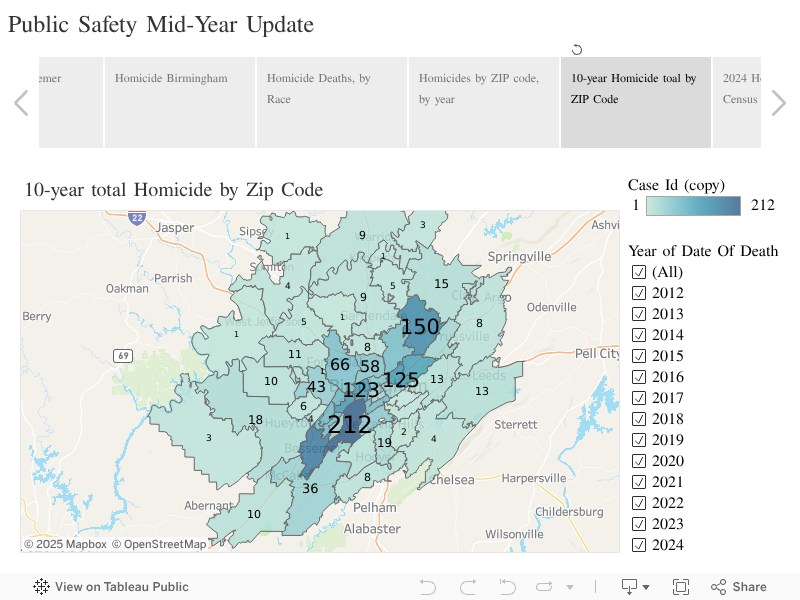
Research shows that violence tends to be concentrated geographically and disproportionately between and within social networks. Using Jefferson County Coroner’s data from 2012 to the present to map where homicide victims have been found reveals a stark pattern. Homicides disproportionately occur in Jones Valley in areas east and west of the central city, stretching down as far as Bessemer.

Figure 4. Jefferson County Homicides by Zip Code 2012-2025

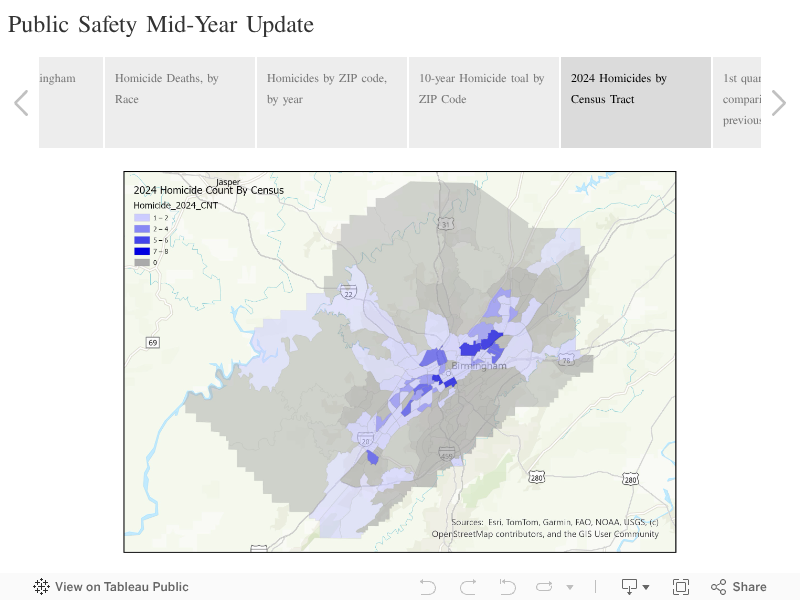
In 2024, homicides were even more concentrated. Figure 5 tallies homicides by Census tract. Tracts are a more compact geographic area than zip codes. Census tracts also tend to group neighborhoods and populations that are economically and demographically similar. In 2024, four Census tracts experienced seven or eight homicides apiece. Seven additional tracts saw five or six homicides. Homicides occurred in 85 of the 189 Census tracts in the county; 43 tracts experienced two or more homicides.

Figure 5. Jefferson County Homicides by Census Tract, 2024

Homicide is impacting the Black community disproportionately. Blacks make up less than half of Jefferson County’s population, but, in 2024, 88% percent of Jefferson County’s homicide victims were Black.

Interventions That May Be Decreasing Homicides

There is no definitive answer to why homicides have dropped so precipitously and whether the trend will continue. However, the combined effects of multiple approaches to violence reduction may be paying off. These include changes to enforcement strategies and public health-oriented approaches to violence reduction.

Research shows that a small number of individuals are responsible for a disproportionate share of community violence. If the charges filed by prosecutors prove true, the arrest of one individual, Damien Laron McDaniel III, would be a factor in decreasing homicides in Birmingham. Initially arrested in October 2024, McDaniel has subsequently been charged with a total of 14 homicides over a 14-month period, including two 2024 mass shootings, both of which saw four people die.

The Birmingham police department and partner agencies have increased their use of focused deterrence, an approach endorsed by the Birmingham Crime Commission, a panel of community leaders and public health and safety officials convened by Mayor Randall Woodfin. In an interview with the Birmingham Times, Police Chief Michael Pickett described the formation of a Special Enforcement Division focused on high-crime areas and networks of individuals involved in violent crimes. The Division, working with federal and local partners, studies data, looks for patterns in time, geography, and among individuals, and works to interrupt those patterns.

The police department has succeeded in increasing homicide clearance rates, the rate at which a murder is followed by an arrest. By mid-year, arrests had been made in 30 of the 37 homicides from 2025.

Pickett said that community and business owners are increasingly cooperating with police by providing information. That increases the department’s ability to make arrests and allows the district attorney’s office to charge and successfully prosecute. The higher clearance rate increases community trust and encourages more communication and confidence that the information provided will be acted upon.

Beyond Enforcement

Cities across the country have increasingly recognized that improving public safety demands sustained investment in programs that interrupt patterns of violence and address the underlying community conditions. Birmingham, in conjunction with partner agencies, has launched a variety of these initiatives in the past two years.

One with a direct connection to violence is a hospital-linked violence intervention program supported by the Jefferson County Health Department and the City of Birmingham, Violence Intervention and Prevention Partners (VIP2). In recent years, public health officials have noted that violence often behaves like a contagious disease. That insight has led to the deployment of public health strategies designed to reduce violence.

A first step is to identify a population that is particularly susceptible to violent injury and intervene with education and support. Researchers have found that people admitted to the hospital with a gunshot wound are at risk of being shot again, returning to the hospital, or dying. Studies find that between 25%-40% of gunshot victims are, within a relatively short time frame, return to the hospital with another gunshot or are killed in a subsequent violent incident.

Each incident costs society. According to a study by Everytown Research & Policy, a gun safety advocacy group, on average, each nonfatal firearm injury costs taxpayers $25,250. Each firearm death costs taxpayers $273,904 in emergency response, health care, law enforcement, and criminal justice proceedings. In addition to the cost to taxpayers nd direct victims, each gunshot victim is connected to additional community members, from children and spouses, who also suffer costs.

VIP2 attempts to interrupt that cycle. Launched in October 2023, VIP2 provides support for patients admitted to UAB Hospital with gunshot wounds. Social workers with UAB’s Division of Trauma and Acute Care Surgery screen patients and refer willing participants to the Offender Alumni Association, which dispatches trained violence intervention specialists to the hospital.

The specialists, all of whom have had personal experience with gun violence, meet with the gunshot victim. The participants are admitted only if they commit to not retaliating against the person or group who shot them. If they do commit to participating, OAA provides an array of support, directly or through partners. Victims often face difficult physical recoveries. They are often financially devastated, facing medical bills and job loss. To avoid further violence, they may need help relocating.

OAA provides access to group therapy and mental health counseling. It also connects victims with education, job training, and job placement, and case-manages individuals in their recovery.

Since the fall of 2023, 175 individuals have participated in VIP2, with 105 currently receiving support. Only four participants have been reinjured. The Health Department and the City are cooperating to provide $1.1 million a year to support VIP2.

In addition, the City’s Office of Public Safety Initiatives is managing investments of federal and local money in violence reduction programs targeting youth, working with Birmingham City Schools, The Housing Authority, and Jefferson County Family Court and Detention Center.

The city, the Community Foundation of Greater Birmingham, and Regions Foundation are also supporting re-entry services for individuals returning to the community after serving prison terms. The goal of the program is to help returning citizens navigate to stability and avoid recidivism.