
SNAP Error is Not SNAP Fraud

The Supplemental Nutrition Assistance Program (SNAP), formerly known as the Food Stamp Program, helps people with low incomes buy food.

In FY2025, approximately 740,300 Alabamians, or about 14.3% of the population, received SNAP benefits. These figures include 300,000 children. Recipients receive an average of $6.31 per day. The U.S. Department of Agriculture’s latest report indicates that there has been a 9.5% reduction in the number of people receiving benefits in Alabama, or approximately 70,000 fewer recipients as of April 2026, compared to April 2025. Nationwide, approximately 5.3 million fewer people receive SNAP over that same period.

States run SNAP, sharing administrative costs with the federal government. All benefits are funded by the federal government. H.R. 1, the One Big Beautiful Bill Act, makes two major changes to that structure.

First, states will be required to cover 75% of administrative costs, up from 50%, beginning in FY2027, at a cost of approximately $39 million to Alabama.

Second, beginning in FY2028, states with payment error rates at or above 6% will be required to pay a share of the cost of benefits provided to recipients.

States with error rates of:

  • 0% to 5.99% will pay nothing,
  • 6% to 7.99% will pay 5%,
  • 8% to 9.99% will pay 10%, and
  • 10% and above will pay 15%.

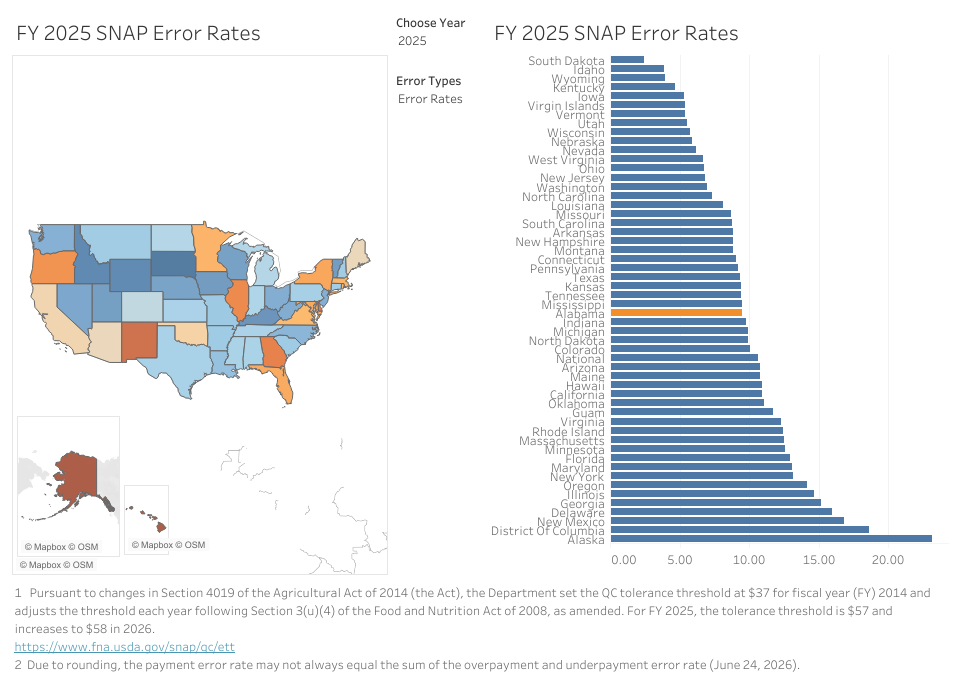
The national average error rate was 10.6% in FY2025.

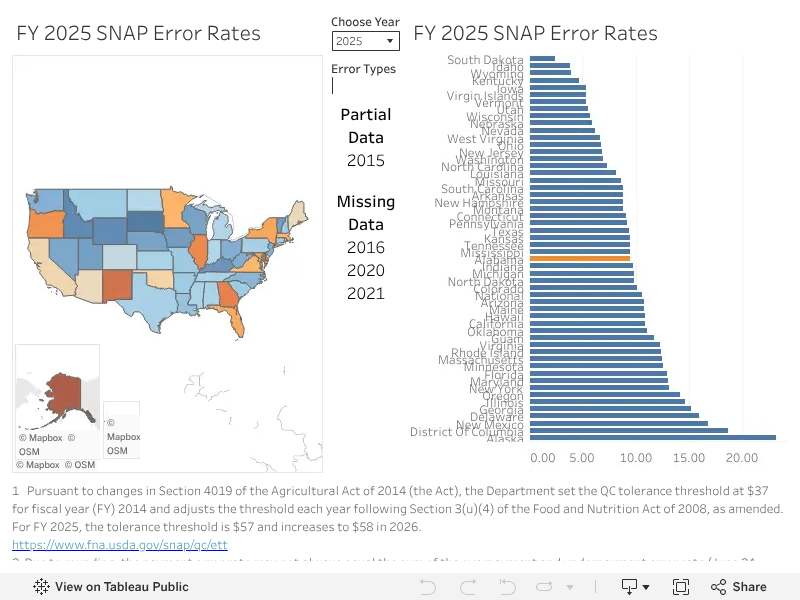
Alabama’s FY2025 error rate was 9.5%. This means the state will be required to fund $174 million in SNAP benefits (based on FY2025 numbers) beginning in FY2028. That cost can be reduced to $87 million if the error rate is kept below 8% and avoided entirely if it is kept below 6%.

Errors versus Fraud

A payment error is a mistake in the size of a benefit paid, not theft. State agencies verify each household’s income, size, and expenses, then recalculate the benefit whenever those circumstances change. Circumstances change often — a new job, lost hours, a household member moving in or out — so the agency is recalculating constantly. When it does not record a change in time, the household receives too much or too little for a month or more. Those timing failures, not deception, produce most of what USDA counts as error.

Not every discrepancy counts. Federal law sets a tolerance threshold — the dollar figure at or below which an error is not counted against a state. The current threshold is $58. A recipient who receives $57 more (or less) than they should is an error, but it is not counted against the state. However, if a household was not eligible for benefits at all that month but received them, that is an error regardless of the size.

Errors run in both directions. Nationally, USDA measured 9.3% of benefits as overpayments and 1.3% as underpayments — a combined error rate of 10.6%, or about $10.1 billion in FY2025.

Fraud is a separate question, and the available evidence indicates it occurs at a low rate, according to the Congressional Research Service report updated in April of 2025. That report noted that retailer trafficking, exchanging SNAP benefits for cash, is a major form of SNAP fraud, estimated to be around 1.6% of benefits.

Trafficking is not part of the payment error rate. The two measure different things: one counts deliberate misuse at the checkout, the other counts administrative accuracy at the eligibility office.

Recipients are more often targets of fraud than its sources. Thieves skim or clone Electronic Benefit Transfer (EBT) cards and empty the accounts.

What’s Next

For the first time in the program’s history, data accuracy carries a cost. At present, the state’s 9.5% error rate could cost $174 million. Reducing that rate below 8% reduces the cost to roughly $87 million. Below 6%, the state owes nothing toward benefits.

In order to avoid these penalties, many states are coordinating error-reduction efforts, like working to modernize software to better track and deliver benefits accurately, and analyzing where documentation and procedural mistakes happen most.

Alabama’s $60 Billion Question: Potential Reductions in Payments?

Passage of the One Big Beautiful Bill Act (H.R. 1) in the U.S. House has sparked discussions about the impact of reductions in federal funding across the U.S. KFF, a nonprofit policy analysis organization formerly known as Kaiser Family Foundation, estimates that the House Budget Committee’s reconciliation bill would reduce federal Medicaid spending by $791 billion without accounting for interactions that would lower estimates to $723 billion. Almost 85% of the total savings derived from five features:

  • Mandating work and reporting requirements ($280 billion),
  • Repealing rules simplifying Medicaid eligibility and renewal ($167 billion),
  • Creating a moratorium on new or increased provider taxes ($89 billion),
  • Revising state-directed payment limitations ($73 billion), and
  • Increasing the frequency of eligibility re-determinations for the ACA expansion group ($53 billion).

Approximately $357 billion of the reductions would only apply to states that adopted ACA expansion.

Printable PDF available here.

Federal cuts to states of $723 billion over 10 years would represent 11% of federal spending on Medicaid over the period. KFF estimates that the cuts range from 5% in Alabama, Wisconsin, and Wyoming to 15% in Washington, Louisiana, and Illinois.

Congressional Budget Office estimates a 10.3 million loss of Medicaid enrollment by 2034, representing 12% of projected enrollment in that year. At the state level, the largest reductions in Medicaid enrollment would be in Washington and Virginia, decreasing by 25% and 20%, respectively. In Alabama, that would be about 4% or approximately 47,000 people.

As described in a previous post, Alabama receives more than $60 billion in federal transfer payments to individuals from Social Security, unemployment benefits, educational benefits such as Pell Grants, or as payments on behalf of individuals in Medicare or Medicaid, etc.

As the Economic Innovation Group noted in its report, The Great Transfer-mation: How American Communities Became Reliant on Income from Government, the main reason federal transfers have increased is the increase in the percentage of the population over the age of 65. Other economic factors have contributed to a reliance on federal transfers, particularly in rural areas with declining economic conditions.

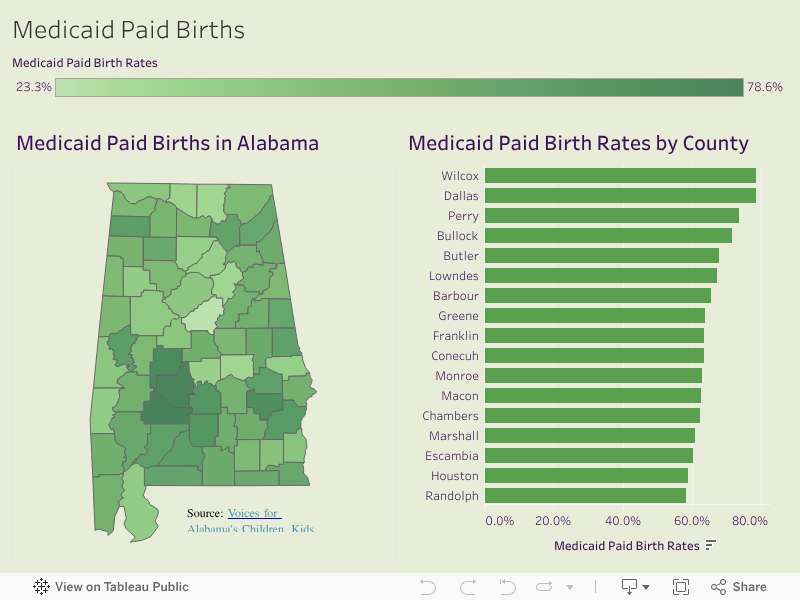
Currently, among the transfer payments are approximately $15.5 billion (2022) to medical providers on behalf of Medicare recipients and another $7.6 billion (2022) on behalf of Medicaid patients, including covering approximately 44.7% of births in Alabama in 2023. Rates vary dramatically across counties, with 78.6% of births in Wilcox County covered by Medicaid to a low of 23.3% in Shelby County. Georgetown University’s McCourt School for Public Policy found that many small towns are dependent on Medicaid/CHIP funding. With 48.6% of children in rural areas of Alabama enrolled in 2023, the state ranks 12th in the nation on that metric.

This past legislative session, the Alabama Legislature passed Senate Bill 102, expanding Medicaid benefits for pregnant women “with an estimated addition of $1 million annually for fiscal years 2026, 2027, and 2028, consisting of $726,300 in federal funds and $273,700 in state funds, by providing certain prenatal coverage to women found presumptively eligible by a qualified provider.” Governor Kay Ivey signed the bill on May 1.

Many medical facilities in Alabama depend on federal funding from Medicaid and Medicare patients. According to KFF, Medicare covered 63% of certified nursing facility residents in Alabama, while Medicaid covered approximately 13%, with only 24% covered by other private funding sources.

For the 80 hospitals in Alabama, operating margins were approximately 2.9% in 2023. However, they are generally thinner in poorer rural areas of the state. Nationwide, operating margins in rural hospitals are notoriously thin, with 44% of rural hospitals operating in the red. According to KFF, “As of July 2024, Medicaid was the primary payer for 63% of nursing facility residents; Medicare for 13% of residents; and the remaining 24% of residents had another primary payer (ex. private insurance, out-of-pocket, etc.) Medicare does not generally cover long-term care but does cover up to 100 days of skilled nursing facility care following a qualifying hospital stay.” 

In states without Medicaid expansion, just over half (53%) of rural hospitals operate in the red. Reductions in Medicaid or Medicare could have a significant impact on rural hospitals. KFF reports that rural hospitals had an average operating margin of 1.7% in 2023. Reductions in these amounts, whether direct payments to individuals or payments on behalf of recipients, as in the case of Medicaid and Medicare, would reduce, dollar for dollar, the purchasing power in those communities.

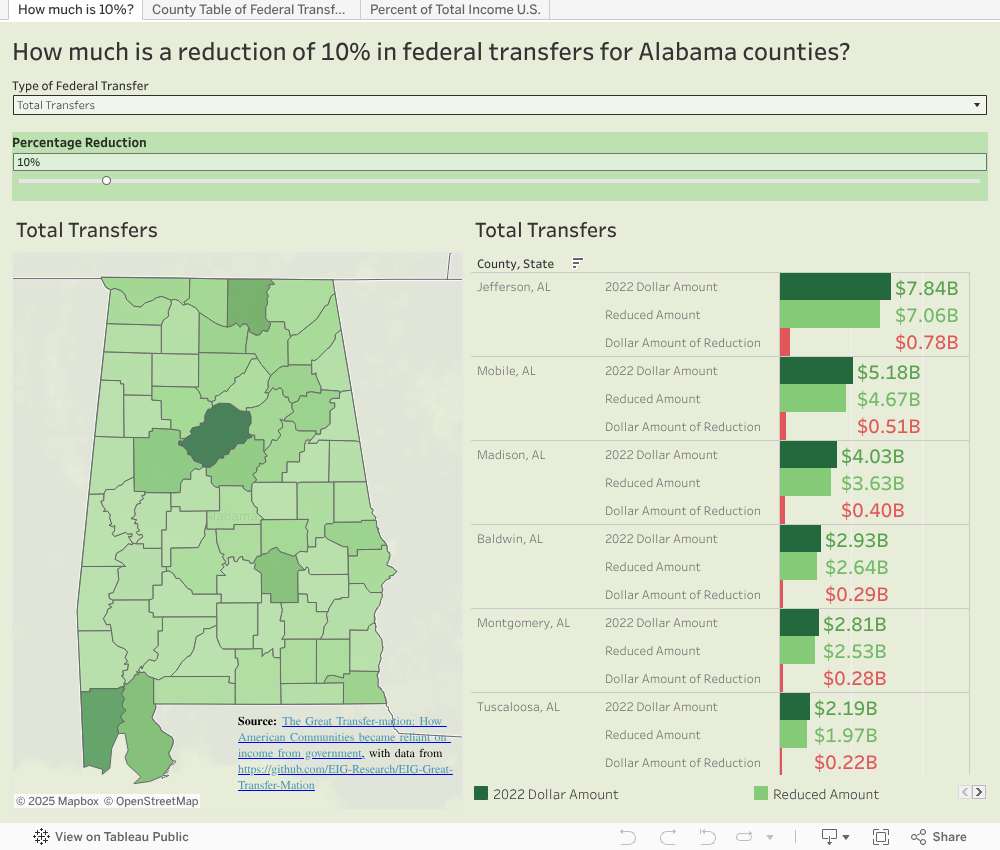
Using the slider and program selector in the visualization below, estimates of how a percentage decrease for each kind of transfer can be adjusted to find dollar amounts for hypothetical decreases:

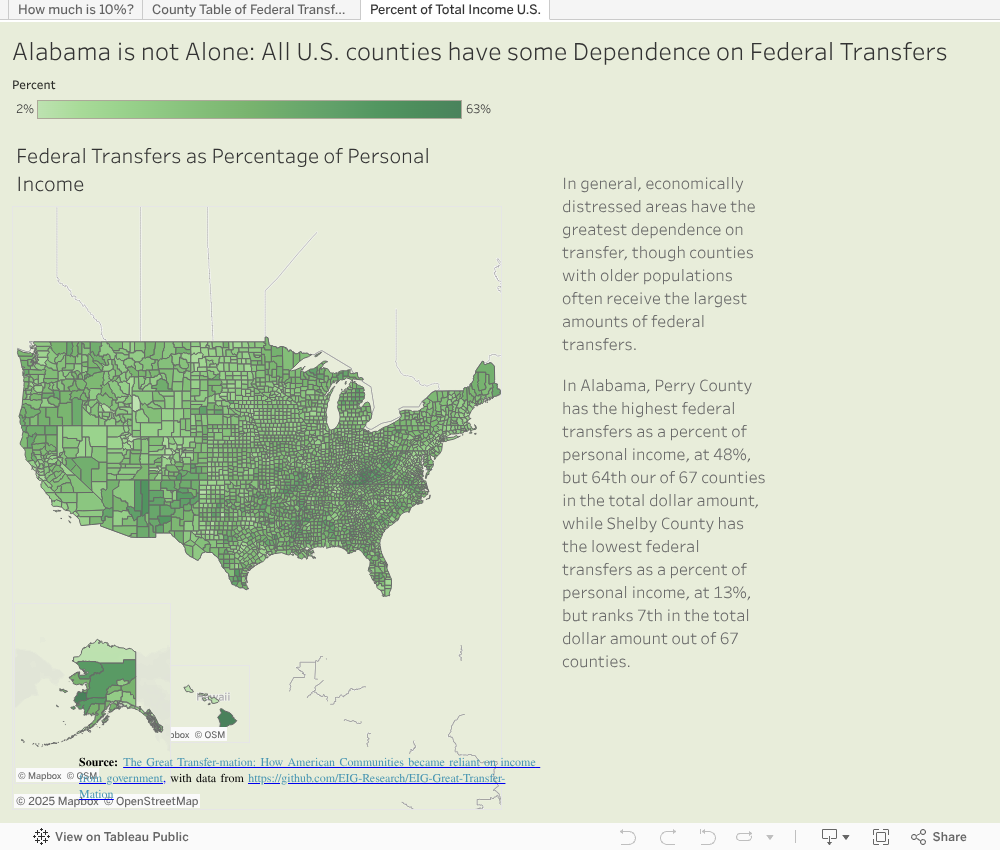
Alabama is not alone. The same kind of dependence can be seen across the country.

There are common patterns across the places where economic activity has been challenging, including the Texas Valley, the Mississippi Delta, Appalachia, and tribal territories. Still, many communities have aging populations, with high percentages of transfer payments compared to earned personal income, as shown below:

For details on the calculation of personal income and transfer payments, see this post on Github:
https://github.com/EIG-Research/EIG-Great-Transfer-Mation


Alabama’s $60 Billion Question

Alabama relies on federal spending—Alabama residents do, too.

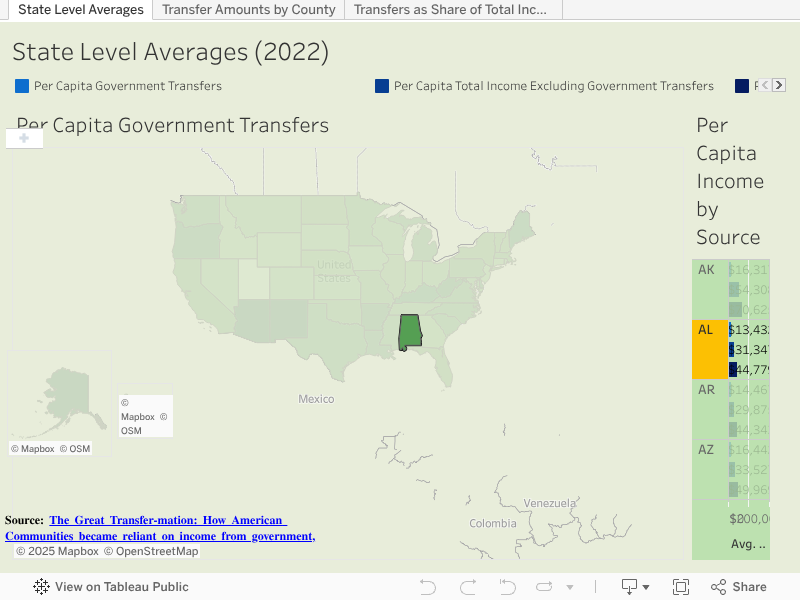
Alabama residents receive over $60 billion from the federal government—23% of all personal income.

These figures are based on a September 2024 report, The Great Transfer-mation: How American Communities Became Reliant on Income from Government, by the Economic Innovation Group (EIG).

These payments, known as transfer payments, include Social Security, Medicare, Medicaid, veteran’s benefits, unemployment, Pell Grants, and others.*  The report explains how an aging population and shrinking economic opportunities have shifted many communities into reliance on these transfer payments.

To put the $60 billion in perspective, Alabama’s four automakers generate $6.4 billion in total compensation, according to a report from Autos Drive America and the American International Automobile Dealers Association, as reported by al.com. That’s about one-tenth of the amount received from federal transfer payments.

In other words, a 10% reduction in these payments would have a similar economic effect on personal income as shuttering Alabama’s entire auto industry.

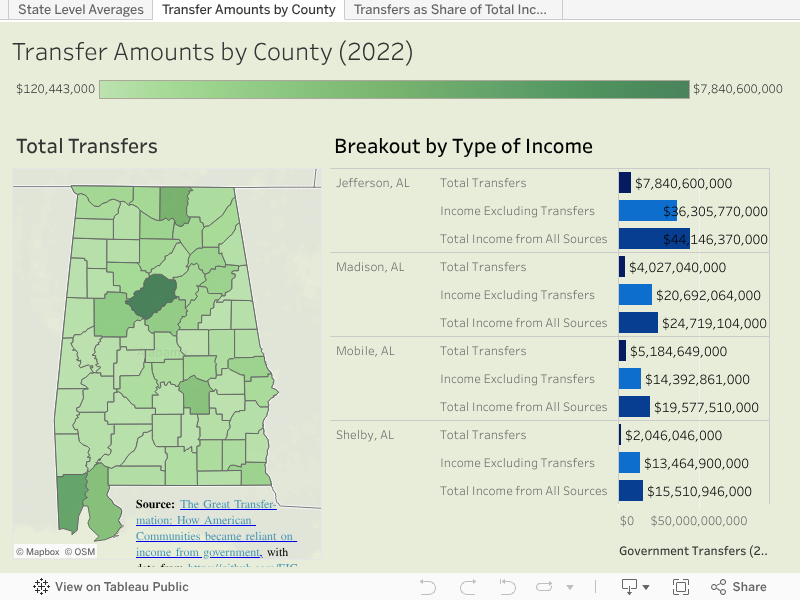
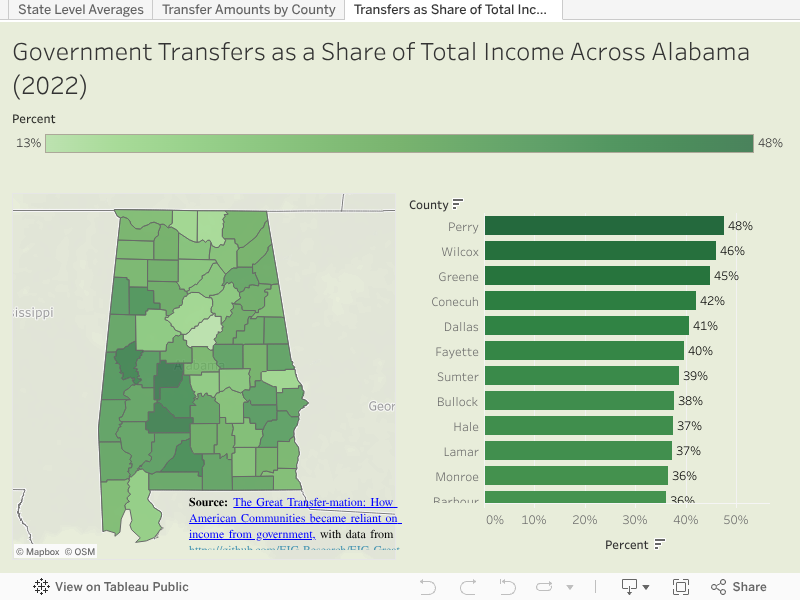
The impact is more pronounced in rural areas. The EIG report notes, “The transfer share of total personal income tends to run much higher in rural areas than in large population centers.” Looking at Alabama, this appears to be a consistent pattern, with most urban counties with low income from federal transfers and rural counties with higher percentages of income from federal transfers.

These trends evolved over decades, having a widespread economic impact that has grown steadily as the population ages.

Meanwhile, these programs are under increasing scrutiny in the current administration. Reducing them would have a profound impact on local communities.

Explore the chart below to see the amount of transfer payments in each county and the share of total income those payments represent. 

*Some of these payments, like Social Security, are made directly to individuals. Other payments, such as Medicare and Medicaid, are made to providers to pay for services on behalf of individuals.

For details on the calculation of personal income and transfer payments, see this post on Github:
https://github.com/EIG-Research/EIG-Great-Transfer-Mation.