
Only 5% of registered voters in the Alabama Congressional Districts holding elections last week cast ballots, producing one of the state’s lowest federal election turnout levels in recent history.
The Tuesday, August 11 elections were highly unusual. They marked the second time this year voters were asked to choose party nominees for U.S. House of Representatives seats in the 1st, 2nd, 6th, and 7th Congressional Districts. But the vote held on May 19 was nullified before it took place. The week before the primary, Gov. Kay Ivey called for the August special elections in reconfigured versions of those districts after the U.S. Supreme Court allowed Alabama to adopt maps drawn by the Alabama Legislature in 2023.
The rescheduled primaries did away with the usual runoff, with candidates needing only a plurality of votes to win their party’s nomination.
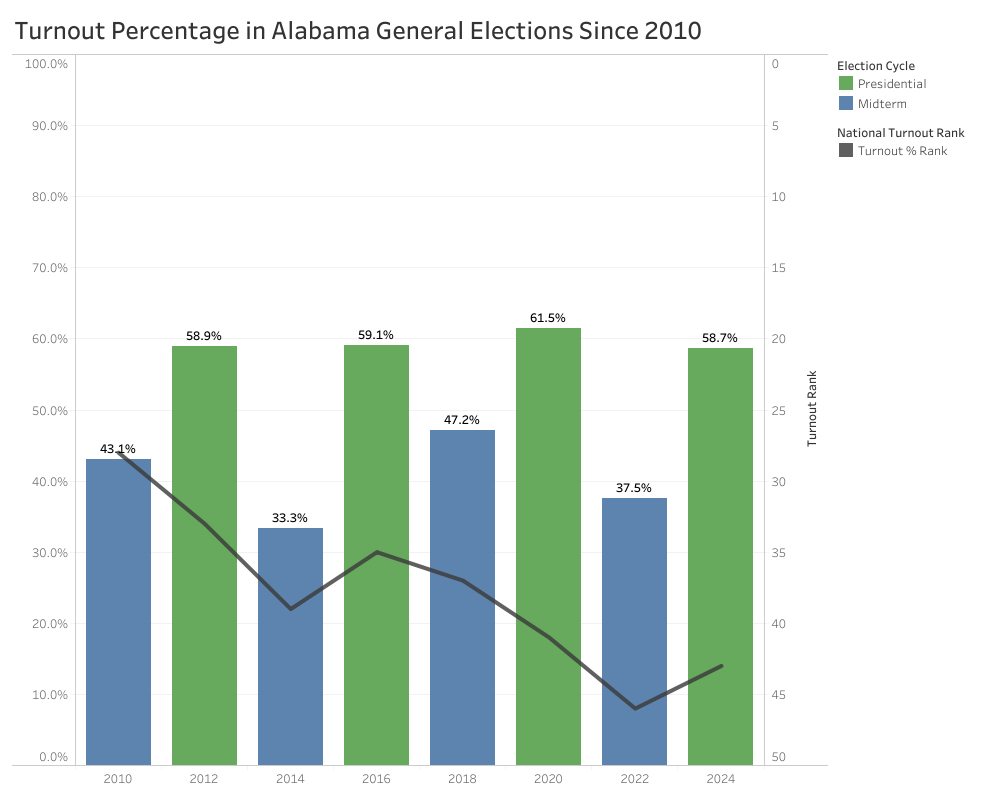
Given the unique circumstances, low turnout was expected, but it was also consistent with a years-long trend of low electoral participation in Alabama. According to data tracked by the Election Lab at the University of Florida, Alabama’s rank in general election turnout, measured as total ballots cast divided by voting-eligible population, has dropped significantly since 2010.
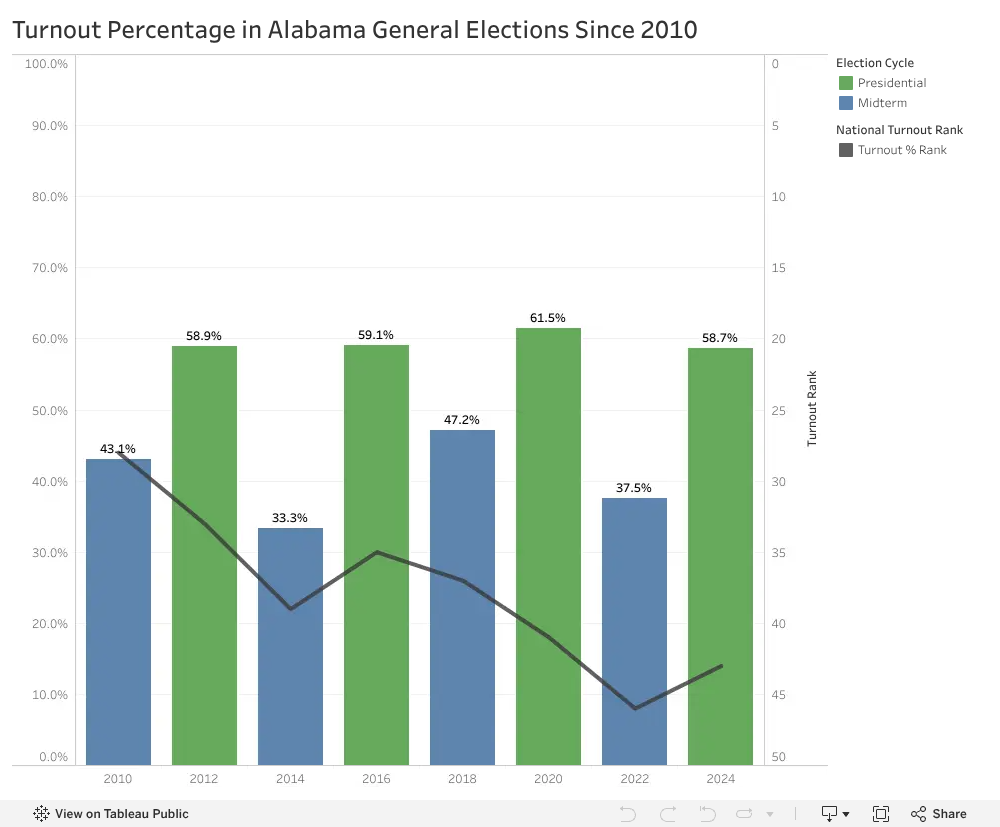
In 2010, when contests between Democrats and Republicans were more competitive, 43% of the state’s eligible voters participated in the midterm elections, and Alabama ranked 28th nationally in general election participation.
But now, after more than a decade of declining electoral competition, Alabama has one of the lowest political participation rates in the U.S. During the 2022 midterm elections, only 38% of eligible voters turned out, putting Alabama 46th in general election participation.
Factors that Weigh on Participation
Alabama’s participation is hindered by relatively inaccessible elections. After the 2024 election, the U.S. Census Bureau surveyed voters who were registered but did not cast ballots and found that conflicting work or school schedules, illness, and disability were among the top reasons cited for not voting.
How Alabama Democracy Compares, a 2024 PARCA report, found that some states have addressed these concerns by adopting measures such as excuse-free mail-in voting, excuse-free absentee voting, and in-person early voting, none of which have been implemented in Alabama.
Weighing voting regulations and procedures, political science professors Scot Schraufnagel, Michael J. Pomante II, and Quan Li developed the Cost of Voting Index (COVI), which provides for comparison of voting ease across all 50 states. Across all presidential cycles since the metric was first calculated, the negative correlation between high COVI scores and turnout has remained statistically significant. In 2024, Alabama ranked 44th nationally, meaning Alabama’s electoral regulations and procedures impose among the highest costs to citizens who wish to participate in democracy.
Compared to 2022 and 2024, Alabama’s 2026 primary season has seen only a slight rise in participation, one that does not portend a significant turnout spike to come during the 2026 general election. The most notable variation in the state’s participation trend has been a drop in Republican turnout in the May primary and an offsetting surge in Democratic turnout.
Republican candidates received 493,988 votes in May’s gubernatorial primary, significantly fewer than the 655,752 they received in 2022. Conversely, Democratic candidates received 365,368 votes in May’s gubernatorial primary, significantly more than the 168,224 they received in 2022. The leading Democrat in the governor’s race, former Sen. Doug Jones, received 287,106 votes, while in the Republican contest, Sen. Tommy Tuberville received 422,255.
The overall turnout rate for the May primary remained below 25%, and the rate dropped to 11% during the June primary runoffs before falling to 5% on Tuesday. None of the state’s primaries or primary runoffs has drawn a turnout rate higher than 25% since 2020.
Such low participation numbers are of concern to all Alabama residents, especially as redistricting has become more scientific, more frequent, and more controversial.
For two decades, Alabama has been at the center of national court fights over the line between redistricting for partisan political purposes, which is legal, and redistricting in a manner that is racially discriminatory, which is illegal.
In its most recent ruling, the U.S. Supreme Court narrowed the circumstances in which courts could find redistricting efforts racially discriminatory. The ensuing redistricting efforts in Alabama and across the country have been even more aggressively partisan.
Partisan redistricting tends to produce predictable outcomes. To the extent that there is competition among candidates, it occurs in the party primary, when relatively few voters are engaged. That allows Alabama officials to be elected by small groups of politically engaged voters, who may not be representative of their broader constituencies.
August Special Primary Election
This dynamic was on display last Tuesday, when unofficial results indicated that just 113,493 of 2,165,142 registered voters cast ballots in the four congressional districts that held elections. At 11%, the highest reported turnout rate was in Coffee County. Use the tabs below to navigate to election results by district, or click this link.

A number of factors unique to Tuesday’s elections played a role in depressing turnout.
Primaries and primary runoffs for statewide and federal offices were held as planned in May and June. As such, Tuesday’s ballots didn’t feature the high-profile races, like those for governor and for U.S. Senate, that typically drive turnout in midterm years.
Likely dampening turnout was also possible confusion among the electorate, with some voters having submitted absentee ballots before the primaries were rescheduled and others seeing their district change between May and August. The replacement election only concerned the four Congressional Districts that changed.
Areas where district boundaries shifted between maps are outlined below. Use the toggles to change between maps.

Overall turnout was further dragged down by the fact that some districts didn’t hold primaries for both parties: Democratic incumbents Shomari Figures and Terri Sewell, for instance, faced no challengers in the 2nd and 7th Districts.
Below is a graph of Alabama’s voter turnout in statewide and federal primaries and primary runoffs since 2016. Turnout is reported by the Alabama Secretary of State’s Office and expressed as total ballots cast divided by registered voters. Alabama did not hold a primary runoff election for a statewide or federal office in 2016.

After falling from the primaries to the primary runoffs, turnout further declined Tuesday, leaving multiple races decided by fewer than 15,000 voters. Running against three opponents in the 6th District, Maurice Mercer became the Democratic Party’s nominee with just 5,398 votes.
Elections that lack high-profile statewide races are particularly vulnerable to turnout issues. During Alabama’s 2024 primary runoffs, which drew a reported turnout of 8%, 14,705 votes were enough for Caroleene Dobson to become the Republican Party’s nominee for U.S. House in the 2nd District.
Voter turnout is low despite the importance of U.S. House primaries in Alabama, a state with no consistently competitive Congressional Districts. Of the 56 general elections and one special general election Alabama has held for Congress since 2010, only three were decided by fewer than ten percentage points.

While low turnout in primary and primary runoff elections is neither a new phenomenon nor one unique to Alabama, it has taken on greater significance as Alabama’s general elections have grown less competitive.
Elections like Tuesday’s, where less than 6% of registered voters exercised their right to vote, threaten to undermine democratic representation, opening the door for officials to assume office based on the preferences of a select group of voters rather than the electorate as a whole.