|
Getting your Trinity Audio player ready...
|
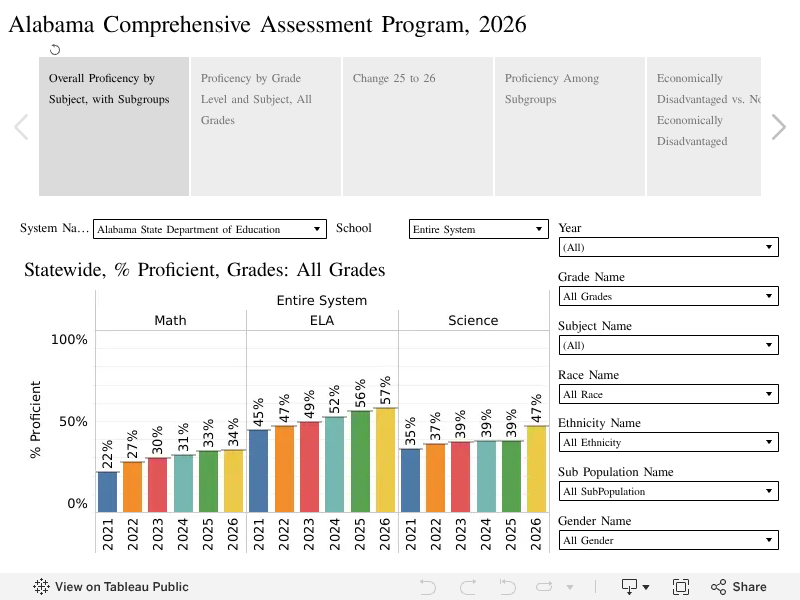
The State Department of Education released the results of the Alabama Comprehensive Assessment Program (ACAP) in August. PARCA provides this internet-based data visualization tool to help educators and the general public to view their local results and to understand them in the context of peer school systems and the state as a whole.
ACAP standardized tests in English Language Arts (ELA), math, and science are administered in the spring of the school year and are designed to measure whether students are mastering the educational standards set out in the state’s course of study.
Those courses of study describe what students need to know at each grade level in order to be progressing at a normal pace. Student scores are grouped into four levels: students scoring in the 3rd or 4th level are considered to have demonstrated grade-level proficiency.
PARCA receives its data from the Alabama State Department of Education in a different form than the publicly posted data. A process of revising our data-sharing led to a delay in receiving the data and updating the tool. We apologize for any inconvenience.
Another difference from previous years: This version of the tool makes available the 11th Grade results as well as the “All Grades” calculation that the state provides. The tool provides a large number of options for viewing results. Through selections in the menus or choosing from the various tabs atop the display, you can see results broken out by subject, grade, school, system, by gender, race, ethnicity, and other subpopulations of students. In accordance with federal privacy laws, results for subgroups with small numbers of students will not appear. Be cautious when making selections, so you know what results you are viewing. The tool is not a ranking system, but can be used to compare performance across demographically and socio-economically similar school systems.
PARCA’s discussion of score performance and trends will focus separately on the ACAP, which is given to students in grades 3-8, followed by an analysis of the high school results, which are based on the ACT, the widely-known college readiness test.
All 11th-grade students take the ACT in school in the spring of their junior year. That administration of the ACT serves as the academic accountability measure for high schools.
Many students take the ACT multiple times in their junior and senior years, in hopes of improving their scores. PARCA publishes a different report on the ACT performance based on the best average ACT scores of graduating seniors.

In general, scores in the tested elementary grades (Grades 3-5) matched the previous year’s proficiency levels in both reading and math. That comes after four years of sizable gains in both subjects. Across the three tested elementary school grades, the percentage of children scoring proficient on the ACAP climbed from 26% to 42% in Math and from 49% to 64% in English Language Arts. So an additional 15% of students in each grade reached the proficiency level compared to 2021.
Elementary science proficiency, measured in fourth grade, rose at a slower rate than the other two subjects from 2021 to 2025, from 34% to 43% proficient, a 9% gain.
But in 2026, new science standards and textbooks were deployed statewide, and significant changes were made to the content and scale scores of the test. Using the recalibrated tests, 50% of fourth-grade students scored proficient in science.
Grade-by-grade results reflect the overall flat pattern, though fifth-grade ELA was a bright point, improving by two percentage points.

Middle School
Results for the middle school grades (Grades 6-8) showed improvement in both reading and math, an encouraging sign, since middle school grades had not shown the same rate of improvement as elementary school grades. Math proficiency across the middle school grades reached 29%, compared to 18% in 2021. And ELA proficiency reached 57%, compared to 46% in 2021.
.

As in the elementary school grades, science proficiency rates jumped significantly after the adoption of the new course of study, textbooks, and corresponding adjustments test.
Grade-by-grade results show 8th-grade proficiency rates rising, with a notable 4-percentage-point jump in ELA: 58% of 8th graders scored proficient in ELA. Though the percentage of 8th-grade students scoring proficient in math improved to 26%, that mark remains low: 7th and 8th-grade math scores are the weakest performance points in the elementary

High School
Another encouraging sign: the biggest performance jump came in the 11th-grade results, which have been low and stagnant since 2021. Each of the subject areas, ELA, math, and science, saw a 3 to 4 point increase in the percentage of students scoring college-ready on the ACT. According to ACT, students scoring above the ACT benchmarks have a 50% chance of earning a B or higher or a 75% chance of earning a C or higher in corresponding credit-bearing freshman college courses.
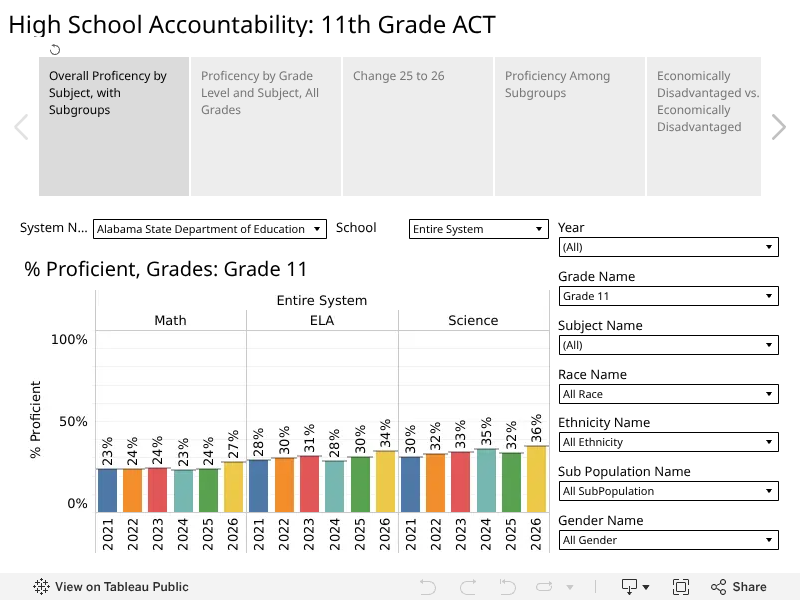
In the graduating class of 2024, about 34% of high school graduates went on to a four-year college or university, while 23% went on to a 2-year college. Both in Alabama and nationally, ACT scores dropped in the wake of the pandemic. Many universities stopped requiring students to take the ACT as part of the application process. One possible explanation for the jump in 2026 is that most colleges have resumed requiring ACT results. Presumably, with the higher stakes, students were more likely to prepare and put forth effort on the test.
Conclusion
After steady gains in elementary school proficiency, proficiency rates remained level, presenting a challenge for elementary school teachers to find new ways to continue improving. That is particularly true in third grade. The benchmark students must meet to demonstrate grade-level reading will be raised for this year’s third graders. Efforts to continue improvements are continuing despite the loss of supplemental federal funds that have been available to address Covid-related learning loss.
Continued improvements in middle school proficiency rates are welcome, but those proficiency rates remain a challenge, especially in math.
Improvement in 11th-grade ACT scores is encouraging but needs to be sustained in order to match the progress seen in earlier grades.