|
Getting your Trinity Audio player ready...
|

In that same year, Alabama had the most overcrowded prisons in the nation. Alabama’s prisons were designed to hold 12,115 prisoners, but instead housed 21,046 prisoners, 174% of the system’s designed capacity. (Data is unavailable for the states of Ohio, Missouri, and Connecticut).

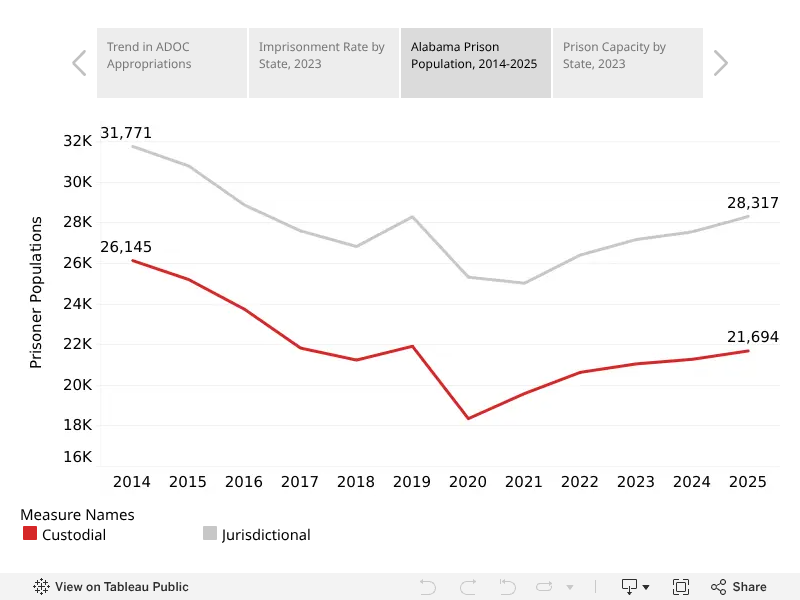
Alabama has added no capacity since, and the state’s custodial prisoner population — the number of people physically housed inside state prisons — has increased by several hundred persons.
The agency charged with managing and staffing Alabama’s prisons is the Alabama Department of Corrections (ADOC).
History
Alabama’s Administrative Code defines the ADOC as the administrative department “responsible for administering and exercising the direct and effective control over penal and correctional facilities” throughout the state.
Though the ADOC was established in February 1983, Alabama’s penitentiary system has existed since the state Legislature passed an official criminal code in 1839, being previously governed by other bureaucratic institutions such as the Board of Inspectors of Convicts (BIC), the Board of Control and Economy (BCE), the Board of Administration (BOA), the Department of Corrections and Institutions (DCI), and the Board of Corrections (BOC).
In its official mission statement, the ADOC describes itself as a group of “dedicated professionals providing public safety through the safe and secure confinement, rehabilitation, and successful re-entry of offenders.”
Governance
The ADOC is led by a commissioner appointed by Alabama’s governor. Most recently, Governor Kay Ivey appointed former Chief Deputy Commissioner Greg Lovelace on May 1, 2026.
Commissioner Lovelace oversees operations at 26 correctional facilities across Alabama, including 14 major correctional facilities and 12 community work centers.
Budget
In FY 2026, the ADOC was budgeted to receive $826.7 million from Alabama’s annual state general fund, nearly a quarter of the fund’s total.
The ADOC was budgeted to receive another $130 million in various earmarked federal and state funds, as well as miscellaneous DOC funds.

Relevant Data
Alabama’s custodial prison population, the total number of individuals in state-run institutions, peaked in 2009 at 26,500. The peak stemmed from the tough-on-crime policies adopted in the 1990s. Those measures included aggressive prosecution of drug-related crimes and a three-strikes law, through which habitual offenders qualified for sentences of life in prison.
Over time, the Legislature made changes to sentencing laws, and the population trended down between 2014 and 2018. The pandemic further depressed the number of prisoners held, but the population has been rising again, due in part to a precipitous drop in the rate of parole, rebounding conviction numbers, and a legislative trend swinging back toward increased incarceration.
Data analysis by the Alabama Sentencing Commission yielded a range of predictions for the future population of Alabama prisons based on the changes. All scenarios point to a rising population, with the highest-rate scenario resulting in a population exceeding 28,000 by 2030.
Alabama’s prisoner populations vastly outnumber the 3,600 staff employed by the ADOC, not all of whom are correctional officers.
Current Challenges
The governor and the state Legislature have attempted to address the Department of Corrections’ challenges by building new prisons and hiring additional correctional officers. However, there have been complications on both fronts.
In 2021, the Legislature approved spending $1.3 billion on the previously mentioned 4,000-bed prisons in Elmore and Escambia Counties. Neither has been completed.
The state planned to fund the prisons with $785 million in bonds, $400 million in federal COVID relief funds and about $150 million from the state’s General Fund. Five years later, the Elmore County prison is nearing completion, but the cost of the Elmore facility alone is estimated at $1.25 billion.
In 2025, the Legislature authorized the state to borrow up to an additional $500 million for prison construction. In August 2026, state officials approved up to $195 million in new bonds, bringing available funding for the Escambia County project to about $885 million. Construction is expected to begin October 1.
When the Governor Kay Ivey Correctional Complex opens, it is expected to improve conditions, security, and efficiency. It will offer on-site health and mental health treatment and vocational education. More inmates will be in cells rather than dormitories, increasing safety.
But the prison population is projected to rise over the next four years, and neither new prison will add capacity. Lawmakers and the governor will still have to find more space or change sentencing and release policies to hold down the population.
The Department has long struggled to staff its prisons adequately and is under a federal court order to hire more correctional officers. Enhanced pay and benefits have drawn record numbers of graduates, but the department is still 1,800 officers short of the court-ordered target, according to then-Commissioner John Hamm in January of 2026.
* Research for this report was contributed by PARCA Intern Hudson McKinney, a student at the University of Alabama at Birmingham.