
|
Getting your Trinity Audio player ready...
|
During the Nov. 3 general election, voters across Alabama will vote on four statewide constitutional amendments. But voters in certain counties will also be deciding on amendments that apply only to the county in question. There are 32 of those local amendments.
Use the mapping tool provided below to determine what amendments will be on the ballot in your county.
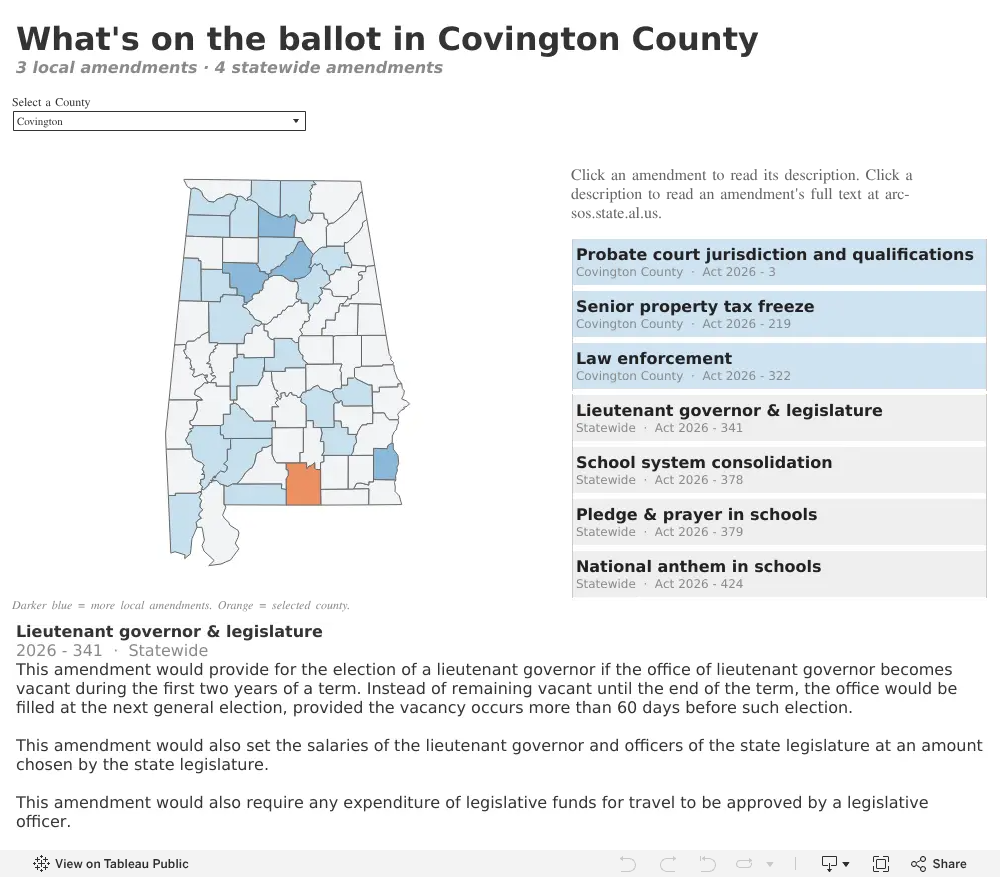
Below is a digest of those amendments, many of which are similar across counties. They are grouped by topic, with the counties affected listed under each.
of the local amendments are property tax freezes for senior citizens.
The vast majority are structured in the exact same way, allowing ___ County homeowners 65 and older to freeze the assessed value of their home for property tax purposes, as long as they’ve lived there at least five years and keep it as their main residence.
- The Henry County amendment requires homeowners to have lived in Henry County for at least 10 years.
- The Mobile County amendment contains an extra provision that raises the income limit for the county’s existing age and income-based homestead exemption to $50,000.
- Counties
- Blount
- Chilton
- Clarke
- Colbert
- Covington
- Cullman
- Fayette
- Franklin
- Henry
- Lamar
- Lawrence
- Limestone
- Mobile
- Monroe
- Morgan
- Perry
- Walker
- Wilcox
of the local amendments have to do with probate court jurisdiction and qualifications.
A discussion of the issue in question follows.
- Counties
- Blount
- Covington
- Morgan
- Pike
of the local amendments relate to public official retirement benefits.
These amendments would allow members of the Montgomery City Council, mayors of municipalities in St. Clair County, and full-time mayors of municipalities in Tuscaloosa County to participate in the Employees’ Retirement System of Alabama under the same terms and conditions as other employees in the same retirement system.
- Counties
- Montgomery
- St. Clair
- Tuscaloosa
of the local amendments raise the cap on age limits for probate judges.
These amendments would increase the age limit for being elected or appointed as Macon/Walker County judge of probate to 75.
- Counties
- Macon
- Walker
of the local amendments relates to court administration.
Alabama law requires the district court to hold court in every municipality of 1,000+ without a municipal court. This amendment would allow the district court of Escambia County to hold court in the county courthouse for cases arising in municipalities of greater than 1,000 in which there is no municipal court.
- County
- Escambia
of the local amendments relates to law enforcement.
This amendment would allow the sheriff of Covington County to sell abandoned, stolen, and unclaimed personal property and firearms, with proceeds going to a sheriff’s fund.
- County
- Covington
of the local amendments relates to municipal annexation.
This amendment would repeal Section 28-11.20 of the Constitution of Alabama of 2022, which requires voter approval to annex any territory within Etowah County into any municipality that was not wholly located within the county before January 1, 1986.
- County
- Etowah
of the local amendments relates to property tax for public schools.
This amendment would levy an ad valorem tax on all taxable property located in Henry County and south of Sandy Creek at a rate of three mills per dollar of assessed value. All proceeds of the tax will be exclusively used for public school purposes in Headland.
- County
- Henry
of the local amendments relates to utility regulation.
This amendment would bring privately owned sewer systems that use public roads in Madison County under the jurisdiction of the Public Service Commission.
- County
- Madison
Local Amendments Concerning the Role of the Probate Judge
Circuit courts are where Alabama’s jury trials take place, while probate courts decide almost all of their cases without one. Circuit courts also have full equity jurisdiction, meaning they hear matters decided on fairness rather than strict law. Instead of awarding money, courts in these cases typically order someone to do something or to stop doing it. In a circuit court, a single judge can hear both law and equity matters.
On the other hand, most Alabama probate courts do not have equity jurisdiction, so certain probate matters, such as will contests and disputes over claims against an estate, are often moved to circuit court. Parties generally have the right to request that transfer, and many do so to get a legally trained judge with broader powers.
The state does not require probate judges to be lawyers. Some counties have given their probate judge equity jurisdiction over cases filed in probate court, but only when the judge is a licensed attorney. Several counties, including Jefferson and Mobile, go further and require every probate judge to be a lawyer.
As a way to speed up the docket, lawmakers have proposed four local amendments that would give probate judges equity jurisdiction in Blount, Covington, Pike, and Morgan counties. In the first three counties, probate judges would be given equity jurisdiction provided they are lawyers, while in Morgan County, probate judges would be given equity jurisdiction and required to be lawyers, as in Jefferson and Mobile.