|
Getting your Trinity Audio player ready...
|
The Supplemental Nutrition Assistance Program (SNAP), formerly known as the Food Stamp Program, helps people with low incomes buy food.
In FY2025, approximately 740,300 Alabamians, or about 14.3% of the population, received SNAP benefits. These figures include 300,000 children. Recipients receive an average of $6.31 per day. The U.S. Department of Agriculture’s latest report indicates that there has been a 9.5% reduction in the number of people receiving benefits in Alabama, or approximately 70,000 fewer recipients as of April 2026, compared to April 2025. Nationwide, approximately 5.3 million fewer people receive SNAP over that same period.
States run SNAP, sharing administrative costs with the federal government. All benefits are funded by the federal government. H.R. 1, the One Big Beautiful Bill Act, makes two major changes to that structure.
First, states will be required to cover 75% of administrative costs, up from 50%, beginning in FY2027, at a cost of approximately $39 million to Alabama.
Second, beginning in FY2028, states with payment error rates at or above 6% will be required to pay a share of the cost of benefits provided to recipients.
States with error rates of:
- 0% to 5.99% will pay nothing,
- 6% to 7.99% will pay 5%,
- 8% to 9.99% will pay 10%, and
- 10% and above will pay 15%.
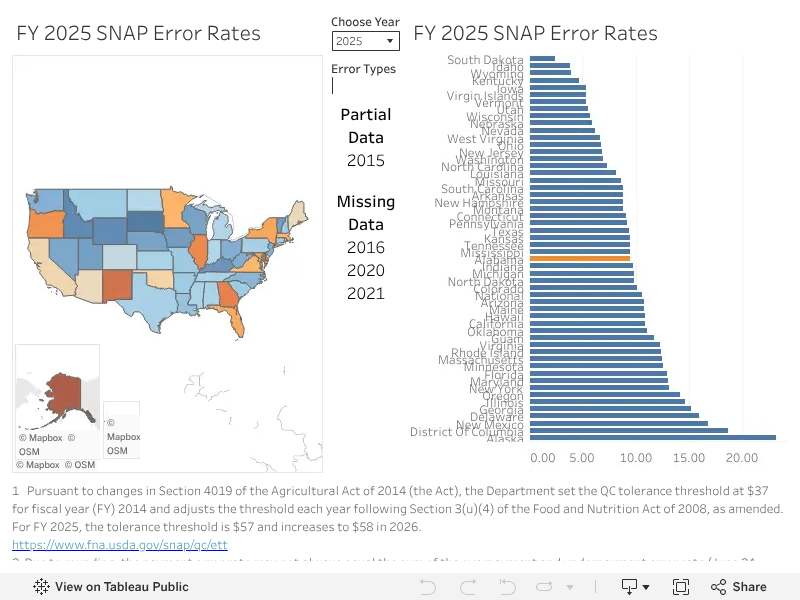
The national average error rate was 10.6% in FY2025.
Alabama’s FY2025 error rate was 9.5%. This means the state will be required to fund $174 million in SNAP benefits (based on FY2025 numbers) beginning in FY2028. That cost can be reduced to $87 million if the error rate is kept below 8% and avoided entirely if it is kept below 6%.
Errors versus Fraud
A payment error is a mistake in the size of a benefit paid, not theft. State agencies verify each household’s income, size, and expenses, then recalculate the benefit whenever those circumstances change. Circumstances change often — a new job, lost hours, a household member moving in or out — so the agency is recalculating constantly. When it does not record a change in time, the household receives too much or too little for a month or more. Those timing failures, not deception, produce most of what USDA counts as error.
Not every discrepancy counts. Federal law sets a tolerance threshold — the dollar figure at or below which an error is not counted against a state. The current threshold is $58. A recipient who receives $57 more (or less) than they should is an error, but it is not counted against the state. However, if a household was not eligible for benefits at all that month but received them, that is an error regardless of the size.
Errors run in both directions. Nationally, USDA measured 9.3% of benefits as overpayments and 1.3% as underpayments — a combined error rate of 10.6%, or about $10.1 billion in FY2025.
Fraud is a separate question, and the available evidence indicates it occurs at a low rate, according to the Congressional Research Service report updated in April of 2025. That report noted that retailer trafficking, exchanging SNAP benefits for cash, is a major form of SNAP fraud, estimated to be around 1.6% of benefits.
Trafficking is not part of the payment error rate. The two measure different things: one counts deliberate misuse at the checkout, the other counts administrative accuracy at the eligibility office.
Recipients are more often targets of fraud than its sources. Thieves skim or clone Electronic Benefit Transfer (EBT) cards and empty the accounts.
What’s Next
For the first time in the program’s history, data accuracy carries a cost. At present, the state’s 9.5% error rate could cost $174 million. Reducing that rate below 8% reduces the cost to roughly $87 million. Below 6%, the state owes nothing toward benefits.
In order to avoid these penalties, many states are coordinating error-reduction efforts, like working to modernize software to better track and deliver benefits accurately, and analyzing where documentation and procedural mistakes happen most.