According to PARCA’s 2026 survey of public opinion, health care is now tied with education as Alabamians’ top priority for state government to address. Rising health care costs and an ongoing decline in federal support for health insurance coverage have raised anxiety about how they will pay for care.
This installment of Issues and Agencies looks at Alabama’s health, with a particular focus on the Alabama Department of Public Health, the state agency that monitors and seeks to improve health.
Due to high rates of chronic disease, poverty, and limited access to health care, Alabama ranks as one of the country’s least healthy states, 47th of 50 in America’s Health Rankings (AHR) 2025 Annual Report.
- Life expectancy in Alabama was 73.8 years in 2022, among the lowest in the nation and nearly four years below the national figure.
- At 11.4 per 1,000 people, Alabama’s death rate was well above the national average of 9 per 1,000.
- Heart disease, cancer, and stroke, all of which afflict Alabamians at disproportionate rates, accounted for roughly half of the state’s deaths.
- One in ten babies was born underweight, a rate the CDC ranks fourth highest in the country.
- 414 infants died before their first birthday.
However, in recent years, Alabama has made progress on several measures: rates of death, teen pregnancy, low-weight births, homicides, cancer deaths, and lung disease have all decreased. Use the interactive tools to explore health statistics.
While several state agencies play a role in health care, the Alabama Department of Public Health (ADPH) has the broad mandate to improve Alabamians’ health.
History
The stated mission of the ADPH is to “promote, protect, and improve Alabama’s health.” Section 22-2-2 of the Code of Alabama authorizes the ADPH to enforce the state’s public health laws, investigate the causes and prevention of disease, inspect premises and drinking water for unsanitary or hazardous conditions, adopt health and quarantine regulations carrying the force of law, supervise county health authorities, and advise the state on all matters of medicine, sanitation, and public health.
The ADPH was established on February 19, 1875. For the next 149 years, Alabama law recognized the Medical Association of the State of Alabama (MASA) — a private association of physicians — as the State Board of Health. As recently as 2024, MASA’s Board of Censors held 12 of the 16 seats on the State Committee of Public Health, the body that oversees the ADPH and, at the time, chose the State Health Officer.
Following the COVID-19 pandemic, Act 2024-247 abolished the State Board of Health, shifted appointment of the State Health Officer to the governor and began cutting MASA’s share of the committee from 12 seats to 8, in stages running from May 2025 to May 2027.
Governance
The ADPH is governed by the State Committee of Public Health. Twelve of the 16 committee members are appointed by MASA and by select medical specialty societies; the remaining seats belong to the chairs of ADPH’s four statutory councils. The State Committee of Public Health meets monthly to discuss and adopt “rules as necessary to promote and maintain public health” in Alabama.
The State Committee of Public Health provides the governor with a list of names from which he or she appoints a State Health Officer, who serves as the ADPH’s executive officer. Dr. Scott Harris was appointed State Health Officer in 2018, when the position was still filled by the committee.
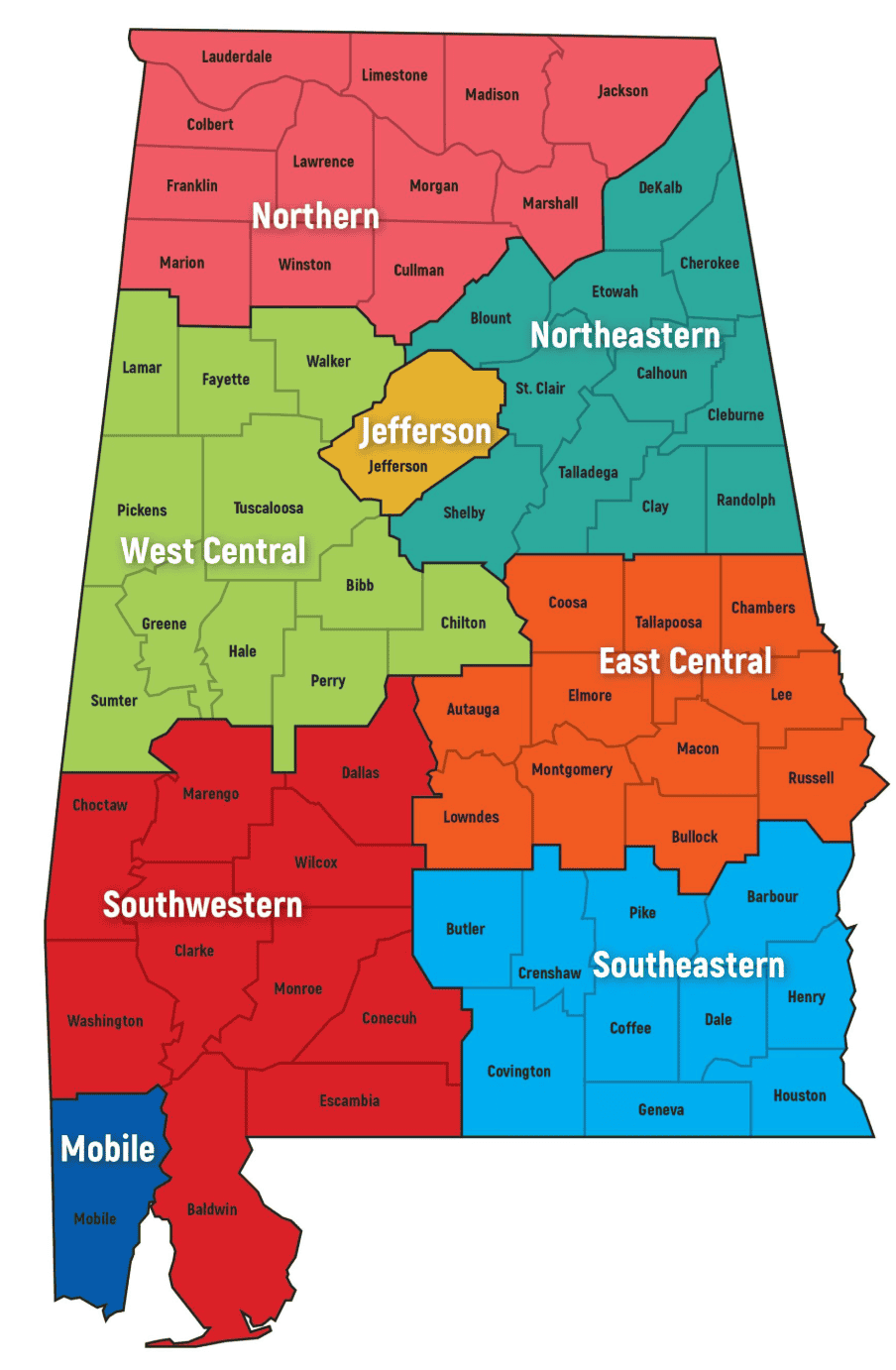
The state is divided into eight public health districts, each led by a district health officer or administrator. They run services across their district’s counties and tailor programs to local needs. ADPH operates roughly 75 offices and employs more than 2,600 people. Jefferson County and Mobile County run their own health departments under local boards of health, which the State Committee of Public Health supervises but does not staff.
That network does most of the visible work of public health. In 2025, ADPH screened roughly 120,000 specimens from newborn babies for genetic and metabolic disorders, conducted 47,000 inspections of food service, lodging, tattoo, and seafood facilities, and investigated 685 disease outbreaks and clusters.
Budget
In FY 2026, the ADPH is budgeted to receive $159.4 million from Alabama’s general fund, about 4% of the fund’s total.
That general fund appropriation is a small part of what the department runs on, however. ADPH’s total FY 2026 appropriation is $1.41 billion. Most of it comes from federal and local funds and revenue the department earns itself through fees, permits, and clinical billing. The 2027 budget represents the first decrease in spending for public health since 2019.
Some of the Department of Public Health’s appropriation goes to support children’s health insurance, a form of spending that is not generally considered public health spending. Factoring that out, a more direct comparison of public health spending across the states finds that Alabama spent $137 per person on public health in 2022-2023.
This spending, which includes both state dollars and federal grants, is higher than the national mark of $124. Alabama public health spending ranked 18th in the country and first in the Southeast, according to the most recent data,
Health Outcomes
The Department of Health also records, analyzes, and publishes the state’s vital statistics, including tracking the leading causes of death. In 2024, heart disease was the leading cause of death, followed by cancer.
If you are interested in the trends in leading causes of death, the visualization below allows you to explore Alabama data on deaths and death rates over time.
The Rural Health Challenge
Alabama is one of the nation’s most rural states. According to the ADPH, 58 of Alabama’s 67 counties are considered rural, and over 40% of Alabama’s population lives in rural areas.
The state’s rural health care infrastructure has been contracting for over a decade. Since 2010, at least seven of the state’s rural hospitals have closed, and as of July 2026, 37% of Alabama’s remaining rural hospitals were at “immediate risk” of closure, one of the highest rates in the country.
Obstetric care is particularly thin in Alabama’s rural areas, where 89.8% of women live over 30 minutes from a birthing hospital compared to 26% of women living in urban areas. Of Alabama’s 58 rural counties, only 15 have labor and delivery units.
In 2023, six rural counties in Alabama had life expectancies below 70 years. ADPH reported the state average at 75.
Alabama has sought to reinforce its rural health infrastructure through federal funding. In 2026, the state received $203.4 million under the Rural Health Transformation Program (RHTP), which is administered by the Alabama Department of Economic and Community Affairs rather than the ADPH. Alabama distributed the first major wave of funding in August, supporting rural health, rural workforce, mental health, rural health practice, and health records and cybersecurity initiatives in all 67 counties.
However, the RHTP is not a permanent solution: the program ends in FY 2030, and what will follow has not been decided.
University of Alabama at Birmingham summer intern Ellie-Annette Jordan provided research for this report.