Alabama’s CHOOSE Act is growing fast. The program awarded $100 million in Education Savings Accounts (ESAs) to 19,000 students in 2025–26, and an estimated $174 million to 34,000 students in 2026–27. Each award works like a scholarship: up to $7,000 per student for approved school expenses, or up to $2,000 per student ($4,000 per family) for home education.
Bigger growth is coming. Starting in 2027–28, the income cap of 300% of the federal poverty level goes away, and the only limit will be the money set aside. The FY2027 budget sets aside $236 million, about 2% of state K–12 spending. That raises a fair question: does the CHOOSE Act take money from Alabama’s public schools?
Where the money comes from
The state supplies about 63% of public school funding, with local and federal sources adding 19% each. State dollars flow through the Education Trust Fund (ETF), built mainly on income and sales taxes earmarked for education.
The CHOOSE Act draws on that same tax base. ESAs are paid from a separate CHOOSE Act Fund, filled by designated income tax revenue and by ETF appropriations. Because that revenue is earmarked, every CHOOSE Act dollar is one that could otherwise have gone to K–12 schools or colleges.
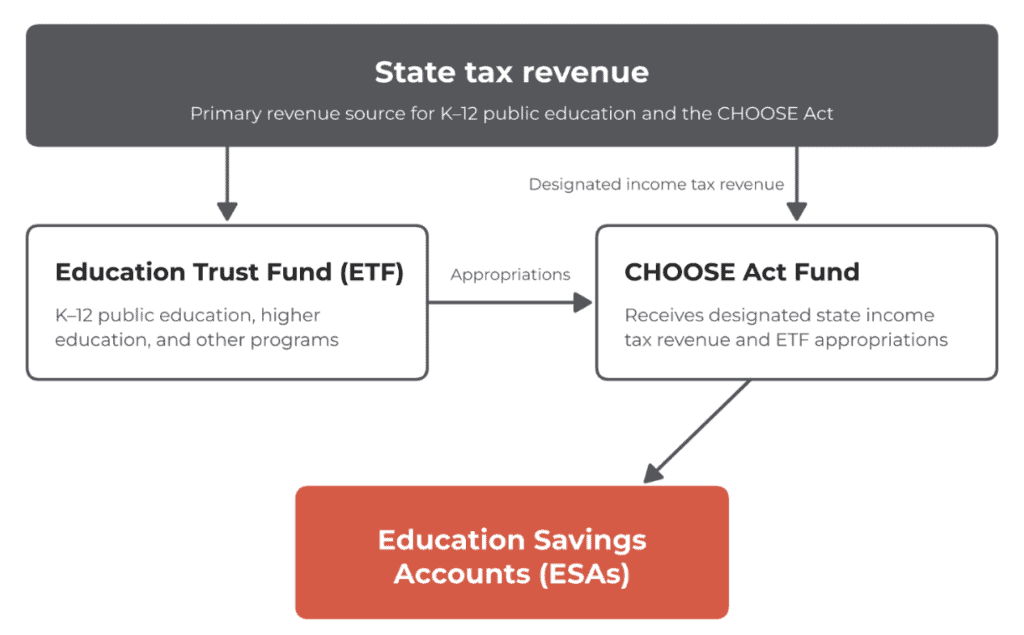 How Alabama’s state tax revenue funds both public schools and the CHOOSE Act. Sources: Alabama Executive Budget Office; Alabama Legislative Services Agency; Ala. Code § 16-6J-8.
What other states show
Florida and Arizona have no income caps, and their programs now equal roughly 10% of K–12 public spending: $4.3 billion in Florida and $1.2 billion in Arizona. Arizona’s ESA spending jumped about 211% in a single year after it opened eligibility to all families in 2022.
