Over the past thirteen years, Alabama has built a set of publicly supported alternatives to the traditional neighborhood public school. Today, Alabama Accountability Act (AAA) scholarships support about 4,000 private-school students each year. Around 7,000 students attend public charter schools. And more than 34,000 students have applied for Education Savings Accounts (ESAs) under the CHOOSE Act for the 2026–27 school year.
A new report from the PARCA Education Research Center, The Evolution of School Choice Policies in Alabama: From the Alabama Accountability Act to the CHOOSE Act, traces how these programs developed. It looks at who is participating, how much has been invested, and what is known so far about student outcomes.
Three programs, three approaches
Alabama’s school choice system rests on three laws, and each uses a different mechanism.
The Alabama Accountability Act (2013) created tax-credit scholarships. Individuals and corporations donate to nonprofit Scholarship Granting Organizations (SGOs) and receive state income tax credits in return. The program was designed for lower-income students, especially those assigned to “priority” schools, which are schools performing in the bottom 6% statewide. From 2013 through 2025, donors contributed nearly $292 million, and SGOs awarded about $252 million across 43,026 scholarships. The program has largely reached its intended population, with most recipients qualifying for free or reduced-price lunch in most years.
The Alabama School Choice and Student Opportunity Act (2015) authorized public charter schools. These schools are tuition-free and publicly funded, with greater operational flexibility. Charter enrollment has grown from 1,187 students in 2020 to 7,228 in 2026. Traditional public schools still serve the vast majority of Alabama students, nearly 715,000 in 2026.
The CHOOSE Act (2024) is the broadest program yet. It provides state-funded ESAs of up to $7,000 per student for private, public, or charter school expenses. Home-education students can receive up to $2,000, with a cap of $4,000 per family. Eligibility is currently limited to households at or below 300% of the federal poverty level, about $99,000 for a family of four. That income limit is scheduled to disappear beginning in FY 2027–28.
CHOOSE Act demand nearly doubled in a year
The most striking finding in the report is how quickly the CHOOSE Act has grown. Applications rose about 86% between the program’s first and second years. Projected awards climbed accordingly.
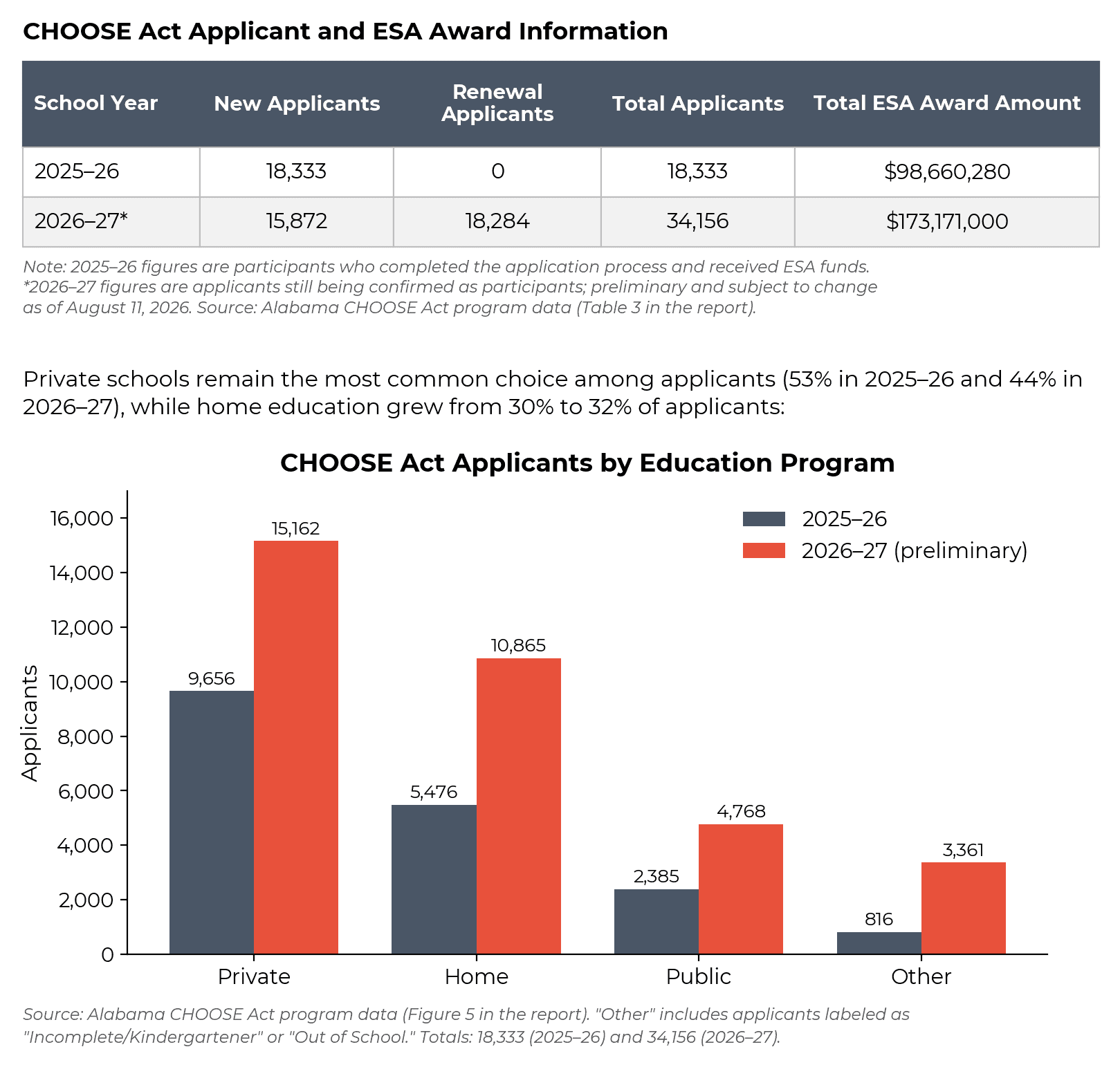
Private-school applicants made up 53% of the total in 2025–26 and 44% in 2026–27. Home education held steady as the second-largest category, at 30% and then 32%. Public-school applicants were about 13–14% in both years.
Who is applying
White students made up about two-thirds of applicants in both years, rising from roughly 66% to 68%. Black students were the second-largest group, at 21% and then 22%. Hispanic applicants rose slightly from 4% to about 5%.
Among the program’s priority groups:
- About 10–11% of applicants received special education services.
- Applicants from active-duty military families jumped from 35 to 762.
- In 2025–26, most income-priority applicants came from households between 51% and 200% of the federal poverty level.
Where you live matters
The report also finds that access to choice depends on geography. Traditional public schools are spread fairly evenly between rural areas (648 schools) and non-rural areas (696). Private and charter schools are not. Non-rural areas have more than three times as many private schools as rural areas (201 vs. 64). Of Alabama’s 26 charter schools, just 3 are in rural areas. For many rural families, an ESA or scholarship may matter less if no participating school is within reach.
What we know and don’t know about outcomes
Evidence on academic results remains limited. Independent evaluations of the AAA found that scholarship recipients generally performed near or below national norms. They did better in reading than in math. Longer participation was not strongly linked to better achievement. The evaluators cautioned that small samples, inconsistent reporting, and differing test requirements make firm conclusions difficult.
In 2025, charter schools trailed traditional public schools in proficiency by about 12 percentage points in ELA and 19 in math. The report notes that some charters serve students with greater academic needs, so measures of student growth are an important complement to proficiency rates.
For the CHOOSE Act, it is simply too early to say. Private-school and home-education students aren’t subject to the same state assessments as public-school students, so the program may face many of the same data gaps the AAA has.
Looking ahead
Alabama’s school choice policies have moved from a targeted program for students in low-performing schools to a broad ESA system that will soon have no income limits. Supporters see this as a major expansion of options for families. As participation and public investment in school choice grows, policymakers will need better information on who has access to these options, how programs are held accountable, and how participating students perform. PARCA plans to explore these questions in future reports.
Read the full report, The Evolution of School Choice Policies in Alabama, on PARCA’s website.